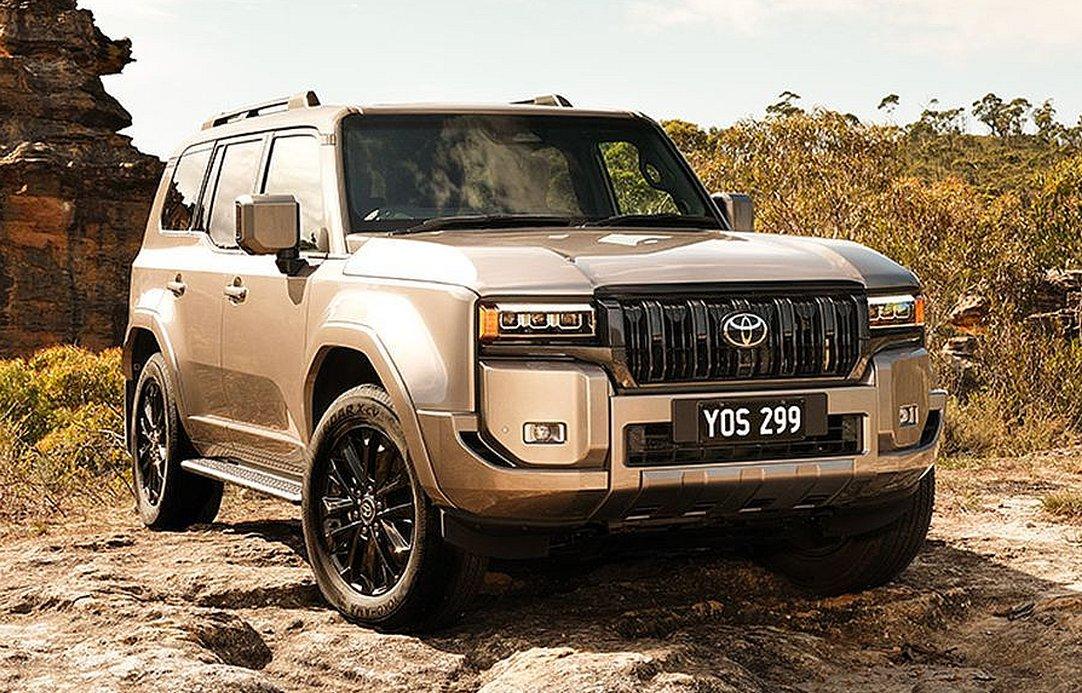

Thirty years ago, a Prado cost $36,990 and undercut the flagship LandCruiser by 26 per cent. Today the range-topping Kakadu sits at $99,990 before on-road costs, within reach of the entry-level LandCruiser 300 Series. Understanding that shift is the starting point for every buyer looking at the 2026 Prado 250 Series.
What the 2026 Prado 250 Series Actually Costs Across the Range
The 2026 Prado is available in five variants. Pricing starts at $72,500 before on-road costs for the base GX and climbs to $99,990 for the Kakadu.
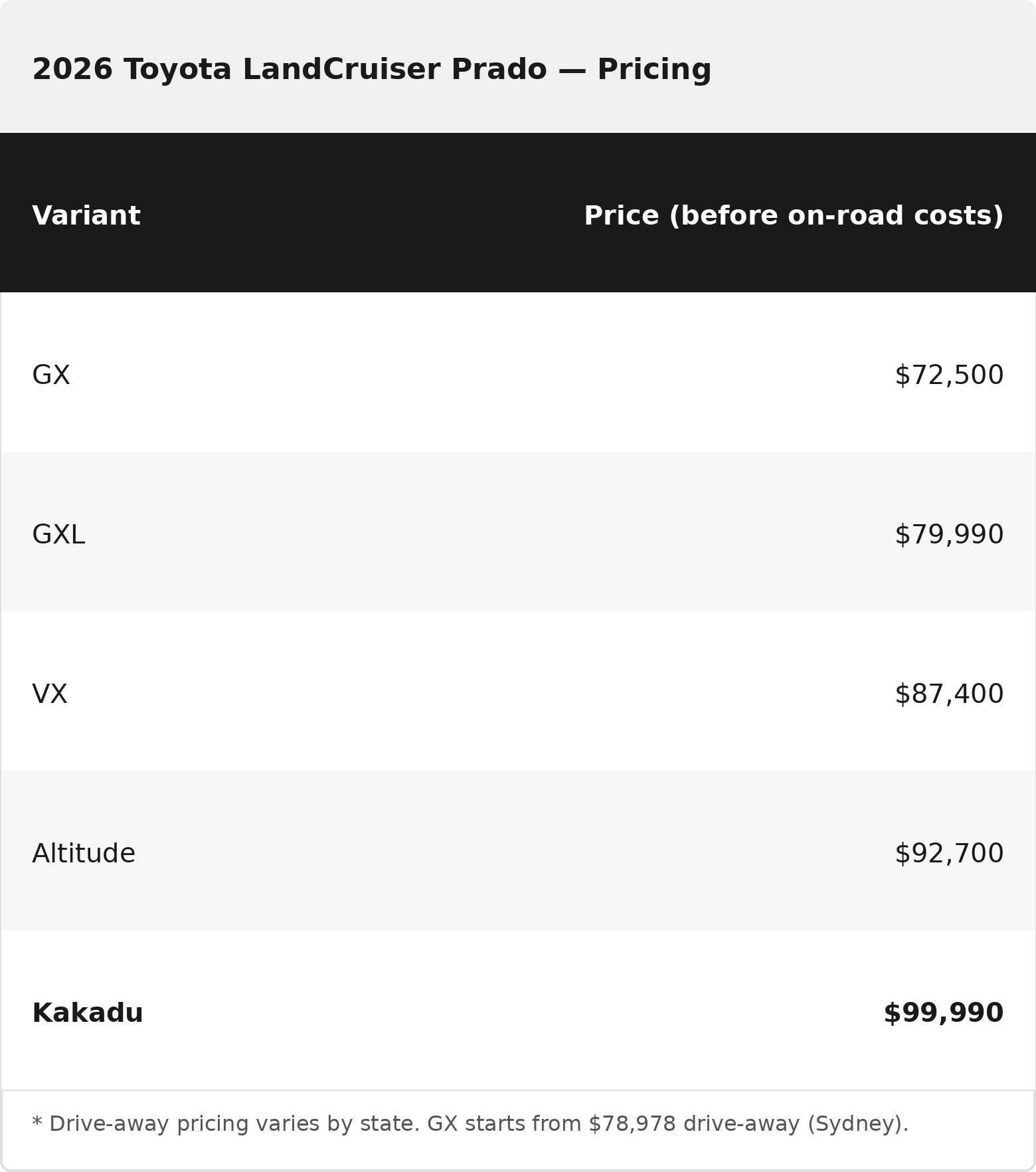
Drive-away pricing in Sydney ranges from $78,978 for the GX to $108,094 for the Kakadu. Pricing varies by state and territory, so always confirm your local drive-away figure before comparing.
The next step up from the Kakadu is the Lexus GX, which shares the same platform and starts from $116,000 before on-road costs. That $16,000 gap buys you a different badge and a noticeably more premium cabin.
The Powertrain Numbers Toyota Kept Quiet About
Every Prado 250 Series variant runs the same 2.8-litre four-cylinder turbo-diesel, now paired with a 48-volt mild-hybrid system. The combined output is 150kW and 500Nm.
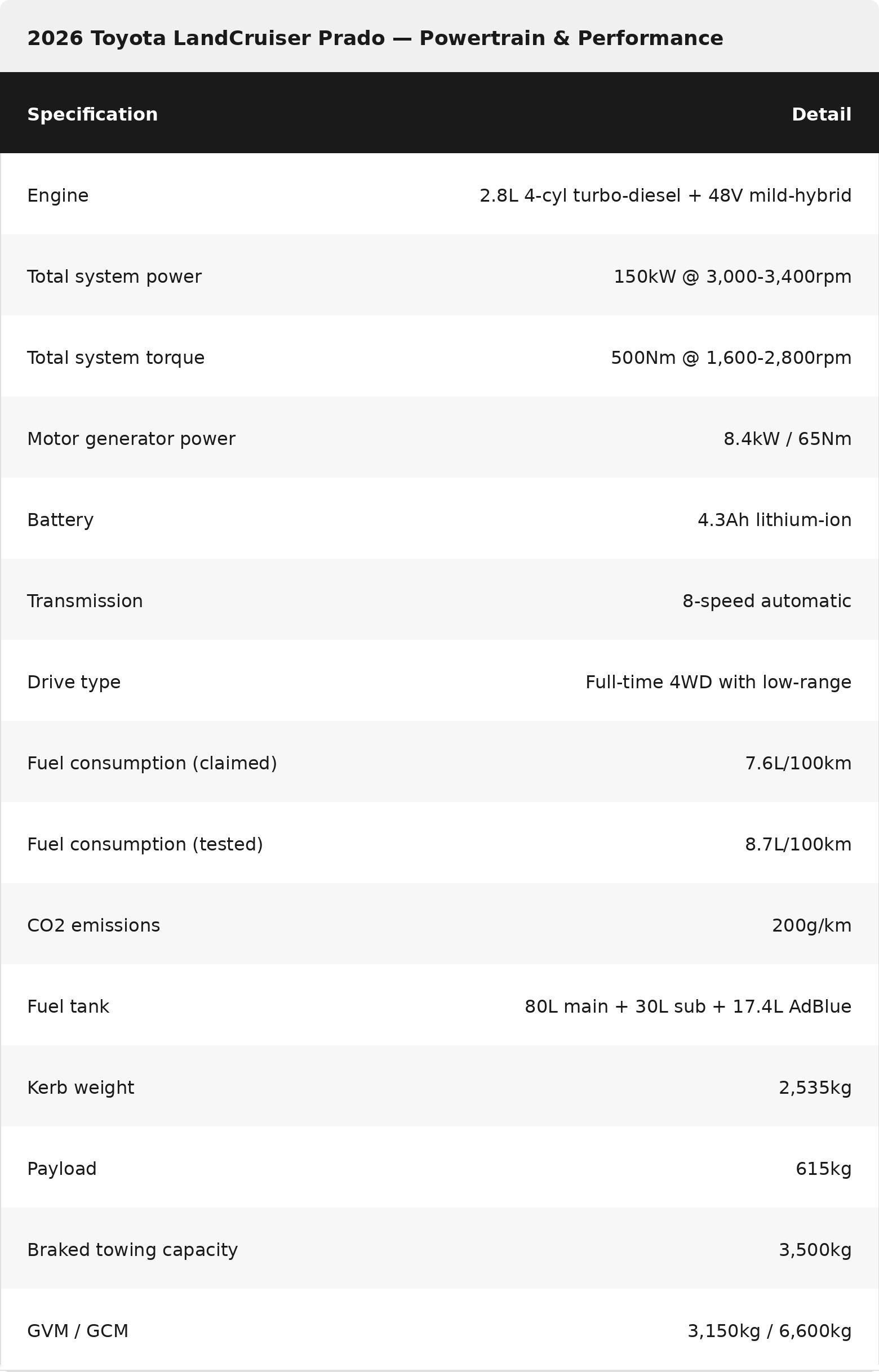
Here is the part Toyota did not lead with: the 250 Series weighs approximately 140kg more than the previous generation. Power output is identical to the 2021 model. The mild-hybrid system adds 8.4kW of motor generator assist, but the net result is a heavier vehicle with the same headline figures and noticeably softer real-world performance.
On hills, under load, or when overtaking at highway speed, the Prado feels laboured. The throttle pedal reaches its ceiling quickly, with little difference between 50 per cent and full throttle. For buyers planning to tow close to the 3,500kg rated limit on long trips, this is a genuine consideration, not a minor footnote.
How Big It Is and How Little Boot Space You Actually Get
The 250 Series is a large vehicle. At 4,990mm long with a 2,850mm wheelbase, it is a serious footprint in urban car parks and suburban driveways.
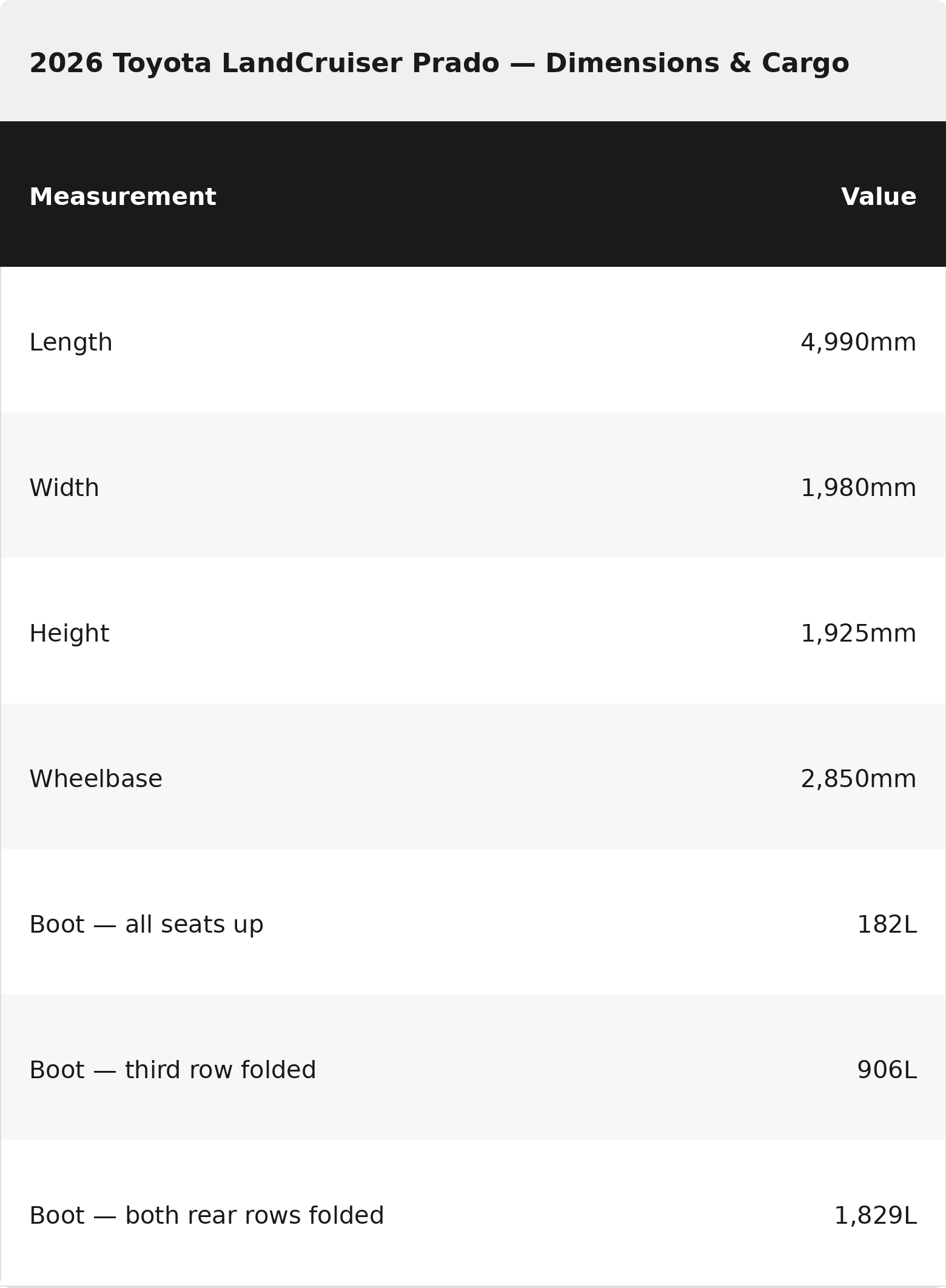
The seven-seat claim deserves scrutiny. With all three rows occupied, boot space is 182 litres. That is roughly one large carry-on bag. For a family of seven heading away for a weekend, this vehicle does not work as a dedicated people mover with luggage.
With the third row folded, 906 litres is usable and functional for five adults with genuine bags. Both rear rows folded opens 1,829 litres for cargo-focused use. The Prado is best understood as a five-seat SUV with emergency seven-seat capability, not the other way around.
What the Prado Can Do Off the Bitumen
The Prado's off-road credentials are real. Ground clearance, approach and departure angles, and wading depth are all competitive for the segment.
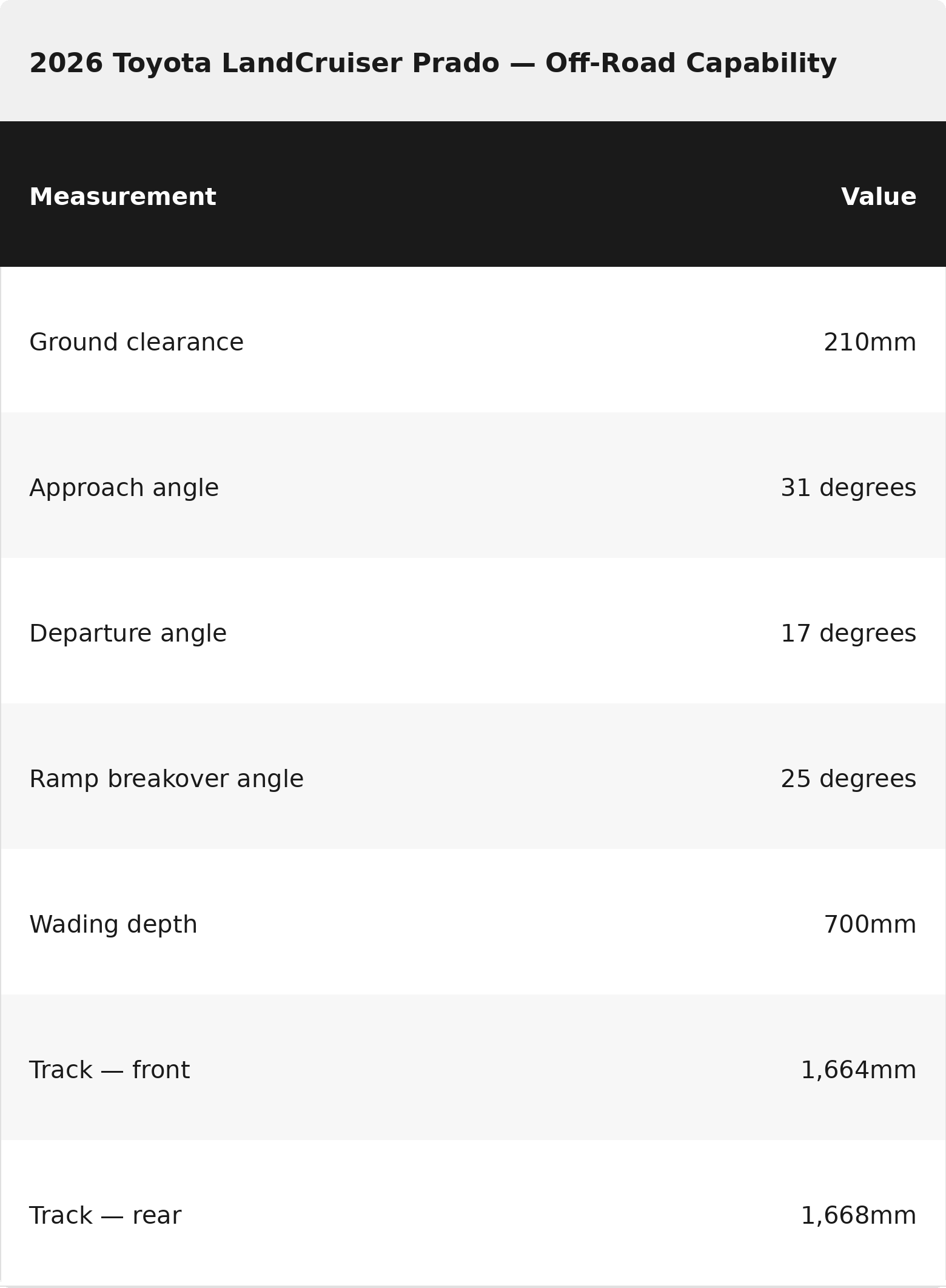
One variant distinction that most buyers miss: the Altitude at $92,700 before ORCs gets a locking rear differential and all-terrain tyres from the factory. The Kakadu at $99,990 gets a torque-sensing limited-slip rear differential instead, but sits on highway tyres on 20-inch alloys.
If genuine off-road use is your primary reason for buying a Prado, the Altitude is a stronger specification for $7,290 less before on-road costs. Most dealers will not volunteer this comparison.
Five Stars Does Not Mean All Stars Are Equal
The 2026 Prado holds a five-star ANCAP safety rating earned in 2024. Performance across all four categories was strong, with child occupant protection the standout at 89 per cent.
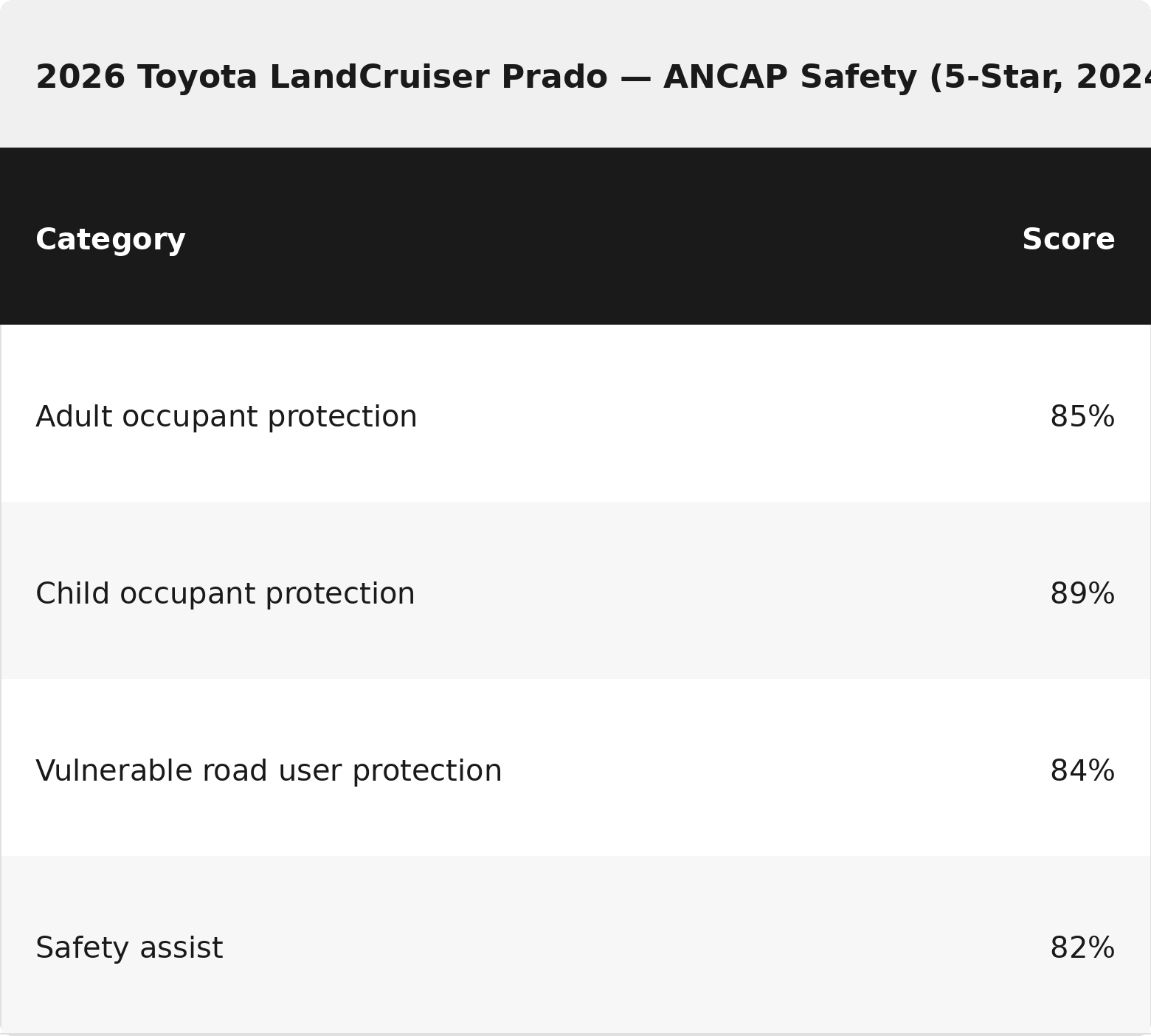
Standard safety equipment across all variants includes nine airbags, autonomous emergency braking, adaptive cruise control, lane trace assist, blind-spot monitoring, rear parking support brake, front and rear parking sensors, trailer sway control and a 360-degree camera. Tyre pressure monitoring is added from the VX grade upward.
One real-world observation worth noting: the brake pedal feel in the first portion of travel is too light for a 2,535kg vehicle. The brakes are fully capable once engaged, but the initial softness creates hesitation that takes adjustment. It is not a safety issue, but it does affect driver confidence, particularly in stop-start traffic.
The Servicing Schedule Is More Demanding Than Its Rivals
Toyota's five-year unlimited-kilometre warranty is competitive. The capped-price servicing program covers five years at $395 per visit.
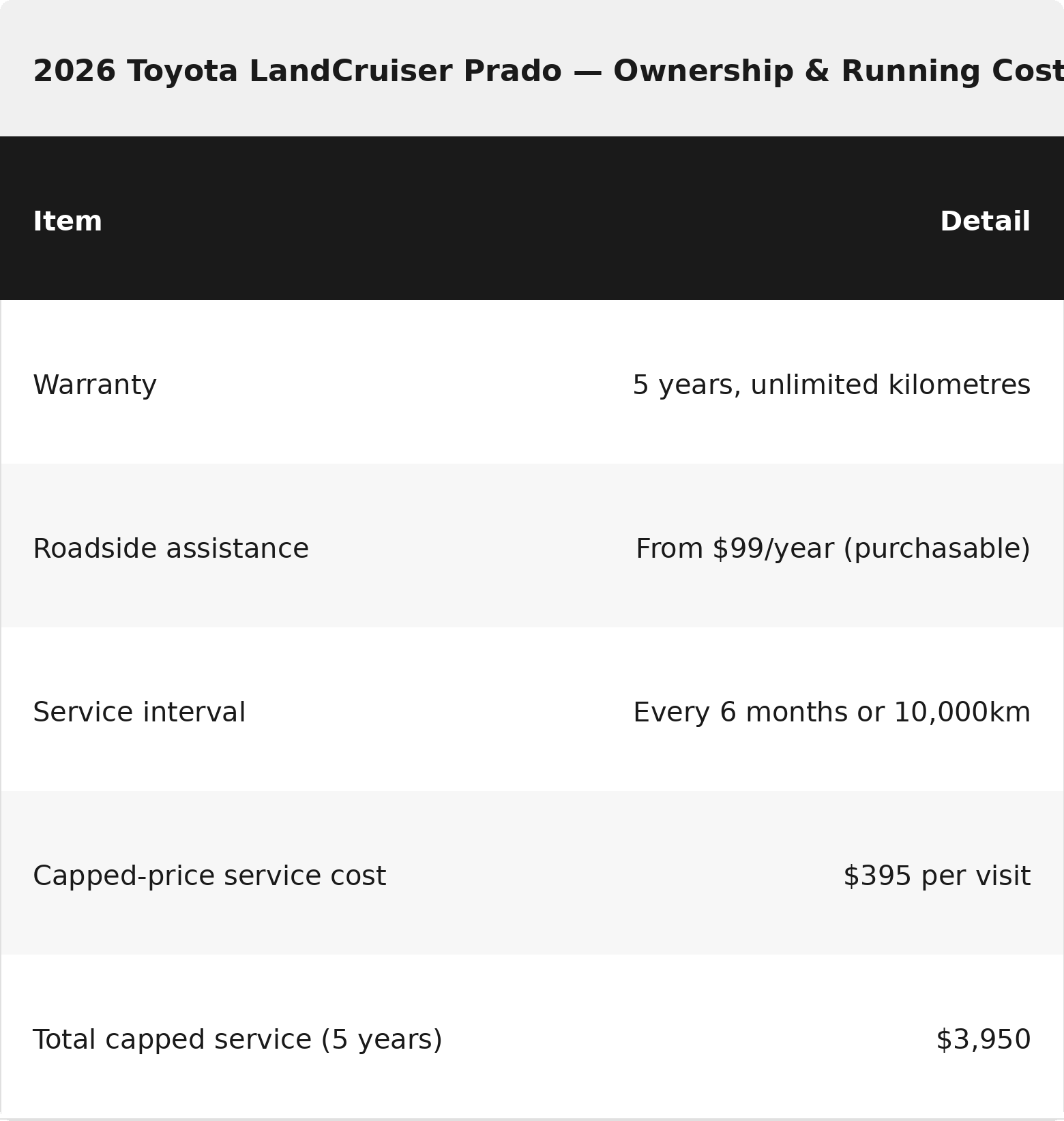
The detail most buyers miss is the service interval. The Prado requires a dealer visit every six months or every 10,000km, whichever comes first. Most comparable large turbo-diesel SUVs, including the Ford Everest and GWM Tank 500, require servicing every 12 months or 15,000km.
If you cover 15,000km or more per year, the interval gap closes and the impact is minimal. If you cover lower distances, you are taking your Prado to a dealer twice as often as you would a rival for the same period. Over a five-year ownership cycle, that is up to five additional service visits compared to annual-interval competitors.
When Dealers Have the Most Pressure and How to Use It
The Prado's initial pre-order surge of more than 17,000 units before launch has cleared. Stock is now available across most variants, and dealers are operating in a normalised selling environment where they need to move cars rather than simply work through a guaranteed order bank.
Toyota increased Prado pricing in early 2025. That reset dealer margin expectations, but it also means the Kakadu at $99,990 before ORCs sits in psychologically difficult territory. Buyers who have also looked at the entry LandCruiser 300 Series will raise that comparison. Dealers know it.
EOFY in June is the strongest buying window for Toyota product in Australia. Dealers face volume targets, and while headline price reductions on Prado are rare, accessories packages, dealer delivery fee waivers, servicing inclusions and trade-in valuations all have room to move. Accessories and services representing $2,000 to $4,000 in real value are achievable without the dealer needing to touch the drive-away price.
Get written competing quotes from at least three Toyota dealers before walking into a negotiation. Dealer fees and accessory inclusions vary more than buyers expect, and having two competing quotes in writing changes the conversation immediately.
The Variant Decision That Saves You $7,290 Before You Even Start Negotiating
The Prado is not a panic purchase. Stock is available, the pre-order queue has cleared, and EOFY is approaching. Buyers who do their homework before stepping into a dealership are in a strong position.
Start by deciding whether you genuinely need seven seats regularly. If not, the GXL at $79,990 before ORCs delivers heated and ventilated front seats, a power tailgate, rear climate control, and wireless charging for more than $20,000 less than the Kakadu.
If off-road capability is your priority, price the Altitude before pricing the Kakadu. The locking rear differential and all-terrain tyres are worth more in practical off-road use than the Kakadu's panoramic sunroof and illuminated side steps.
Carseekers puts competing dealer quotes in front of you without the back-and-forth of visiting multiple showrooms. Submit your Prado request at carseekers.com.au and let dealers come to you with their best number.e in a strong position.
Start by deciding whether you genuinely need seven seats regularly. If not, the GXL at $79,990 before ORCs delivers heated and ventilated front seats, a power tailgate, rear climate control, and wireless charging for more than $20,000 less than the Kakadu.
If off-road capability is your priority, price the Altitude before pricing the Kakadu. The locking rear differential and all-terrain tyres are worth more in practical off-road use than the Kakadu's panoramic sunroof and illuminated side steps.
Carseekers puts competing dealer quotes in front of you without the back-and-forth of visiting multiple showrooms. Submit your Prado request at carseekers.com.au and let dealers come to you with their best number.
Considering finance for your next car? Loanseekers can help you explore car loan options.
The finer details
Your questions answered.
How much does the 2026 Toyota LandCruiser Prado 250 Series cost in Australia?
The 2026 Prado 250 Series starts at around $70,000 for the GX and reaches $99,990 for the Kakadu before on-road costs. The range-topping Kakadu sits within reach of the entry LandCruiser 300 Series, which represents a significant price shift from when the Prado was positioned as the affordable alternative.
Is the 2026 Toyota Prado 250 worth the price compared to the previous generation?
The 250 Series is a significant upgrade over the outgoing model on safety technology, interior quality, and powertrain efficiency. The new 2.4-litre turbocharged hybrid engine is meaningfully better than the previous V6 diesel at its price point. Whether the premium over the outgoing generation is justified depends heavily on how much you use the third row and premium technology features.
How does the 2026 Toyota Prado compare to the GWM Tank 500 in Australia?
The Tank 500 PHEV undercuts the Prado significantly on price while offering comparable seven-seat capability and plug-in hybrid running cost benefits. The Prado retains a substantial advantage on resale value, dealer network depth, and off-road proven reputation built over decades. For buyers prioritising value, the Tank 500 case is strong; for buyers prioritising long-term security, the Prado wins.
Does the 2026 Toyota Prado 250 have a hybrid version in Australia?
Yes. The 2026 Prado 250 introduces a 2.4-litre turbocharged hybrid engine as the primary powertrain, replacing the V6 diesel. A diesel variant remains available in some grades. The hybrid delivers improved fuel economy and lower running costs compared to the outgoing V6 diesel, addressing a longstanding criticism of the previous generation.
How long is the wait time for a new Toyota Prado in Australia?
New Prado 250 Series wait times in Australia vary by variant and dealer but have been running from three to twelve months depending on grade and colour. The high-demand Kakadu and GXL grades attract longer waits. Confirm current delivery timelines with your local dealer and factor this into your planning if you need the vehicle within a specific timeframe.
Is the Toyota LandCruiser Prado 250 good for off-road driving in Australia?
Yes. The Prado 250 retains Toyota's KDSS (Kinetic Dynamic Suspension System) on higher grades, crawl control, and multi-terrain select, making it capable of serious off-road use. It is not as capable as the LandCruiser 300 in extreme off-road conditions, but exceeds the needs of the vast majority of Australian buyers for bush and outback travel.