
Toyota has just delivered a forecast that nobody in the automotive industry wanted to hear. The world's largest automaker is now predicting a third consecutive year of declining profits, with Middle East conflict alone expected to drag AUD$5.8 billion off the bottom line on top of the existing damage from US tariffs.
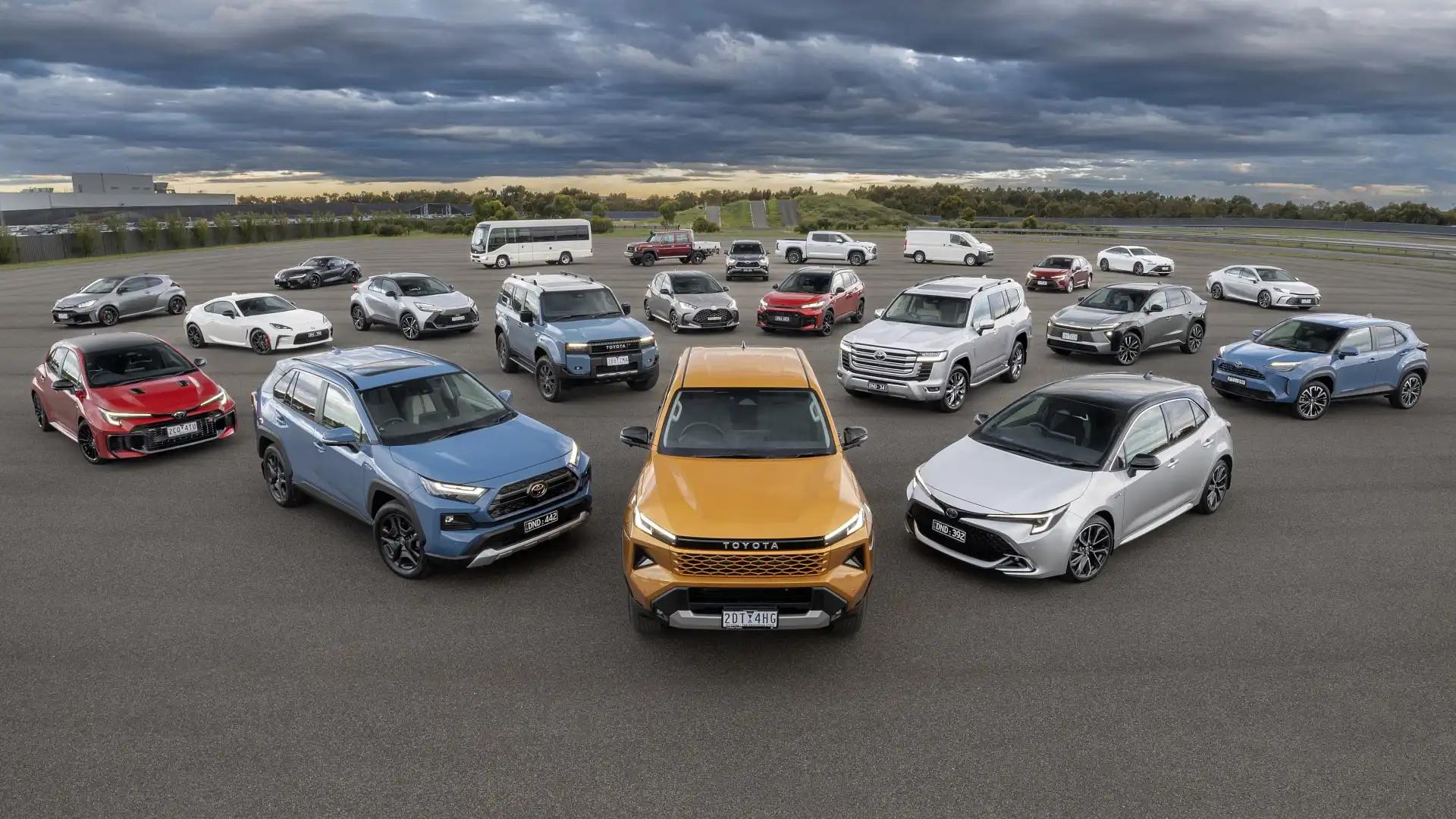
For Australian buyers, Toyota's pain is more than a corporate-finance story. It is the brand that has sat at the top of the local sales charts for 24 straight years. Almost one in four new cars sold in Australia wears a Toyota badge. Anything that affects Toyota's global cost structure ultimately shows up in showroom pricing for the Toyota HiLux, Toyota RAV4, Toyota Corolla Cross and the LandCruiser range.
If you are weighing a Carseekers deal on any Toyota model right now, this is the moment to understand what is changing.
The forecast in plain numbers
Toyota is still expected to generate 3.0 trillion yen (AUD$26.2 billion) in operating profit for the year ending March 2027. That is a huge number in absolute terms, but it represents a 766.2 billion yen (AUD$6.7 billion) decline on the previous year.
The drivers of that decline are direct quotes from Toyota's Accounting Group Chief Officer Takanori Azuma. The Middle East conflict alone is expected to take 670 billion yen (AUD$5.8 billion) off the books. That is on top of the 1.4 trillion yen (AUD$12.2 billion) hit from US tariffs in the 2026 financial year, with a similar tariff impact forecast again for 2027.
Azuma was direct on what Toyota can and cannot absorb. "We will work to absorb increases in labor cost and other expenses through marketing such as price revisions and the expansion of value chain profits. However, we do not believe we can fully offset the negative 670 billion yen Middle East impact."
The phrase price revisions matters. That is corporate-speak for putting prices up.
What Toyota's leadership is actually saying
The Chief Financial Officer Yoichi Miyazaki was unusually candid in the financial presentation, acknowledging that Toyota has been slow to respond.
"I am acutely aware that this is our third consecutive year of declining profit forecasts. The key reason for this decline is that, in a rapidly shifting business environment, the scope and manner of our response has been limited to the short term. We have been slow to sow the seeds for the future and restructure the business from a longer-term perspective."
Toyota President Kenta Kon went further, calling out internal bureaucracy and urging managers to get involved at the operational level rather than just managing numbers on paper. "We actually need to reduce costs at our worksites. From management work to work that creates value, I feel we need to return to the starting point of Toyota work, the Toyota Production System."
This is the language of a company that knows it needs to change. For an organisation as large and historically conservative as Toyota, that is a significant admission.
Why Australian buyers are already paying more
Toyota Australia's price increases have not happened in a vacuum. Local pricing on the Toyota HiLux, Toyota RAV4 and LandCruiser 300 Series has all gone up over the past 12 months. Operating margin globally has fallen from 10 per cent to 7.4 per cent.
For Australian buyers, the practical implication is that the standard discounting room on Toyota product is shrinking. Toyota dealers have historically had less negotiation flexibility than other brands because demand has consistently outstripped supply on popular models. With margins now under further pressure, that negotiation room is shrinking further.
The most affected models are likely to be those most exposed to US tariff costs, which means the LandCruiser 300 Series, Toyota Tundra and any model with significant North American content in its supply chain. Toyota Tundra prices in Australia were just cut by about $20,000 to clear year-old stock, which is partly explained by tariff-related cost pressures making fresh imports more expensive at higher RRPs.
Australia is a drop in the global ocean
One sobering detail in Toyota's financial presentation: Australian and New Zealand sales did not rate a prominent mention.
Toyota sold 239,863 cars in Australia in 2025, and Lexus sold a further 14,562. Those are large numbers in absolute terms, and Toyota is the country's best-selling brand. But against the 10.477 million Toyota and Lexus vehicles sold globally in the Japanese 2026 financial year, Australia represents just 2.4 per cent of total volume.
What this means in practice is that decisions affecting product pricing, allocation and feature content are made in Toyota City with Australian volumes as a relatively minor input. If a North American or Chinese market needs allocation of a popular variant, Australia is unlikely to be the priority.
This matters for buyers waiting on long-wait-list models. The new-generation RAV4, the LandCruiser 300 hybrid, and high-grade variants of the Prado 250 are all examples of Toyota product where Australian allocation is constrained by global priorities.
What the restructuring will and will not do
Kon's focus on the Toyota Production System and reducing bureaucracy is mostly internal-facing. It is unlikely to deliver dramatic cost reductions in the short term. Toyota's manufacturing operations are already among the most efficient in the global auto industry. There is no obvious 20 per cent cost saving sitting on a factory floor somewhere.
What the restructuring will likely deliver is faster product development cycles and more agile responses to competitive threats. Toyota has been criticised for being slow on EVs, slow on advanced infotainment, and slow to respond to Chinese hybrid pricing. The current leadership's signalling is that this needs to change.
For Australian buyers, the practical implication is that you should expect more frequent product updates and refreshes from Toyota over the next 24 months, particularly in areas where the brand has been falling behind. Look for the Toyota Corolla Cross, Toyota RAV4 and Camry to receive accelerated tech upgrades to keep pace with Chinese and Korean rivals.
How Toyota's pain compares to Nissan's
It is worth putting Toyota's situation in context. Nissan has just reported a 533 billion yen loss (AUD$4.6 billion) and is closing seven factories with 20,000 job cuts. Toyota is forecasting a $26.2 billion profit, even with the declines.
The difference is structural. Toyota's pain is margin compression. Nissan's pain is existential. A buyer choosing between a Toyota X-Trail competitor and a Nissan X-Trail can be confident in long-term parts supply and warranty support from both, but the strategic health of Toyota's product roadmap is in a completely different league.
For Australian buyers comparing across Japanese brands, Toyota's financial muscle remains a meaningful asset. The brand can absorb shocks that would crush smaller manufacturers and still invest in next-generation product. That is worth something when you are committing to a five-to-ten-year ownership cycle.
Practical buyer takeaways
Four things matter for anyone shopping a Toyota right now.
First, the discounting room is shrinking. If you are negotiating on a popular Toyota model, do not expect to extract dramatic dealer concessions. The negotiation lever is more likely to be in bundled accessories, extended warranties and finance packages rather than headline price reductions.
Second, on long-wait-list models, lock your order in early. Australian allocation will continue to be constrained as Toyota prioritises higher-volume markets. The Prado 250, LandCruiser 300 hybrid and new-generation RAV4 are particular flashpoints.
Third, watch the Tundra pricing situation closely. The recent $20,000 price cut to clear stock is unusual for Toyota and reflects tariff-induced cost pressures on imported US-built vehicles. If those pressures continue, the next round of Tundra fresh stock could land at significantly higher RRP than the current run-out pricing.
Fourth, take Toyota's leadership signalling seriously. When the CFO publicly says the company has been slow to respond, that usually precedes faster product cycles and more aggressive feature updates. The Toyota product you buy in 2027 is likely to be meaningfully better-equipped than the same model today.
The Carseekers buyer tools let you compare current Toyota dealer offers across the range alongside the Mazda, Hyundai, Kia and Mitsubishi alternatives that share most of Toyota's competitive segments.
Considering finance for your next car? Loanseekers can help you explore car loan options.
The finer details
Your questions answered.
Will Toyota prices go up in Australia because of this?
Yes, gradually. Toyota's Accounting Group Chief Officer has explicitly flagged price revisions as part of the response to rising costs. The HiLux, RAV4 and LandCruiser 300 Series have already had Australian price increases in the past 12 months, and another round is likely as the Middle East and tariff impacts work through the supply chain.
Is Toyota in financial trouble?
No. Toyota is still forecasting AUD$26.2 billion in operating profit for 2027. The story is margin compression, not survival. Toyota has the financial muscle to absorb tariff and conflict-related shocks while still investing in product, which is the opposite of what brands like Nissan are facing right now.
Should I delay buying a Toyota until prices stabilise?
Probably not. Toyota's price trajectory is upward over the next 18 to 24 months, so waiting is more likely to cost you money than save you money. If you have an active need for a new HiLux, RAV4 or LandCruiser, lock the order in now to anchor current pricing.
Why was the Toyota Tundra just discounted by $20,000?
The Tundra received a major price cut to clear year-old stock. The cut reflects tariff-induced cost pressures on US-built vehicles, with the next round of fresh Tundra imports likely to land at higher RRPs. If you have been waiting for a Tundra, the current run-out pricing is the deal.
Will Toyota's restructuring affect Australian dealers?
Not directly. The restructuring is focused on internal bureaucracy and global production efficiency, not on the Australian dealer network. Service support, parts supply and warranty coverage are unaffected. What may change is the pace of product updates, which is expected to accelerate.
How does Toyota's situation compare to Nissan's?
Very differently. Nissan reported a $4.6 billion loss and is closing seven factories. Toyota is forecasting $26.2 billion in profit, just less than the year before. Toyota's pain is margin compression while Nissan's is structural survival. For long-term ownership confidence, Toyota remains in a substantially stronger position.