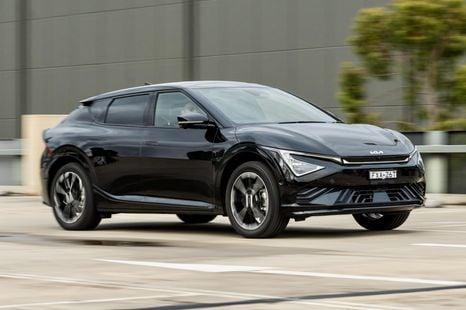
The facelifted Kia EV6 has finally arrived in Australian showrooms, two years after Kia first revealed the update overseas. The headline numbers look familiar: four variants, prices from $72,660 to $99,660 before on-road costs, and a barely-there $70 increase across the range. Look closer and there is more going on, particularly for buyers ready to spend their end-of-financial-year money on an EV that has actually matured rather than landed half-baked.
This is a mid-life refresh, not a new car. But the bigger 84kWh battery, the long-overdue ccNC infotainment system and a flagship GT that now matches the Hyundai Ioniq 5 N for outputs and theatrics make the 2026 EV6 a more complete proposition than the version it replaces. Whether it is a smart buy depends on how clearly you read the showroom maths.
What actually changed for 2026
The big mechanical news is the new 84kWh lithium-ion battery, replacing the old 77.4kWh unit across every variant. WLTP range climbs to a claimed 582km in the rear-drive Air on 19-inch wheels, with the all-wheel-drive cars rated at 522km or 450km depending on grade. Kia retains the 350kW DC charging capability, with a quoted 10 to 80 per cent top-up in 18 minutes on a compatible plug.
Visually, the EV6 picks up Kia's newer family face with angular daytime running lights, redesigned headlights and a fresh front bumper treatment that splits between Air and the GT-Line and GT. There is a thicker B-pillar for body rigidity, new second-row side airbags and additional sound deadening around the rear motor. The shock absorbers have been retuned for ride comfort, which is a quiet but meaningful improvement for an SUV that has always rolled on relatively firm rubber.
Inside, the dual 12.3-inch screens move to Kia's ccNC system, which finally delivers wireless Apple CarPlay, wireless Android Auto and over-the-air software updates. The steering wheels are new (two-spoke for Air, three-spoke for the rest), GT-Line and GT grades pick up a fingerprint authenticator, and new Interstellar Grey and Wolf Grey paints replace the old Steel Grey and Moonscape Matte options.
The pricing trap most EV buyers miss
A $70 price rise sounds like generosity, but it is the wrong number to focus on. The number that matters is the drive-away figure plus any dealer-added accessories, paint upcharges, or 'protection packs' that get bundled in at the desk. The 2026 EV6 is a low-volume car for Kia in Australia, and dealers know early stock is the moment to lean on buyers.
Before signing anything, check three things. First, ask whether the quoted drive-away includes the $700 premium paint surcharge that applies to every colour except Runway Red. Second, demand a line-by-line breakdown of any dealer 'protection' or 'preparation' charges, which are almost always negotiable and frequently worthless. Third, get a written quote on the car's Carseekers network or directly from a competing dealer, then bring that quote back. The factory price has barely moved, but the showroom margin has not, which is exactly why comparison shopping pays off here.
If you are cross-shopping the GT-Line AWD at $87,660 against an Ioniq 5 Epiq from Hyundai, do not let either dealer claim the cars are mechanically identical and therefore priced fairly. They share a platform, but the equipment and cabin design are different enough that the right deal could swing $3000 either way depending on stock pressure.
84kWh battery, but the real-world range matters more
The new battery adds 6.6kWh of usable capacity. In the rear-wheel-drive Air, that pushes WLTP range from 528km to 582km, a 54km improvement. The GT-Line RWD now claims 560km, the GT-Line AWD 522km and the high-performance GT AWD 450km. WLTP figures are optimistic in Australian highway conditions, particularly with air conditioning hammering through a 35-degree day, but the relative gap between variants is a useful guide.
For most Australian buyers doing daily city and suburban driving, the rear-drive variants will easily cover a week of commuting on a single charge. The all-wheel-drive cars trade some range for traction and acceleration, which only matters if you regularly tow, drive in alpine conditions or want the launch performance of the GT.
Energy consumption claims sit at 15.9kWh/100km for the Air, 16.9kWh/100km for the GT-Line RWD, 17.7kWh/100km for the GT-Line AWD and 20.9kWh/100km for the GT. Real-world figures will run higher, but the EV6 remains one of the more efficient mid-size electric SUVs on sale in Australia.
The GT now plays in Ioniq 5 N territory
The most interesting change for performance buyers is the GT's promotion to Ioniq 5 N levels of theatre. Combined outputs climb to 478kW and 770Nm, up 48kW and 30Nm. The 0-100km/h claim drops to 3.5 seconds. More importantly, Kia has added the simulated gear shifts and synthesised motor sounds that Hyundai's Ioniq 5 N owners have been raving about since launch.
Whether artificial gear changes belong in an electric performance car is a matter of taste, but the GT now offers the same toolkit as the Ioniq 5 N for $99,660 before on-road costs. The Hyundai equivalent is $111,000 plus on-roads in Epiq trim, so there is a meaningful price gap if you are happy with the EV6's wagon-like silhouette over the Ioniq 5's hatchback shape.
The GT also picks up adaptive damping, larger 380mm front and 360mm rear ventilated brakes, 21-inch alloys, GT-specific bucket seats and neon green brake calipers. It is a serious bit of kit, and one of the few electric performance cars in Australia that puts more usable theatre on the table than its rivals.
Charging in Australia: 350kW is great, if you can find it
Kia's 18-minute 10 to 80 per cent claim assumes a 350kW ultra-fast DC charger and a battery in the right pre-conditioning window. In practice, that means Chargefox or Evie ultra-rapid sites in capital cities, plus a thinly spread network on the major highway routes. The Hume between Sydney and Melbourne is well covered. The route from Brisbane to Cairns is not.
For day-to-day ownership, the 10.5kW AC charging rate is more relevant. A Wallbox or similar 11kW home charger will replenish the EV6 from empty to full overnight on a three-phase supply. On a single-phase 7kW home charger, expect closer to 12 hours for a full charge from low single digits.
Vehicle-to-load is standard across the range with an interior socket, and the GT-Line and GT add an exterior V2L adaptor for powering camping gear, tools or a fridge. It is genuinely useful for buyers who want their EV to do more than commute.
Cabin tech: ccNC finally arrives
The move to Kia's ccNC infotainment system is the change current EV6 owners will envy most. Wireless Apple CarPlay and wireless Android Auto are now standard, over-the-air updates mean the system can be improved without a service centre visit, and the new processor handles map redraws and menu transitions far more smoothly than the system it replaces.
The GT-Line and GT pick up the fingerprint authenticator, which lets a registered driver unlock personalised settings without needing the key fob nearby. The 14-speaker Meridian sound system on GT-Line and GT remains one of the better factory audio installations in the segment.
Standard kit by grade
The Air is the entry point at $72,660. It rolls on 19-inch alloys, gets reflector LED headlights, six-way manual front seats, synthetic leather upholstery, dual-zone climate, a 6-speaker sound system, the new ccNC infotainment with wireless smartphone mirroring, three front USB-C ports and i-Pedal one-pedal driving.
GT-Line at $79,660 RWD and $87,660 AWD adds 20-inch alloys, projector LED headlights, eight-way power front seats with memory, heated and ventilated front seats, the 14-speaker Meridian system, hands-free power tailgate, sunroof, head-up display, ambient lighting and the fingerprint authenticator.
The GT at $99,660 adds 21-inch alloys, adaptive damping, larger ventilated brakes, intelligent LED headlights, GT-specific bucket seats, power steering wheel adjustment, heated rear outboard seats and a sixth GT drive mode.
Safety equipment is comprehensive
The EV6 retains its five-star ANCAP rating from 2022, with seven airbags including a new rear side airbag for second-row occupants. Adaptive cruise with stop-go, AEB with pedestrian and cyclist detection, blind-spot monitoring, lane-centring, junction assist, safe exit warning, rear cross-traffic alert and a reversing camera are all standard.
GT-Line and GT add a blind-spot view monitor, parking collision avoidance, safe exit assist, surround-view monitor and Remote Smart Park Assist 2. For an electric SUV that may be carrying young children for the next decade, this is a strong baseline.
Servicing and warranty: where Kia wins
Kia's seven-year, unlimited-kilometre warranty remains one of the best in the Australian market, EV or otherwise. Servicing is required every 12 months or 15,000km, with prepaid plans of $728 for three years, $1391 for five years and $2055 for seven years on the Air and GT-Line. The GT runs slightly higher at $842, $1570 and $2319 respectively.
For context, that is roughly half the seven-year servicing bill of comparable European EVs, and the warranty period is two years longer than what most German brands offer. If you are planning to keep the car long-term, this is a real-money advantage that often gets overlooked at the test-drive stage.
How it stacks up against rivals
At the Air's $72,660 price, the EV6 sits between the Volvo EX30 Twin Motor Performance Ultra ($69,990 plus on-roads, smaller and less practical) and the Tesla Model Y Long Range RWD (around $69,000 drive-away depending on offer). The Tesla offers more range on paper and Tesla's Supercharger network advantage, but the EV6's interior space and dealer service network will matter more to many buyers.
The GT-Line AWD's natural rival is the Ioniq 5 Epiq AWD, with the EV6 typically priced a few thousand cheaper. The GT goes head-to-head with the Ioniq 5 N for the simulated-gear-change crowd, while undercutting it by more than $11,000.
Against the BMW iX1 and Audi Q4 e-tron, the EV6 trades brand cachet for more usable space and longer warranty cover. Both Germans are due updates of their own, so cross-shop carefully.
What dealers will not volunteer about wait times
Facelifted EV6 stock has only just landed in Australia. Some grades will be in short supply through to spring, particularly the GT-Line AWD and the flagship GT. Dealers know this, and a small number will quietly push buyers towards available stock with extra options or paint colours rather than the spec the buyer actually wants.
If you are shopping the EV6, decide your variant and option list before you walk in, then ask the dealer for the realistic delivery window in writing. If a salesperson tells you a car is 'on the water' but cannot supply a build date or VIN, treat that as background noise, not a commitment. Brokers and EV-specialist consultants on the Carseekers network can often get earlier delivery slots than walk-in buyers.
Should you buy now or wait?
If you have been holding off on an EV6 because of the old 77.4kWh battery and the dated infotainment, this is the update that solves both. The pricing barely moves and the warranty is unchanged, so there is little incentive to wait further unless you are specifically holding out for an end-of-model-year clearance in 2027.
For performance buyers, the GT is now genuinely competitive with the Ioniq 5 N at a meaningful price discount. For everyone else, the GT-Line RWD at $79,660 hits the sweetest balance of range, equipment and value in the lineup. Just do not let a dealer convince you the $70 price rise means there is no room to negotiate. There always is.
Considering finance for your next car? Loanseekers can help you explore car loan options.
The finer details
Your questions answered.
How much is the 2026 Kia EV6 in Australia?
The 2026 Kia EV6 starts at $72,660 before on-road costs for the Air RWD, with the GT-Line RWD at $79,660, GT-Line AWD at $87,660 and the flagship GT AWD at $99,660. All grades are just $70 more than the previous model, but premium paint adds $700 and dealer charges can vary.
What is the driving range of the 2026 Kia EV6?
WLTP claimed range is 582km for the Air RWD, 560km for the GT-Line RWD, 522km for the GT-Line AWD and 450km for the GT AWD. Real-world Australian highway range will be lower, particularly in summer with air conditioning running, but the rear-drive variants comfortably cover a week of commuting on a single charge for most buyers.
How fast does the 2026 Kia EV6 charge?
On a 350kW ultra-fast DC charger, Kia claims 10 to 80 per cent in 18 minutes. AC home charging maxes out at 10.5kW, which means around 9 to 10 hours for a full charge on a three-phase wallbox, or roughly 12 hours on a typical single-phase 7kW home charger.
Is the 2026 Kia EV6 GT as quick as the Hyundai Ioniq 5 N?
Yes. The updated EV6 GT now produces 478kW and 770Nm with a claimed 3.5-second 0-100km/h time, matching the Ioniq 5 N. It also gains the simulated gear shifts and synthesised engine sounds, but undercuts the Hyundai by more than $11,000 at $99,660 before on-road costs.
What is the warranty on the Kia EV6?
Kia Australia covers the EV6 with a seven-year, unlimited-kilometre warranty, which is two years longer than most German competitors. Service intervals are 12 months or 15,000km, with prepaid plans of $728 for three years on the Air and GT-Line, or $842 for the GT.
Should I buy the 2026 Kia EV6 now or wait for a better deal?
The facelifted EV6 has only just landed, so dealer discounts will be limited through to spring. If you want the new 84kWh battery, ccNC infotainment and updated GT outputs, buying now makes sense. If you are happy with the outgoing model, the next round of run-out clearance pricing will likely come in early 2027.