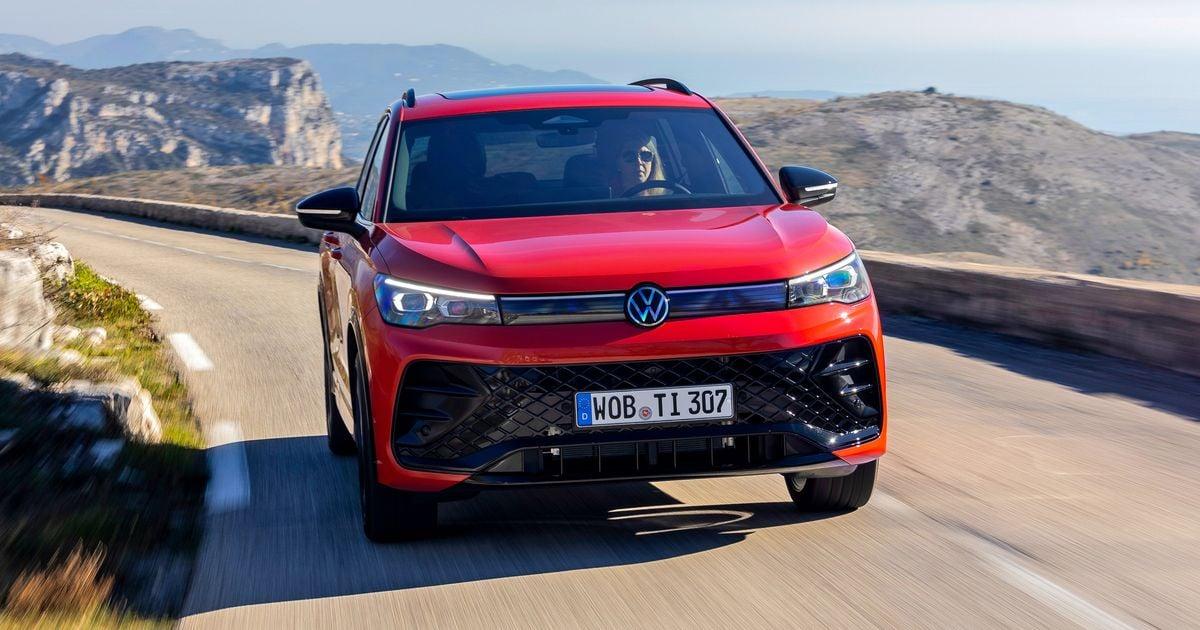

Volkswagen Australia has rolled out the new Tiguan and Tayron eHybrid plug-in SUVs with EOFY drive-away pricing that does something VW does not usually do. It undercuts the Japanese.
Until 30 June, the Tiguan 150TSI eHybrid is $63,990 drive-away, and the longer seven-seat-capable Tayron 150TSI eHybrid sits at $61,990 drive-away. Compared to the list pricing of $64,590 and $62,390 before on-roads, that is roughly $6000 to $7000 in real-money savings depending on your postcode.
For Australian buyers shopping mid-size and large PHEV SUVs, this is the kind of pricing that changes the shortlist. The big Japanese players, who have been able to charge a premium for plug-in tech, are now the more expensive option in this segment.
The headline pricing in one place
VW's eHybrid range splits into two power tunes. The 150TSI versions sit at the value end, with the 200TSI eHybrid R-Line versions slotting above.
Drive-away pricing during the promotion runs as follows. Tiguan 150TSI eHybrid: $63,990 D/A. Tayron 150TSI eHybrid: $61,990 D/A. Tiguan 200TSI eHybrid R-Line: from $73,990 D/A. Tayron 200TSI eHybrid R-Line: from $75,990 D/A.
The Tayron undercutting the Tiguan in the entry grade is a quirk worth understanding. The Tayron 150TSI eHybrid Elegance does not include the contents of the Sound and Vision Package as standard, a $4200 option, while the Tiguan does. So the Tiguan is the better-equipped car at the higher price.
How it compares to the Toyota RAV4 PHEV
This is where it gets interesting. The cheapest Toyota RAV4 PHEV, the XSE 2WD, lands at around $64,370 drive-away on a Sydney postcode.
That means the Tayron 150TSI eHybrid is over $2000 cheaper than a base RAV4 PHEV drive-away, and the Tiguan is within a few hundred dollars while offering meaningfully more equipment. Items like ventilated and massaging front seats, 15-stage adaptive damping and HD Matrix LED headlights are not on the RAV4 XSE.
Claimed EV range is also a wash or better for VW. The Tiguan and Tayron eHybrids quote 110km-plus on the WLTP cycle, while Australian-spec RAV4 PHEVs quote up to 150km on the more lenient NEDC cycle. UK WLTP figures for the RAV4 PHEV come in at around 85 miles, or about 136km.
So on the standardised number, VW is competitive. On real-world expectations, the RAV4 probably stretches a touch further, but not by the gap the NEDC number implies.
How it compares to the Mitsubishi Outlander PHEV
The other big PHEV SUV in this fight is the Mitsubishi Outlander PHEV. The base ES AWD lists from $58,990 before on-road costs, which works out to a drive-away figure roughly in line with the base RAV4 PHEV's drive-away price.
So on like-for-like, both VWs are also cheaper drive-away than the entry Outlander PHEV once on-roads are added. They are substantially better equipped too. The base Outlander PHEV ES is a fairly bare offering compared to the Tiguan eHybrid Elegance.
The Outlander's WLTP EV range is 84km, well behind the Tiguan and Tayron's 110km-plus. The Mitsubishi still has the seven-seat advantage in some specs, but the Tayron also has seven-seat capability in its non-PHEV variants and a flexible interior in the PHEV.
How it compares inside the VW Group
This is where the pricing math becomes interesting for VW Group brand-loyalty buyers. The Tiguan 200TSI eHybrid R-Line at $73,990 drive-away significantly undercuts the related Cupra Terramar VZe, which is priced from $77,990 plus on-roads, working out to between $82,490 and $85,490 drive-away depending on state.
The two cars share platforms and most of the PHEV powertrain components. You are paying around $10,000 more for a Cupra badge and slightly different positioning.
The smaller Cupra Formentor VZe with the same 200kW PHEV drivetrain also works out more expensive than the Tiguan eHybrid R-Line, at $68,990 plus on-roads, or $76,490 D/A before options. If you wanted that powertrain in the most affordable way possible, the VW is now clearly the play.
What about Skoda?
The Tayron 150TSI eHybrid Elegance has the same dynamic against the related Skoda Kodiaq Select PHEV, which is priced from $68,990 drive-away. The two SUVs share underpinnings and componentry, in the same way the Tiguan and Terramar do.
To match the Tayron Elegance's level of specification, the Kodiaq needs a $6500 option package. There is a counter-balance here, with the Tayron Elegance itself needing the $4200 Sound and Vision Package to match a fully-optioned Kodiaq, but the Tayron remains the more cost-effective starting point.
What the dealer will do with this
Be ready for two tactics. First, dealers will try to add on-road costs back in if you have not nailed down the drive-away nature of the price in writing. The published figures are drive-away. Get that on the order.
Second, expect pressure to upgrade you into the 200TSI R-Line on finance, since the monthly difference looks small even though the cash price gap is $10,000. The R-Line is a strong car, but if you came in for the 150TSI Elegance, do the maths on the total cost of ownership before you let the conversation get rerouted.
Tax implications worth knowing
Both eHybrid models are now above the luxury car tax fuel-efficient vehicle threshold, depending on your final spec and options. That is something to clarify with the dealer if you are running a novated lease or salary-sacrificing the vehicle.
The fringe benefits tax exemption for PHEVs has wound back from 1 April 2025, so this is no longer a tax-free novated lease the way pure EVs still are. The eHybrids are still tax-effective compared to petrol equivalents on a lease, just not as aggressively so as an EV.
The market context
PHEV sales are up 76.9 per cent year to date in 2026 through to the end of April, with 28,858 plug-in hybrids registered in Australia in the first four months of the year. In 2025, PHEVs grew by 130.9 per cent to 53,484 registrations.
That is the curve VW is leaning into. Buyers who were not ready for a full EV but wanted the cost of running benefits of a plug-in are showing up in real volume, and the segment is finally seeing manufacturers compete properly on price.
The Tiguan and Tayron eHybrids landing with drive-away pricing that undercuts the Japanese, while offering more EV range than the Outlander and matching the RAV4 on the standardised test, is a genuine shift. Whether VW holds this aggression after 30 June is the question.
How Carseekers sees the play
For most family-SUV buyers comparing PHEVs right now, the order to think about looks something like this. Tiguan 150TSI eHybrid is the value-and-equipment leader. Tayron 150TSI eHybrid is the cheapest in absolute terms and the play if you do not need the Sound and Vision pack.
RAV4 PHEV is the safe Toyota resale bet, especially if you trade every four years. The Outlander PHEV is the budget option but feels its age inside the cabin.
Lock in the drive-away figure in writing before 30 June, and do not let the dealer talk you out of the Elegance grade into a higher trim you did not budget for.
Considering finance for your next car? Loanseekers can help you explore car loan options.
The finer details
Your questions answered.
How much is the 2026 VW Tiguan eHybrid drive-away in Australia?
The Tiguan 150TSI eHybrid Elegance is $63,990 drive-away as part of Volkswagen's EOFY 2026 promotion running until 30 June. The more powerful 200TSI eHybrid R-Line is from $73,990 drive-away. Pricing after 30 June reverts to list, currently $64,590 before on-road costs for the 150TSI.
Is the VW Tiguan eHybrid cheaper than a Toyota RAV4 PHEV?
Effectively yes when you compare like for like. The Tayron 150TSI eHybrid at $61,990 D/A is over $2000 cheaper than a base RAV4 PHEV XSE 2WD at around $64,370 D/A in Sydney. The Tiguan is within a few hundred dollars but better equipped, including features the RAV4 does not offer at that price.
What is the EV range on the new VW Tiguan and Tayron eHybrids?
Both quote 110km or more on the WLTP test cycle. That is materially better than the Mitsubishi Outlander PHEV's 84km on the same standard. Real-world range in Australian driving will typically come in 15 to 20 per cent below WLTP, so plan for 85 to 95km of usable EV range in normal use.
Should I wait for the T-Roc or buy the Tiguan eHybrid now?
Different cars for different buyers. The T-Roc is smaller, more affordable and won't get a PHEV at launch. If you need a family-sized PHEV with room for adults in the rear and a decent boot, the Tiguan eHybrid is the right size now. The T-Roc is the play if you want a smaller SUV and are happy with mild-hybrid efficiency rather than plug-in range.
Is the Tiguan eHybrid eligible for the EV FBT exemption?
No. The FBT exemption for plug-in hybrids was wound back from 1 April 2025. The Tiguan eHybrid is still tax-effective compared to a petrol equivalent on a novated lease, but it does not get the full tax-free treatment that pure EVs still enjoy. Get advice on your specific situation.
What happens to the Tiguan eHybrid pricing after 30 June 2026?
Volkswagen has only confirmed the drive-away pricing through 30 June. After that, pricing reverts to the list figures of $64,590 for the Tiguan 150TSI eHybrid and $62,390 for the Tayron 150TSI eHybrid before on-road costs. Whether VW extends or runs another promotion in July depends on stock levels and how the campaign performs.