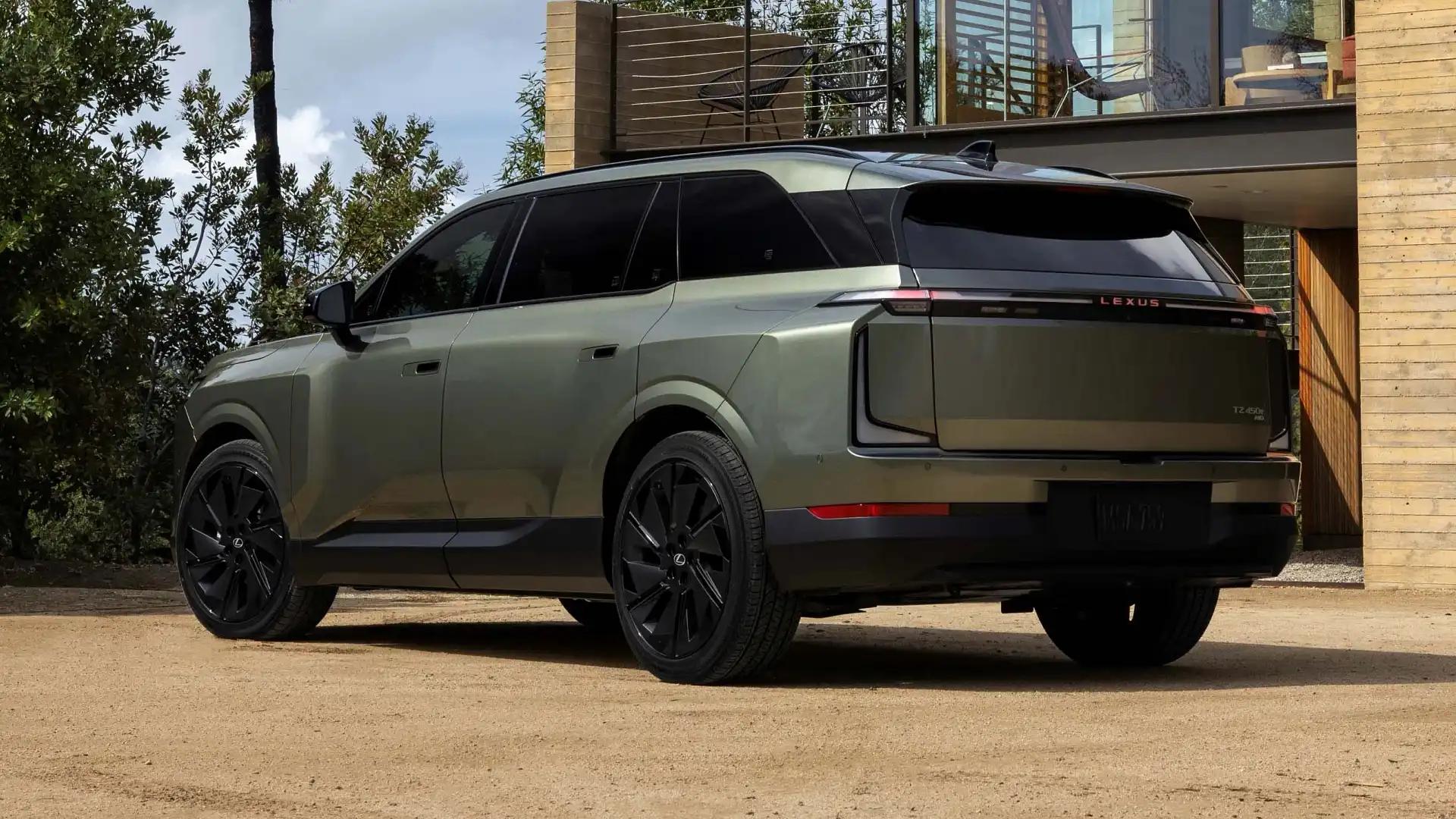

Lexus has revealed its biggest electric SUV yet, and it brings something the Australian premium-EV market has been short on: a third row of seats. The 2027 Lexus TZ is currently under assessment for Australian launch, slotting above the smaller RZ as a luxury sibling to the Toyota Highlander EV and Subaru Getaway.
A Lexus Australia spokesperson confirmed the brand is "currently assessing the TZ for potential introduction" but stopped short of an outright commitment. For Carseekers readers shopping a premium seven-seat EV right now, the TZ joins the Hyundai Ioniq 9, Kia EV9, Volvo EX90 and Cadillac Vistiq on the watch list.
The key advantage Lexus has here is Japanese build, which strongly implies right-hand drive engineering and a real shot at Australian launch rather than a US-only proposition.
Six seats first, with seven on the table
Lexus has shown the TZ in five and six-seat configurations so far, with a seven-seat version expected before launch. The six-seat layout uses captain's chairs in the second row, which is increasingly the format of choice for premium family SUVs because it makes third-row access easier and adds usable space between front passengers.
For Australian buyers, the seven-seat is the more important call. Premium three-row SUVs without a usable third row tend to underperform here, where buyers in this segment are usually genuine school-run families rather than empty-nesters chasing back-row luxury.
The TZ is built in Japan rather than the United States, which is what makes Australian launch a real possibility. The North American sister model, the Lexus TX, is not coming here because it is built in the wrong place for right-hand drive markets.
Size, platform and how it relates to the LX
Measuring 5100mm long, 1990mm wide and 1705mm tall on a 3050mm wheelbase, the TZ is identical in length and width to the Lexus LX, but 190mm lower and stretched 200mm further between the front and rear wheels. That extra wheelbase translates to more usable second and third-row space than a 4WD-derived three-row.
Underneath, the TZ uses a modified version of the GA-K platform that supports the new-generation hybrid and electric Lexus ES sedan and the latest Lexus RX. It is not built on the dedicated e-TNGA EV platform, which means it is a car-derived monocoque rather than a body-on-frame construction. Off-road and towing capabilities will be much closer to a Toyota RAV4 than a LandCruiser, which matters for buyers planning to tow or take the family touring beyond made roads.
Doors are shared with the Toyota Highlander EV, but the TZ gets unique front and rear styling, plus a more luxurious cabin focused on noise reduction. That is the standard Toyota-Lexus playbook: shared bones, distinct finish.
Range and the artificial engine sound
The TZ produces 300kW from 167kW front and 269Nm rear electric motors combined. In the United States it will be offered with 76.96kWh or 95.82kWh lithium-ion battery options. Only the larger battery is listed in global specs, claiming 530km of WLTP range for Europe.
For Australian buyers used to seeing 600km-plus range claims on rivals like the Mercedes-Benz EQE SUV or BMW iX3, 530km is competitive but not class-leading. Real-world range with a family of seven and roof boxes loaded will land closer to 400km, which is still enough for any reasonable single-day drive.
Unusually, Lexus has fitted the TZ with artificial engine sounds, including one setting that emulates the LFA's V10 engine. The brand is following the Hyundai Ioniq 5 N's playbook of using sound to compensate for the silent EV experience, which is divisive: some buyers love it, others find it gimmicky after the first month.
Pricing speculation, FBT and the $75k question
If the TZ is confirmed for Australia, Lexus will likely position it from around $110,000 to $120,000 plus on-road costs, similar to its closest electric three-row rivals. That puts it firmly above the FBT exemption threshold, with the Federal Government already legislating to wind back the EV novated lease tax break from April 2027.
For salary-package buyers, the TZ will not qualify for the full FBT discount under the new rules, although a 25 per cent discount is expected to apply to vehicles under the LCT 'fuel-efficient' threshold. The smaller Lexus RZ, now starting from $84,500 plus on-roads after a recent $36,559 to $42,059 price cut, is more attractive on this front.
Lexus Australia has been aggressive on RZ pricing as the brand pushes EV volume. Whether that aggression carries over to a TZ launch is the open question, and the answer depends largely on how Mercedes-Benz and BMW price their respective three-row EVs in the same window.
Equipment and interior detail
Lexus lists 20 to 22-inch alloy wheels, a 21-speaker Mark Levinson audio system, soft-closing doors, powered ottomans, heated and ventilated first and second-row seats, power-folding second and third-row seats, and a panoramic glass roof. Optional rear-wheel steering reduces the turning radius and aids rear comfort with a specific drive mode.
Design elements include bamboo wood decorative interior surfaces, a suede-look instrument panel, seat accents, and aluminium for the roof rails. An adhesive-free seat assembly structure suggests Lexus is making genuine sustainability claims about the build, not just colour-coordinated marketing.
For buyers who want a properly luxurious EV cabin in a family format, the TZ is shaping up as a real alternative to the Volvo EX90 and Mercedes-Benz EQS SUV. The pricing question is everything here, and Australian launch confirmation will hinge on Lexus believing it can hit the right number against those German and Swedish rivals.
What Carseekers thinks
The TZ is a genuinely interesting addition to the premium three-row EV segment, and Japanese build is the strongest signal yet that Australia will get a turn. Watch for an official launch announcement in the second half of 2026 ahead of US deliveries by year-end. The seven-seat variant is the one to wait for. Pricing under $115,000 plus on-roads makes this a real Volvo EX90 fight; pricing above $125,000 means buyers will keep choosing the cheaper Korean alternatives.
Considering finance for your next car? Loanseekers can help you explore car loan options.
The finer details
Your questions answered.
Is the 2027 Lexus TZ confirmed for Australia?
Lexus Australia has stated it is currently assessing the TZ for potential introduction, but a launch confirmation is yet to be issued. Japanese build supports right-hand-drive availability, making Australian launch a strong possibility rather than a guaranteed one.
How many seats does the Lexus TZ have?
Lexus has shown five and six-seat configurations of the TZ so far, with a seven-seat version expected to be revealed before launch. For Australian families, the seven-seater will be the priority variant given local buyer preference for usable third-row seating.
What range does the Lexus TZ claim?
The Lexus TZ with the larger 95.82kWh battery claims 530km of WLTP driving range in European testing. The smaller 76.96kWh battery option offered in the United States is yet to receive a global range figure. Real-world range under family loads is expected to land closer to 400km.
How much will the Lexus TZ cost in Australia?
Lexus Australia has not confirmed local pricing. Industry expectation is a starting price of $110,000 to $120,000 plus on-road costs, in line with rivals like the Volvo EX90 and Cadillac Vistiq. That places the TZ above the upcoming FBT cliff for novated leases.
Will the Lexus TZ qualify for the FBT exemption?
At expected pricing of $110,000 plus, the TZ will sit above the $75,000 FBT cap that takes effect from April 2027. EVs in this price band will get a 25 per cent discount on FBT under the new rules rather than the full exemption, assuming they sit under the LCT fuel-efficient threshold.
How does the Lexus TZ compare to the LX?
The TZ is identical in length and width to the LX 4WD but 190mm lower with a 200mm-longer wheelbase. It uses a car-derived monocoque platform rather than the LX's body-on-frame construction, which means more interior space and better on-road refinement, but much lower towing and off-road capability.