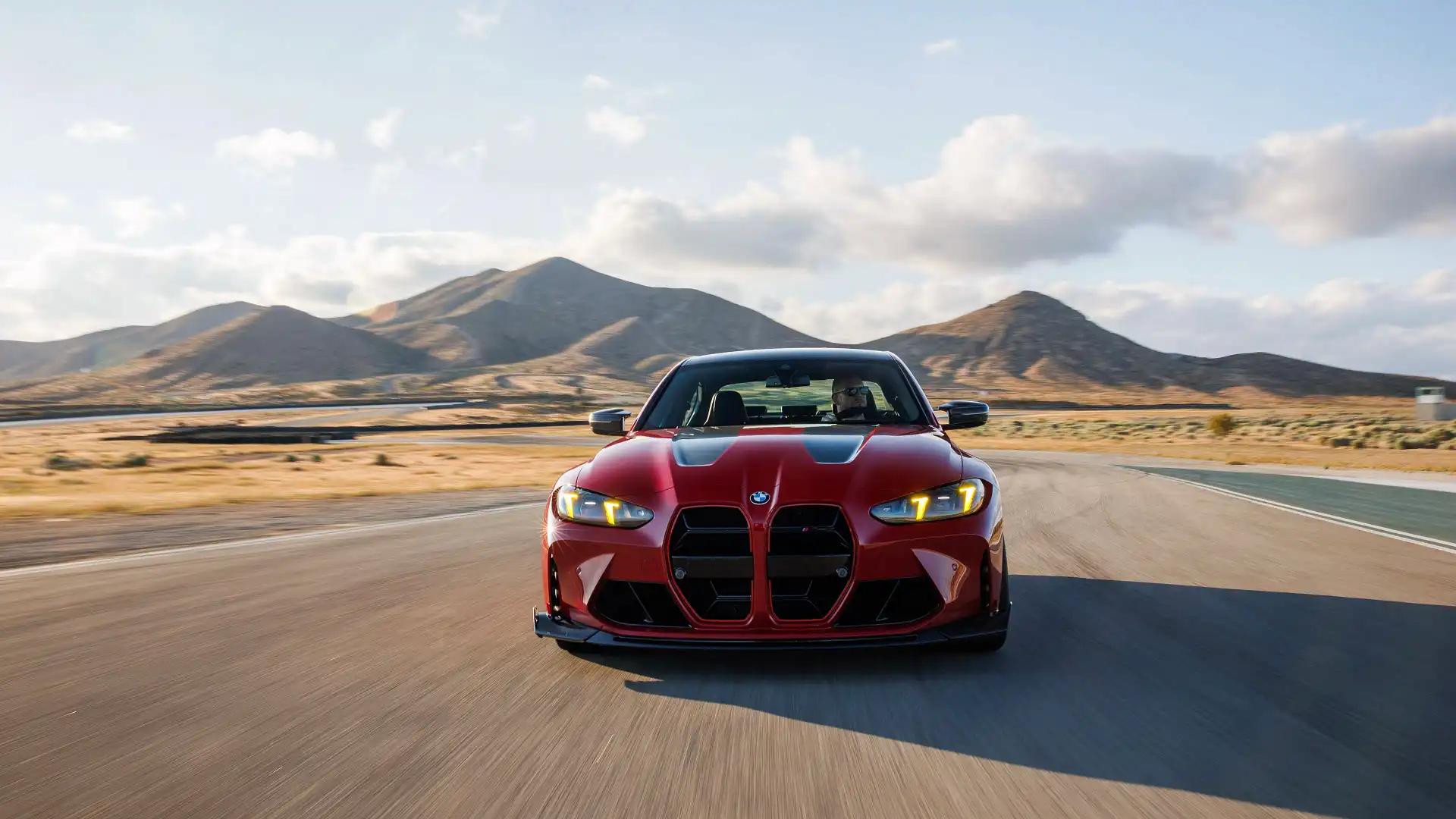
The current generation BMW M3 is heading off into retirement with a serious send-off, just not one that Australian buyers will get to enjoy. BMW has confirmed the M3 CS Handschalter, a stripped-back, manual-only, rear-wheel-drive limited edition pitched at the M3 purist. It will be sold only in the United States, and Australia will not get an allocation.
The Handschalter, German for "manual gearshift", pairs the existing M3 CS package with the first six-speed manual gearbox in this generation of M3. That alone makes it a collector's piece. The next-generation M3, expected to offer both petrol and electric variants, has not yet been revealed but is widely understood to drop the manual entirely.
What you get
The Handschalter is built specifically for the manual-only American market and gets a comprehensive lightweight package:
- Approximately 34kg lighter than the standard M3, making it the lightest M3 of this generation - Carbon-fibre reinforced plastic on key body panels - Forged alloy wheels (gold, bronze or black, 19-inch front and 20-inch rear) - Titanium muffler - Standard M Carbon bucket seats - 6mm reduction in ride height with new springs reportedly borrowed from the M2 CS - Rear axle links and dampers borrowed from the M4 CSL - Unique steering and traction control calibration - Optional carbon-ceramic brakes - M Drive Professional with M Drift Analyser and M Laptimer
Under the bonnet sits the same 3.0-litre twin-turbo inline-six as the regular M3, but the Handschalter keeps power at 353kW and 550Nm. The auto-only M3 CS makes 405kW and 650Nm, but the manual gearbox cannot reliably handle that level of torque, hence the lower outputs.
What it costs in the US
The M3 CS Handschalter is priced from US$108,450 in the United States, which is US$10,250 cheaper than the all-wheel-drive M3 CS sold there. That is one of the rare cases where the limited-edition variant is actually less expensive than the regular CS, because BMW is positioning it as a driver's car rather than a top-spec model.
For reference, the M3 CS was last sold in Australia in 2024 from $249,900 plus on-road costs. If BMW had brought the Handschalter here, expect a similar premium over the standard M3, putting it somewhere around $260,000 to $280,000 before options and on-road costs. The fact that it is not coming saves Australian buyers from that hypothetical decision.
Why Australia missed out
BMW has not explicitly explained the US-only decision, but the most likely reasons are:
- Production volume is extremely tight, BMW described it as "very limited numbers" - The US accounts for a disproportionate share of manual M3 demand - Right-hand-drive engineering for a low-volume manual variant would be cost-prohibitive - Australia has already received good M3 representation through the existing M3 Competition, M3 Touring, and the auto-only M3 CS
This is a familiar pattern for limited-edition BMW M cars. Australia tends to miss out on the most extreme variants, particularly anything that requires unique tooling for right-hand drive at low volume. The M4 CSL was a similar story when it was first announced.
What this means for the broader M3 market in Australia
The Handschalter being US-only does two things for the local M3 market.
First, it makes existing Australian M3 stock more interesting. The M3 Competition, M3 Competition Touring and (where available) used examples of the M3 CS are now the only ways for Australian buyers to enter this generation. Demand for clean low-kilometre examples is likely to firm up as the model approaches end-of-life.
Second, it confirms that the next-generation M3 is the one to watch. The current M3 will leave production after this Handschalter run, and the next-gen will offer petrol and electric variants but is widely expected to be eight-speed-auto only. Buyers wanting a current-shape manual M3 in Australia will need to look at existing imported examples or accept the auto.
The bigger picture: the manual is dying
The Handschalter is the latest sign that the manual transmission is being slowly phased out of premium performance cars. Porsche still offers manuals in the 718 and 911, Aston Martin builds the Vantage with a stick on request, and Ford offers the manual Mustang GT. The list is short, and getting shorter.
For Australian buyers wanting a true driver's car with three pedals, the realistic options today are the Toyota GR Yaris and GR Corolla, the Ford Mustang GT, and a small handful of European sports cars. The luxury manual market is effectively closing.
What Australian M3 buyers should do
If you have been waiting for an M3 Handschalter, the practical options are:
- Accept that the car will not be officially imported to Australia - Explore grey-import pathways once US cars enter the used market, accepting the price premium and re-engineering cost - Consider the Audi RS5 PHEV, which slots in below the BMW M3 AWD on price - Look at the existing M3 CS Touring or the used M3 Competition market for an alternative track-focused M car - Watch for the next-generation M3 reveal, expected within the next 12 to 18 months
For most M3 buyers, the realistic answer is to focus on the broader BMW M lineup currently available rather than fixating on a car BMW will not sell here. The M2 CS, M3 Competition, and the upcoming next-gen M3 will all be more relevant for Australian decisions over the next 24 months.
What to watch next
The M3 CS Handschalter will make its public debut at the Petersen Automotive Museum in Los Angeles. US production starts in July 2026, with deliveries expected through the second half of the year. Carseekers will be tracking the broader M3 generation change closely, including any signals about how the next-generation M3 will balance petrol and electric variants for Australia.
Considering finance for your next car? Loanseekers can help you explore car loan options.
The finer details
Your questions answered.
Is the BMW M3 CS Handschalter coming to Australia?
No. BMW has confirmed the M3 CS Handschalter will be sold only in the United States. Australian buyers will not receive an allocation, and BMW Australia has not signalled any plan to bring the manual variant here. Grey imports may become available later through used-car channels.
Why is the BMW M3 CS Handschalter US-only?
Production is being tightly limited, and the US accounts for the majority of manual M3 demand. Right-hand-drive engineering for a low-volume variant would be cost-prohibitive against the small Australian market. BMW followed the same pattern with previous limited M cars like the M4 CSL.
How is the BMW M3 CS Handschalter different from the regular M3 CS?
The Handschalter swaps the standard M3 CS's automatic and all-wheel drive for a six-speed manual and rear-wheel drive. Power drops from 405kW to 353kW because the manual gearbox cannot reliably handle the higher torque output, but the car is around 34kg lighter and gets unique suspension and steering tuning.
How much does the BMW M3 CS Handschalter cost?
US pricing starts at US$108,450, which is US$10,250 less than the standard M3 CS in that market. For Australian context, the previous M3 CS was priced from $249,900 plus on-road costs. If officially imported, the Handschalter would likely have been priced similarly, but it will not be sold here.
Will the next-generation BMW M3 offer a manual?
BMW has not confirmed specifications for the next-generation M3, but the model is widely expected to be eight-speed automatic only, with both petrol and fully electric variants. The CS Handschalter is being positioned as the final manual M3, making it a collector's piece even at full retail.
What are the best alternative manual performance cars in Australia?
Australian buyers wanting a manual performance car can look at the Toyota GR Yaris, Toyota GR Corolla, Ford Mustang GT, Porsche 911 and 718 ranges, and a small number of niche European sports cars. The luxury manual market has been shrinking quickly, with most premium brands moving to automatic-only powertrains.