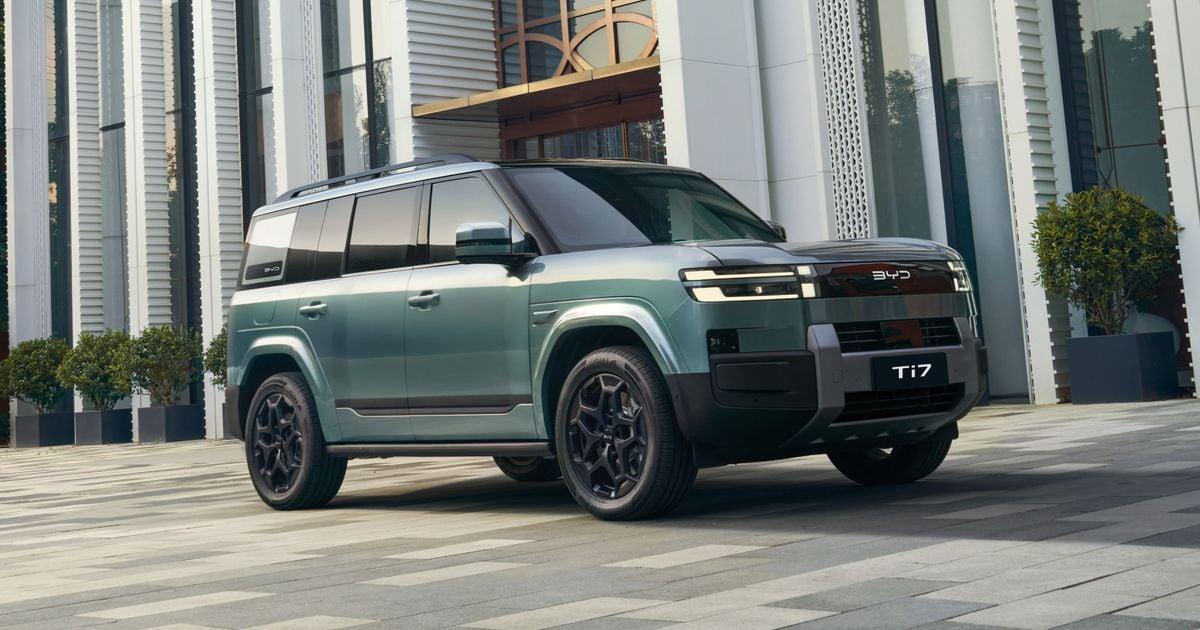
BYD is preparing to drop another large SUV into the most contested part of the Australian market, and this one looks like a Denza but might not wear the badge.
The model in question is the Ti7, part of parent company BYD's Fangchengbao 'Titanium' SUV family in China. It was revealed late last year at the Bangkok Motor Expo, has already launched in Kuwait, and BYD lodged Australian trademark filings for both the Ti7 and a larger Ti9 name in December 2025.
BYD Australia confirmed earlier this year it was performing local chassis calibration on a plug-in hybrid or extended-range off-road model. Multiple industry sources now point to that mystery vehicle being the Ti7, with a launch window expected before the end of 2026.
What the Ti7 actually is
Think Hyundai Santa Fe sized, but lower-riding and unibody rather than ladder-frame. The Ti7 measures 4999mm long, 1995mm wide and 1865mm tall, with a 2920mm wheelbase. That makes it longer and wider than the Santa Fe but slightly shorter overall than the seven-seat BYD Sealion 8 already on sale.
Unlike the Sealion 8, the Ti7 is a strict five-seater. There is no third row. Suspension uses a double-wishbone front and a five-link rear setup across the range, with all-wheel independent geometry standard.
The Ti7 sits above the smaller Ti3 in BYD's Chinese-market off-road sub-brand, but it skips the heavy-duty ladder-frame construction used by the Fangchengbao B5 and B8, which sell in Australia under the Denza banner. That is the key distinction. The Ti7 is built for everyday family use, not serious low-range work.
Two completely different powertrains
The plug-in hybrid Ti7 uses a turbocharged 1.5-litre four-cylinder petrol engine producing 115kW and 225Nm. Front-drive versions pair it with a single 200kW/315Nm electric motor, while all-wheel-drive variants add a 160kW front motor and a 200kW rear motor.
Buyers in China choose between a 26.6kWh battery and a 35.6kWh pack. Electric-only range on the CLTC cycle ranges between 135km and 200km, with DC fast-charge rates of 54kW to 72kW. By any reasonable measure, that is plenty of pure-electric daily driving for an Australian buyer who plugs in overnight.
The full-electric Ti7 is where things get interesting. The rear-drive single-motor model gets a 300kW/365Nm rear motor and a choice of 92kWh or 105.7kWh batteries, good for 675km or 755km of CLTC range. Add a 215kW front motor for the all-wheel-drive setup and the 0-100km/h time tumbles from 7.3 seconds to a serious 4.5 seconds.
More importantly, the EV Ti7 supports BYD's flash-charging technology. BYD claims a 10 to 70 per cent DC charge can be completed in as little as five minutes. That figure assumes a megawatt-grade charger on a perfectly conditioned battery, but even a fraction of that pace would be transformational on an Australian road trip.
What you actually get inside
BYD is loading the Ti7 with screens. There is a 15.6-inch central touchscreen, a 10.25-inch digital instrument cluster, and a 26-inch head-up display projected across the windscreen. Whether Australian buyers find that genuinely useful or simply visually busy is a matter of taste, but it is on-brand for the segment.
Standard equipment in China includes a panoramic sunroof with a power sunshade, leather upholstery, heated and ventilated power front seats, a heated leather-wrapped steering wheel and wireless phone charging.
Safety and driver assistance comes courtesy of BYD's DiPilot 100 suite, with higher-spec versions stepping up to DiPilot 300 with an added LiDAR unit. Features across the range cover front and rear cross-traffic assist, blind-spot monitoring, safe exit warning, adaptive cruise control and a surround-view camera.
Why this matters for Australian buyers
The Ti7 is the latest in a relentless wave of BYD product expansion. The brand has moved from four models to 11 in just two years, and now sits fifth on the Australian sales charts behind only Toyota, Mazda, Kia and Ford. It has set its sights on a top-three finish.
Buyer-wise, that aggression cuts both ways. On the upside, BYD's lineup explosion means a new car shopper has more electrified options at sub-$50,000 price points than they did at any point last decade. On the downside, BYD dealers are increasingly running out of physical space in showrooms, and waiting times for some popular variants have already crept upwards.
If you are weighing a Ti7 against the existing BYD Sealion 8 or against a Hyundai Santa Fe, the case rests on whether you actually need seven seats. The Ti7 will likely undercut the Sealion 8, deliver more range on the EV variant, and offer the flash-charging advantage. The Sealion 8 keeps the third row.
The Denza question
The trademark filing for the Ti7 in Australia is registered to BYD itself, not Denza. That is interesting given the Fangchengbao B5 and B8 are sold here under the Denza brand. The filing does not lock the Ti7 into a BYD-branded launch, but it does suggest BYD Australia is at least open to selling it through the mainstream channel rather than the luxury offshoot.
From a buyer's perspective, a BYD-badged Ti7 likely means more accessible pricing and a wider dealer network. A Denza-badged Ti7 would mean fewer showrooms but more premium positioning, potentially with a leather and material upgrade over the Chinese-market base car.
Neither outcome would be a surprise. Carseekers will update this story as BYD Australia confirms specifications, pricing and which badge the Ti7 will wear when it finally lands.
Dealer behaviour to watch
BYD orders have generally been smooth in Australia, but the rapid product cadence has occasionally caught dealers and customers out. If you order a Ti7 in the opening months, expect dealers to push popular paint colours and accessory packs hard because their margin on the metal itself is slim by legacy-brand standards.
Deposit deals are common to lock the early build slots. If a dealer presses for a non-refundable deposit before pricing is confirmed by BYD Australia head office, that is a clear walk-away signal. Wait for the formal price book.
How the Ti7 stacks up in China
The Ti7 has been a runaway sales success in its home market. BYD sold 57,197 examples in the first four months of 2026, which alone outsold every other Fangchengbao model combined, and the Ti7 has cracked the top 20 best-sellers in the entire Chinese market. That kind of volume should help Australian production scheduling and reduce the supply bottlenecks that have plagued some BYD launches.
It also tells you Chinese buyers are voting with their wallets for the unibody, car-like setup over the heavy-duty ladder-frame B5 and B8. That preference is likely to translate to Australia, where most large SUV buyers spend their time on tarmac school runs and motorway commutes, not on station tracks.
Bottom line
The Ti7 looks set to be one of the more significant BYD launches of 2026. It plugs a gap in the lineup between the mainstream Sealion family and the premium Denza offerings, brings flash-charging tech to a sensible family-sized SUV, and offers a real PHEV alternative for buyers who are not ready to commit to full electric. Watch for an official BYD Australia announcement before the end of the year.
Considering finance for your next car? Loanseekers can help you explore car loan options.
The finer details
Your questions answered.
Is the BYD Ti7 coming to Australia?
Yes. BYD trademarked the Ti7 name in Australia in December 2025 and BYD Australia confirmed it was performing local chassis tuning on a PHEV or extended-range off-road model. A launch is expected before the end of 2026, although BYD has not yet confirmed pricing.
Will the BYD Ti7 be sold as a Denza in Australia?
It could go either way. The trademark filing is held by BYD, not Denza, which suggests the mainstream BYD badge is the more likely path. The Fangchengbao B5 and B8 are sold here as Denza models, so a luxury-positioned Ti7 is not off the table.
How big is the BYD Ti7?
The Ti7 is 4999mm long, 1995mm wide and 1865mm tall on a 2920mm wheelbase. That makes it slightly larger than a Hyundai Santa Fe but with only five seats instead of seven. It sits below the BYD Sealion 8 in size, which carries a third row.
What is the BYD Ti7 EV range?
In China, the rear-drive Ti7 EV offers 675km or 755km CLTC range depending on whether you choose the 92kWh or 105.7kWh battery. The all-wheel-drive model is rated at 675km. Real-world WLTP figures for Australia will be lower once they are confirmed.
How does BYD flash charging work on the Ti7?
BYD's flash-charging system can take the Ti7's battery from 10 to 70 per cent in as little as five minutes under ideal conditions on a megawatt-class charger. Australian charging networks have not yet rolled out megawatt hardware widely, so real-world charging speeds will be slower until that infrastructure arrives.
Should I wait for the Ti7 or buy a BYD Sealion 8 now?
If you need seven seats, the Sealion 8 is the only BYD option. If you are happy with five seats and want longer EV range or fast charging, the Ti7 will be the better fit. Hold off on a deposit until BYD Australia publishes a formal price book.