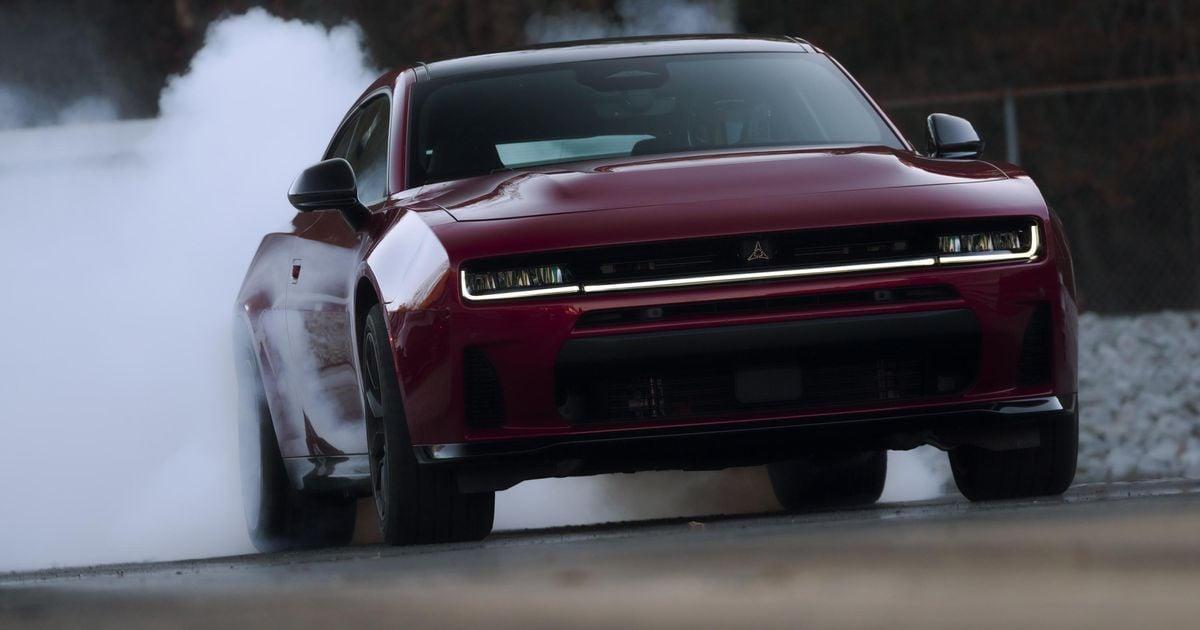

When Dodge launched the new-generation Charger with electric power only, the reaction from its traditional customer base was immediate and loud. The nameplate synonymous with thundering V8s had arrived in showrooms with a battery and a motor, and buyers who had grown up with the sound and fury of a Hemi under the bonnet weren't impressed.
Stellantis has heard the feedback. The Dodge Charger SRT is coming, and it will carry the supercharged 6.2-litre Hellcat V8.
The Hellcat Returns
The announcement came from Stellantis during an Investor Day presentation, followed by a behind-the-scenes media preview at the company's Auburn Hills, Michigan design facility. No photos were permitted, but the confirmation was clear: the Charger SRT variant will use the supercharged Hellcat V8 that powered the last generation of the car.
In its previous application, the Hellcat V8 produced 527kW and 881Nm of torque. In the more extreme Redeye variant, that climbed to 594kW and 959Nm. For comparison, the most powerful current electric Charger Daytona produces 470kW and 850Nm, and the twin-turbocharged Hurricane petrol inline-six tops out at 410kW and 720Nm.
The SRT variant will reportedly feature more aggressive front-end styling, a prominent bonnet scoop to feed the supercharged engine, and a large rear wing described as reminiscent of the Plymouth Superbird and original Dodge Charger Daytona of the late 1960s. It's designed to look as extreme as it performs.
The new Charger SRT is due on sale before 2030.
A New Sports Car Called Copperhead
The Charger SRT isn't the only new performance model confirmed. Stellantis also previewed a new sports car called the Copperhead, the brand's first dedicated sports car since the Viper was discontinued. Like the SRT Charger, media were shown the car but not permitted to photograph it.
The preview description from journalists present suggests a proper two-door coupe with long bonnet proportions and a dramatic rear wing. Tim Kuniskis, Stellantis' head of American brands, was explicit that the Copperhead is not a variant of the existing Charger.
"Not the hard points of a Charger. You couldn't get a Charger with those proportions and that stance because of the multi-energy design of where the battery is encapsulated in the bottom of the car," said Kuniskis.
The Copperhead will also receive an SRT variant. Kuniskis was coy about what would power it, but confirmed it will have a combustion engine and hinted at a possible hybrid V8 arrangement.
"It would have a combustion engine. Don't really know what it would be yet at this point. We have some ideas and some things that we're kicking around. It could be something that you're not aware of. It could be something that doesn't exist today," he said.
What SRT Actually Means
SRT has existed within the Chrysler-Dodge-Jeep family since 2004. It started as a standalone performance marque and later became a premium package designation. Kuniskis was clear about what the badge requires to earn its place.
"We have very specific rules for SRT and what they have to be for the powertrain, for the interior, for the suspension, for the user experience," said Kuniskis.
Importantly, SRT isn't necessarily synonymous with V8s. Previous non-V8 SRT vehicles include the Chrysler Crossfire SRT-6 (supercharged V6) and the Dodge Neon SRT-4 (turbocharged four-cylinder). But in the context of the Charger, the Hellcat V8 is the natural culmination of the SRT promise.
Kuniskis was also clear that SRT variants have to help sell the broader model range, not just exist as halo cars.
"I wouldn't take a Hornet with a small internal combustion engine and say, 'You know what? I'm going to put a V10 in it and it's going to be awesome. It doesn't do anything. It doesn't sell other Hornets. It has to trickle down. If it doesn't trickle down, it's not going to work."
That's a commercially astute position. Performance variants that are too extreme to sell in meaningful volumes drive showroom traffic but don't convert to transactions. The SRT formula works when it creates aspiration for the full lineup.
The Broader Stellantis Performance Offensive
The Charger SRT and Copperhead aren't standalone announcements. Stellantis is rebuilding the performance credentials of its entire American brand portfolio.
Jeep's Wrangler Scrambler will receive an SRT variant. The Ram Dakota pickup, a smaller Ranger-class ute confirmed for development, will also get an SRT treatment. The Dodge GLH hot hatch will open the brand's range at the affordable end, replacing the discontinued Hornet and riding the new STLA One platform.
The Durango SUV will continue with its V8 as the primary powertrain option. It's the last of a dying breed of large, V8-powered American family SUVs sold outside of North America, but for buyers who want that configuration, Durango remains the answer.
Chryler is also being repositioned. The brand will expand with the Airflow medium-to-large crossover, plus smaller models called the Arrow and Arrow Cross, which will be rebadged versions of the Fiat Grizzly. Chrysler, Dodge, Jeep, and Ram vehicles are sold alongside each other at combined dealerships in North America, so the combined portfolio renewal has a strategic logic to it.
What Does This Actually Mean for Buyers in Australia?
Here's the honest answer: not much directly. Dodge exited the Australian market in 2016. There are currently no official Dodge products on sale here, and the brand's North American leadership hasn't indicated any plans to return.
For Australian buyers who grew up coveting the Charger nameplate but never had the chance to own one locally, this news carries emotional weight without practical purchase implications. Dodge will sell the Charger SRT in North America and potentially a handful of other markets. Australia is not on that list.
However, there's a parallel story here that is relevant to Australian muscle car enthusiasts. The supercharged Hellcat V8 in various displacements already exists in the RAM 1500 TRX, which is importable to Australia via the specialist vehicle scheme. If Stellantis brings the Charger SRT to right-hand-drive markets at any point, or if the powertrain finds its way into a RAM or Jeep product sold here, the Australian angle opens up.
For now, the Ford Mustang remains the primary V8 muscle car choice in Australia. The GT trim packs a 5.0-litre V8 with 338kW, and unlike the Dodge Charger, it's officially imported and fully supported by the dealer network.
The Symbolism of This Announcement
Beyond the specifications, there's a broader message in Dodge's decision to revive the Hellcat V8. The brand had been gradually moving toward electrification, driven by regulatory pressure and Stellantis corporate strategy. The launch of the electric Charger Daytona was framed as the brand's future. The backlash from Dodge's core buyer base was swift and sustained.
The reversal is significant. Stellantis has decided that Dodge's identity as a raw, V8-powered, driver-focused brand outweighs the incremental gains from a fully electric transition. Kuniskis' language at Investor Day was unambiguous:
"Dodge will literally be back on track, literally and figuratively, by the end of the plan, and Dodge will be restored to its proper position, and we will recover the number one selling muscle car title."
That's a direct shot at the Ford Mustang, which has held that title during the period Dodge has been in transition. Whether the Charger SRT, Copperhead, and performance GLH can collectively unseat Mustang's market position in North America will be one of the more compelling automotive rivalries of the late 2020s.
The EV Charger Isn't Going Away
It's worth being clear: the electric Charger Daytona isn't being cancelled. It launched to solid sales figures among buyers who were already EV-converted. The SRT Hellcat variant is an addition to the range, not a replacement for it.
Stellantis is pursuing a multi-energy strategy across its brands. Some Dodge buyers want a screaming V8. Some want instant-torque electric performance. The brand will now serve both explicitly, rather than forcing either group to compromise.
For enthusiasts who value authenticity over environmental optics, the return of the Hellcat is a genuine reason to pay attention to the Charger lineup again. The spec sheet will matter when it's released. But the announcement alone has achieved something equally valuable: it's made Dodge relevant to its core buyers again.
When Will It Arrive?
The Charger SRT is confirmed for launch before 2030. Given typical Stellantis product development cycles and the fact that the basic Charger platform is already in production, a 2027 or 2028 market launch in North America is plausible. Exact timing hasn't been confirmed.
The Copperhead sports car is also pre-2030, though its development appears to be at an earlier stage. The GLH hot hatch is expected sooner, positioned as the entry-point that rebuilds Dodge's showroom traffic while the bigger models come to market.
For anyone keeping a long-term list of imports to watch, the Charger SRT is worth monitoring. If it arrives in right-hand-drive form in any market, the grey-import pathway to Australia exists. Given the appetite for big American V8s among a dedicated cohort of local buyers, demand won't be a problem.
Considering finance for your next car? Loanseekers can help you explore car loan options.
The finer details
Your questions answered.
Is the Dodge Charger SRT Hellcat coming to Australia?
No. Dodge exited the Australian market in 2016 and currently only sells vehicles in North America and the United Arab Emirates. There are no confirmed plans to return to Australia. The Charger SRT will be a North American market model when it launches before 2030.
How much power does the Dodge Charger Hellcat V8 make?
In the previous-generation Charger, the supercharged 6.2-litre Hellcat V8 produced 527kW and 881Nm of torque. The more extreme Redeye variant made 594kW and 959Nm. Exact output for the new SRT application hasn't been confirmed yet.
What is the Dodge Copperhead sports car?
The Copperhead is a new two-door sports car from Dodge, the brand's first dedicated sports car since the Viper. It will have its own SRT variant and is due before 2030. Stellantis has shown journalists the car but hasn't released photographs or confirmed full specifications yet.
Will the Dodge Charger SRT replace the electric Daytona?
No. The electric Charger Daytona is staying in the lineup. The Charger SRT with the Hellcat V8 is an addition to the range, not a replacement. Stellantis is pursuing a multi-energy strategy, keeping electric options for buyers who want them and adding the V8 for traditional muscle car buyers.
What V8 performance cars can Australian buyers buy right now?
The Ford Mustang GT is the main option, packing a 5.0-litre naturally aspirated V8 with 338kW and available in coupe and convertible form from Australian dealers. The Ram 1500 TRX is importable via specialist vehicle schemes with its 525kW Hellcat V8, though at significant cost.
When will the Dodge Charger SRT with the Hellcat V8 go on sale?
Dodge has confirmed it will launch before 2030. Given the existing Charger platform is in production, a 2027 or 2028 North American launch is plausible. No exact date has been confirmed, and Australian availability is not planned based on current information.