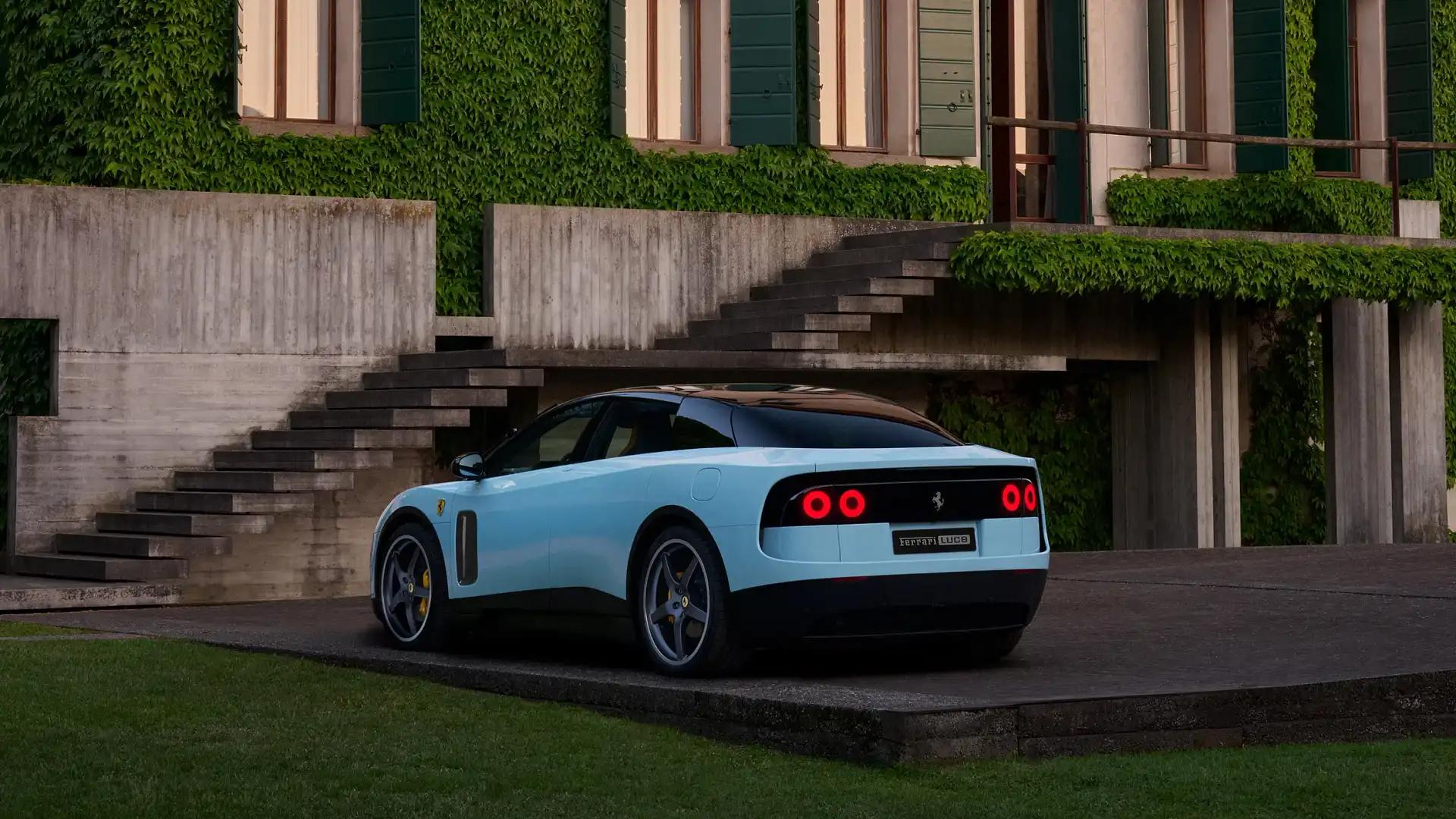
Ferrari has finally pulled the cover off its first all-electric car, and the 2027 Luce is unlike anything the Prancing Horse has built before. Five years of secrecy ended with the unveiling of a five-door, five-seat super sedan styled by Jony Ive and Marc Newson's LoveFrom design house, the same pairing behind the iPhone and Apple Watch.
The headline numbers are eye-watering. The Luce makes a peak 772kW, sprints from 0 to 100km/h in 2.5 seconds, hits 200km/h in 6.8 seconds, and claims over 500km of driving range from a 122kWh battery pack. It also marks the first time Ferrari has built a five-seater, breaking decades of two-seat and four-seat orthodoxy.
What the Luce actually is
This is not a hypercar. Ferrari is calling the Luce a hyper-efficient luxury saloon, and it is positioned as a brand-new entry point for buyers who want a Ferrari but never wanted a mid-engine coupe. It will sit alongside the brand's petrol and hybrid models rather than replace them, which is the line Ferrari has been pushing to existing owners.
At 5026mm long, 1999mm wide and 1544mm tall, the Luce is marginally longer than the Purosangue SUV but lower and narrower. The battery in the floor drops the centre of gravity by 95mm compared with that SUV, which Ferrari claims gives it sports-car body control despite the size.
The Jony Ive design is the story
Buyers will either love or hate the look, and Ferrari knows it. The Luce wears a near-seamless 'shell' of aluminium panels with a kammtail rear and floating aero surfaces that double as spoilers. Even the wiper design has been re-engineered for slipperiness, and the Cavallino badge can be specced as a laser-etched flush element to reduce drag.
The wheels are the largest ever fitted to a road-going Ferrari, with 23-inch fronts and 24-inch rears wrapped in bespoke Pirelli rubber. Brakes are carbon-ceramic as standard. A structural rear C-pillar element, similar to a Porsche 911 Targa hoop, can be configured in carbon or body colour.
Inside is where Ive's fingerprints are clearest
The cabin is the cleanest case yet that Apple alumni are reshaping how car interiors are built. The driver display sits in an iPhone-style aluminium housing with two layered OLED panels behind glass, presenting three circular dials, including a real mechanical needle that sweeps 360 degrees for the speedo. The colours shift depending on which Manettino mode the car is in.
Ferrari has resisted the rest of the industry's slide into touch-only controls. There are physical toggles for climate, a glass dial for volume, a swivelling central screen, and a mechanical instrument in the top right that flips between clock, compass and stopwatch with a single button press.
Twelve motors and a 122kWh battery
The Luce runs on an 800-volt architecture with a 122kWh battery and accepts up to 350kW DC charging through ports on both sides. Inside the architecture sit 12 electric motors, three per wheel. Four motors drive the car, the other eight handle suspension damping and steering control on the fly.
Front motors deliver 210kW and 280Nm, the rears push out 620kW and 710Nm. Torque at the motors tops out at 990Nm, but step-down gearing per wheel multiplies that to a staggering 11,500Nm at the contact patches. In Range mode the front motors decouple entirely to extract maximum efficiency, which is how Ferrari is claiming over 500km of range with this much firepower on tap.
What Australian buyers should actually be thinking about
Ferrari has not yet confirmed Australian pricing or delivery timing for the Luce, but expect both to land late, expensive, and tightly allocated. Existing Ferrari customers will get first dibs, and the Luce is being positioned as a brand-entry product offshore, which usually means even longer wait lists at the bottom rung.
This is also a car designed to bring in buyers who would otherwise be looking at a Porsche Taycan or a Mercedes-AMG GT 4-Door EV. If you have been considering one of those, the Luce is now the third option in that segment, and the only one badged Ferrari. Carseekers expects local price tags to start well above $500,000 before on-road costs and options, with most buyers spending considerably more once the personalisation catalogue opens.
The bigger picture for Ferrari
The Luce arrives at a moment when global enthusiasm for ultra-luxury EVs has cooled. Porsche has admitted the Taycan is selling under expectations, and electric versions of Bentleys, Lotuses and Maseratis are quietly slipping their launch dates. Ferrari is launching this one anyway, because it sees electric power not as a replacement but as a parallel offering for a different buyer.
The gamble is that the Jony Ive halo, the five-seat practicality, and the hyper-tech interior will tempt people who currently put their money into Range Rovers, Bentaygas and AMG sedans rather than mid-engine V8s. The risk is that traditional Ferrari buyers see it as a betrayal of the brand's identity. From the early reaction, both camps are already vocal.
What to do if you are interested
For Australian buyers, the practical answer is: register your interest with Carseekers and your local Ferrari dealer now, accept that allocations will be small, and assume the first delivery slots will go to existing owners with long buying histories. Walk-in orders at retail are not how this market works, and Ferrari's price walk on options can easily add six figures to the sticker.
If you are not in the Ferrari club already, the Luce is unlikely to change that quickly. But it is a useful signal of where the very top of the market is heading, with Apple-style design language, hyper-efficient packaging, and a willingness to break with brand orthodoxy that we have not seen at this price point before.
How the Luce slots into Ferrari's broader strategy
Ferrari has been clear about its long-term plan: build petrol, hybrid and electric cars side by side, and let buyers self-select. The Luce is the EV pillar of that strategy, sitting alongside the V12 12Cilindri, the V8 296 GTB hybrid, the V12 Purosangue SUV, and the next-generation models still in development. Crucially, Ferrari is not phasing out combustion engines, the Luce is being positioned as a new revenue stream rather than a replacement for anything in the lineup.
That distinction matters because it sets expectations for what Ferrari does next. Expect a second electric model within three to four years to broaden the EV lineup, but expect petrol and hybrid Ferraris to continue for the foreseeable future. The brand's leadership has been explicit that V12 production will continue, regardless of what regulators in Europe and California eventually require.
What the cabin tech signals for the wider industry
The Luce's interior is going to be studied by every other premium-brand product planner for the next two years. Several specific design decisions stand out as deliberate counter-moves against the current industry direction:
- Physical climate controls, a glass volume dial, and tactile drive-mode switches. Ferrari is openly admitting that touch-only interfaces are about cost-saving, not driver experience. - Layered OLED displays behind glass, with a real mechanical needle for the speedometer. This is a deliberate fusion of digital flexibility and analogue craft. - A swivelling central screen with a physical aluminium handle, which the passenger can angle toward themselves without going through a menu. - A roof-mounted launch-control "plug" handle that triggers the 2.5-second sprint sequence, complete with cabin lighting and instruction prompts.
Expect Porsche, AMG, Bentley and Aston Martin to quietly start specifying physical controls again in their next product cycles. Ferrari is leading the swing back, and the rest of the industry will follow because the alternative is owners complaining about distracted-driving issues.
The wider EV super-sedan context
The Luce arrives in a market that has not exactly welcomed luxury EVs with open arms. The Porsche Taycan has missed targets, the Mercedes-AMG EQS has been a notorious slow seller, and Lotus, Bentley and Maserati have all quietly slipped their EV launch schedules. Buyers at this price point have not embraced electric the way EV advocates predicted.
Ferrari is launching the Luce anyway, and is positioning it not as the future of Ferrari but as a parallel product. The five-seat layout is the key tell. The Purosangue SUV is already selling beyond Ferrari's planning targets, partly because it gives existing owners a usable family car. The Luce extends that logic, a Ferrari you can use for school runs, airport pickups, and long-distance touring without compromising the brand experience.
If that positioning works, the Luce will broaden Ferrari's customer base rather than cannibalising existing buyers. If it fails, it becomes a niche curiosity sold to Apple alumni and tech founders rather than core Ferrari enthusiasts. Either way, the car gives Ferrari a credible answer when buyers ask what its EV plan is, and that is increasingly important for the brand's positioning in California and Europe.
What this means for Australian Ferrari dealers
Australian Ferrari dealers will not see meaningful Luce volume until 2028 at the earliest. The initial allocation will go to Europe and the Middle East, with the US and Asia following, and right-hand-drive markets falling behind that. Australia will likely see fewer than 50 Luce deliveries in its first full year of sales.
For dealers, this is both an opportunity and a complication. The opportunity is that Luce gives them a new conversation with EV-curious luxury buyers who might otherwise have walked into a Porsche or Mercedes showroom. The complication is that allocations will be tightly controlled by Ferrari head office, and the long wait list means dealers will need to keep customers warm for years between order and delivery.
Buyers should expect their dealer to ask for substantial deposits well in advance of build slots being confirmed, and to require existing Ferrari ownership history before being moved up the queue. This is how Ferrari has always done it, and the Luce will not change the playbook.
Final read
The Ferrari Luce is the most interesting car the brand has launched in a decade, not because of its powertrain, but because of how comprehensively it breaks with Ferrari design tradition. Jony Ive's design team has produced a car that looks like nothing else on the road, with an interior that puts a stake in the ground against the touch-screen drift the rest of the industry has been doing. The combination of mechanical detail and digital flexibility could become the new luxury template.
For Australian buyers, the practical message is simple: this is real, it is coming, and the line forms early. If you are serious about owning one, the conversation with your dealer principal should start now. If you are not in the Ferrari club, the Luce gives you a clear early signal of where the very top of the market is heading, which is useful intelligence even if the car itself is out of reach.
Considering finance for your next car? Loanseekers can help you explore car loan options.
The finer details
Your questions answered.
Is the Ferrari Luce coming to Australia?
Ferrari has not yet confirmed an Australian on-sale date for the Luce, but the brand sells most of its global models locally, so expect a delayed but eventual launch. First Australian deliveries are likely from 2027 at the earliest, with allocation prioritised for existing Ferrari owners.
How much will the Ferrari Luce cost in Australia?
Ferrari has not released Australian pricing, but Carseekers expects the Luce to start well above $500,000 before on-road costs, with most cars selling for considerably more once Tailor Made personalisation and options are added. Local luxury car tax and import duties will widen the gap to international list prices.
How fast is the Ferrari Luce?
The Luce hits 100km/h in 2.5 seconds and reaches 200km/h in 6.8 seconds, thanks to 772kW of peak power and four drive motors. Torque measured at the wheels is around 11,500Nm because each wheel has its own step-down gearbox, which is the underlying trick Ferrari is using to make a heavy EV feel light.
How does the Ferrari Luce compare to a Porsche Taycan or AMG GT 4-Door EV?
The Luce has more power, more range, and more brand cachet than the Taycan Turbo S, and it brings a five-seat layout that neither Porsche nor Mercedes-AMG currently offers. It will cost roughly double, however, and allocations will be far smaller. For most buyers, the Taycan and AMG remain the realistic alternatives.
What range does the Ferrari Luce offer?
Ferrari claims over 500km of driving range on the WLTP test cycle from a 122kWh battery pack. The car runs on an 800-volt architecture and accepts up to 350kW DC fast charging through ports on both sides of the car, putting it among the fastest-charging EVs on sale.
Will Ferrari still build petrol cars after the Luce?
Yes. Ferrari has been explicit that the Luce sits alongside the brand's petrol and hybrid models rather than replacing them. The naturally aspirated V12 remains in the line-up, and new combustion-powered Ferraris are still being developed. The Luce is positioned as a new buyer entry point, not a successor to anything.