Diesel is now well past $3 a litre in parts of Australia, and ute brands are scrambling to keep order banks moving. The latest is JAC, which has just announced a $4000 fuel card across the entire T9 dual-cab 4x4 range, valid until June 30. On paper that is roughly 21 tank fills, or more than 21,500km of driving. In a normal year, that would be a generous sweetener. In 2026, it is starting to look more like a defensive move from a brand that needs the showroom traffic.
The T9 is JAC's answer to the Ford Ranger, and Ford was first out the gate with the same $4000 fuel card play on certain Ranger and Everest variants. Now JAC is matching it, and we expect more brands to follow as the diesel crunch drags on. For buyers, that is genuinely good news, but only if you understand what is actually being offered and what is being held back.
What you actually get for $4000
The fuel card is available across the full T9 lineup, which now spans six grades: two dual-cab/chassis variants and four dual-cab pickups. Every one of them runs a 78-litre tank and a claimed 7.6L/100km combined. According to the New South Wales Government's FuelCheck website, the average diesel price right now is 245.3 cents per litre, so $4000 fills the T9 about 21 times.
Do the maths against the claimed combined consumption and that is enough fuel for roughly 21,500km of driving. For a tradie covering big distances, that is real money. For a weekend warrior who tows a trailer twice a year, it is more like a free year of commuting.
The more interesting wrinkle is that JAC will let you take the offer as a cash discount off the purchase price instead. That changes the calculation completely, because it gives you actual leverage at the desk rather than a voucher tied to JAC's preferred fuel partner.
Why the cash option matters more than the fuel card
A fuel card looks generous in the brochure. In practice it locks you into a specific provider, ties up the value over time, and only pays out if you actually use the vehicle the way the manufacturer assumed you would. Take the cash and you keep all the optionality.
It also lets you stack the discount against the rest of your negotiation. A $4000 cash deduction from the listed price compounds with whatever the dealer can move on accessories, paint protection, finance margin, and trade-in over-allowance. A fuel card, on the other hand, is presented as a fixed item the dealer cannot negotiate around.
Walk in already knowing you want the cash version and you take a bargaining chip out of the dealer's hand. That is the right way to use this kind of promotion.
The pricing on every T9 variant
If you are seriously considering the T9, here is the lineup as it stands. Every grade is dual-cab 4x4, every grade is powered by the same 120kW/410Nm 2.0-litre four-cylinder turbo-diesel paired with an eight-speed automatic, and every grade comes with the $4000 fuel card or cash equivalent until June 30.
The entry-level Tradepro cab/chassis is priced from $38,990 before on-road costs. The Oasis cab/chassis steps up to $41,162 before on-roads and adds leather-accented seat trim. The Oasis dual-cab pickup also starts at $41,162 plus on-road costs and brings in LED headlights, side steps, and a powered driver's seat.
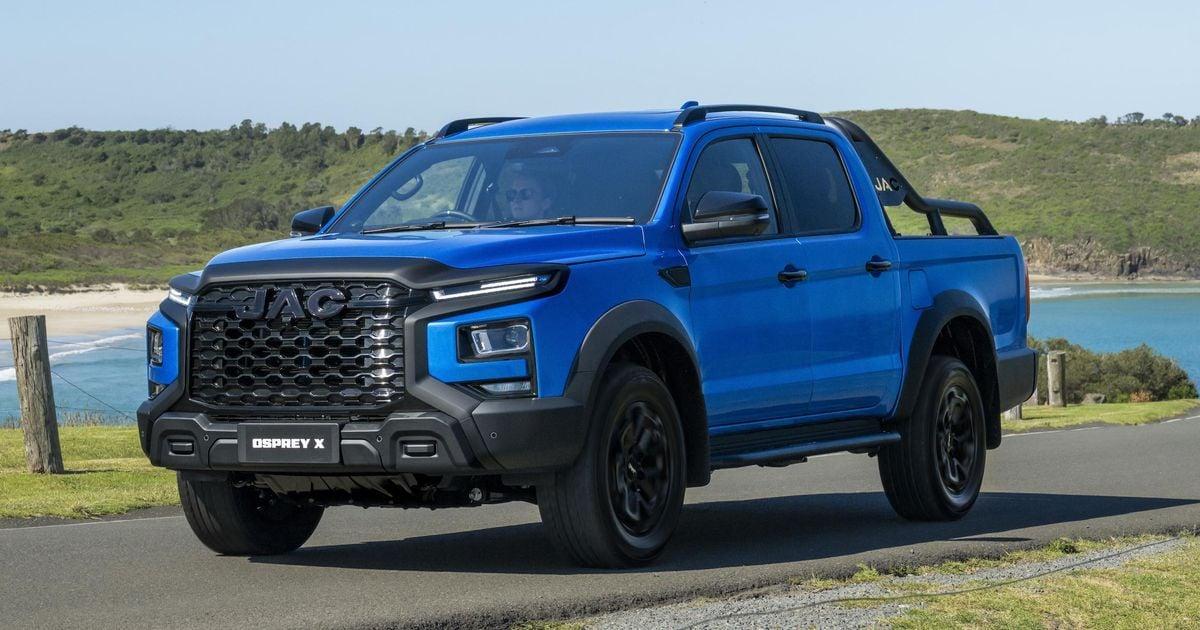
The mid-range Haven is $45,630 plus on-road costs and adds power mirrors, roof rails, rear privacy glass and a powered front passenger seat. The Osprey is $46,629 plus on-roads, and the range-topping Osprey X tops out at $47,079 plus on-roads with black exterior detailing and a power sunroof.
Payload sits between 980kg and 1165kg depending on variant, and braked towing capacity is 3200kg across the board. That is 300kg short of the 3500kg figure that Ranger, HiLux and Triton buyers expect, which is the single most important spec to be aware of if you tow a heavy van or trailer.
How the T9 stacks up against the Ranger
The Ranger is the benchmark every new ute in Australia is measured against, and JAC knows it. The T9 undercuts the Ranger on price, even before the fuel card discount, but it also undercuts it on towing capacity, on resale, and on dealer network density. That gap matters when you live more than an hour from a metro service centre.
Ford's own $4000 fuel card was applied to specific Ranger and Everest variants, not the entire range, and Ford has since gone further by cutting Ranger PHEV pricing by as much as $10,000. That is a much sharper move, and it tells you Ford is actively defending the segment from the Chinese newcomers.
If you are cross-shopping, do not just compare drive-away prices. Build out a five-year ownership cost including servicing, tyres, depreciation and resale before you sign anything. The T9 will look great on day one. The Ranger usually wins the long-term sums.
The Hunter PHEV is the real story coming next
JAC's bigger play is the JAC Hunter PHEV, which is days away from opening reservations and will land in Australian showrooms later in 2026. The Hunter is the model that will actually take a swing at the BYD Shark 6 and the GWM Cannon Hi4-T PHEV, as well as the new Ranger PHEV.
If you are shopping the diesel T9 right now, it is worth knowing that the brand's flagship plug-in hybrid is months away. Diesel buyers do not necessarily care, but if you have any flexibility around fuel type, the PHEV utes coming this year will reset the segment's running costs in a way no fuel card can match.
What dealer behaviour to expect
When the headline is "free fuel", the temptation for a dealer is to hold firmer on everything else: drive-away charges, dealer delivery, finance rates, trade-in valuations. That is where the real margin sits, and that is where most buyers leak money on a deal that looks great on the front sticker.
Go in with three things prepared. First, get a written competing quote from at least two other utes in the segment. Even if you do not want a Ranger, the price they will give you on a Ranger is the only thing that will make a JAC dealer sharpen their pencil. Second, lock in a finance pre-approval from your own bank or broker before you walk in, so you can ignore the dealer's finance pitch entirely. Third, demand the cash version of the offer, in writing, before you start negotiating accessories or trade.
Do all three and the $4000 starts working for you instead of for JAC. If you would rather have the Carseekers team do that pricing pressure for you, that is what we exist for.
Should you buy now or wait?
The pragmatic answer depends on your timeline. If you genuinely need a ute before the end of June, the T9 with the cash discount option is one of the sharpest deals on the market right now. If you can wait, the JAC Hunter PHEV, the new Ranger PHEV pricing, the GWM Cannon Hi4-T and the BYD Shark 6 cab/chassis variants are all due to crystallise within months.
Fuel prices are not retreating quickly. The promotional pressure on diesel utes is going to keep rising. Buyers who hold their nerve through winter will likely see better drive-away pricing than what is on the table today, even with the fuel card factored in.
The T9 is a credible ute at a sharp price. The $4000 fuel card is real value if you take the cash. Just do not let the headline distract you from the rest of the deal.
Considering finance for your next car? Loanseekers can help you explore car loan options.
The finer details
Your questions answered.
How does the JAC T9 $4000 fuel card offer work in Australia?
JAC is offering $4000 in fuel value across the entire T9 dual-cab 4x4 range until June 30. You can take it as a fuel card, or, more usefully, as a $4000 cash discount off the listed purchase price. It applies to all six grades from the Tradepro cab/chassis through to the Osprey X.
Is the JAC T9 cheaper than a Ford Ranger?
Yes, the T9 starts at $38,990 before on-roads, well below an equivalent Ranger 4x4. The trade-off is a 3200kg braked towing capacity versus 3500kg on the Ranger, plus a thinner dealer network. Once you factor in resale, servicing and ownership costs over five years, the price gap narrows considerably.
How much can the JAC T9 tow?
Every JAC T9 variant has a braked towing capacity of 3200kg and a payload of between 980kg and 1165kg. That is 300kg short of the 3500kg towing benchmark set by the Ford Ranger, Toyota HiLux and Mitsubishi Triton, which matters if you regularly tow a heavy van or boat trailer.
Should I take the fuel card or the cash discount on the JAC T9?
Take the cash. A $4000 deduction from the purchase price gives you full flexibility, lets you stack the discount against accessories and finance, and avoids being locked into a single fuel provider. The fuel card is only better if your annual diesel spend is high and you would otherwise leave the value sitting on the dealer's desk.
When does the JAC T9 fuel offer end?
The promotion runs until June 30, 2026, across all T9 grades. Given fuel prices in Australia have not retreated, expect either a renewal or a similar offer from a competing brand soon after. If you are not pressed for time, watching what JAC and Ford do in July is worthwhile before locking anything in.
Is it worth waiting for the JAC Hunter PHEV instead of buying a T9?
If you can wait, yes. The JAC Hunter PHEV opens reservations imminently and will arrive in Australian showrooms later in 2026 to rival the BYD Shark 6, GWM Cannon Hi4-T and Ranger PHEV. A plug-in hybrid ute will reset running costs in a way no fuel card promotion on a diesel can match. If you need a ute before then, the T9 with cash discount is still a sharp deal.