
Lotus has quietly shelved its all-electric roadmap and pivoted to a hybrid V8 flagship that could produce more than 745kW. The car is internally called the Type 135 and is widely expected to revive the Esprit nameplate. It is the most significant Lotus product decision since Geely took over, and it changes what a future Lotus showroom looks like for Australian buyers.
Lotus CEO Qingfeng Feng confirmed the powertrain in a recent interview. The Type 135 will use a brand-new twin-turbocharged V8 derived from a 3.0-litre V6 developed by Horse Powertrain, the Geely and Renault joint venture. The V6 makes up to 400kW on its own and weighs just 160kg. The V8 variant, paired with hybrid assistance, is expected to deliver well beyond that figure.
Why this matters more than the spec sheet
Lotus has spent the last decade trying to escape an awkward problem. Its only current combustion model, the Emira, runs externally sourced engines from Toyota and Mercedes-AMG. That left Lotus paying a margin to use someone else's hardware and losing the engineering identity that built the brand in the first place.
Feng's argument is straightforward. An in-house powertrain finally lets Lotus chase the kind of performance numbers Ferrari, Lamborghini and McLaren take for granted. Without it, the brand was capped. With it, the Type 135 can credibly play in the supercar segment, not the sports car one.
F1-style energy recovery, not a plug-in
This is where the Type 135 gets interesting. Rather than a plug-in hybrid arrangement with a large battery, Lotus is going with a small battery and an energy recovery system closer in concept to Formula 1 kinetic energy harvesting. Energy is captured under braking and redeployed for acceleration.
That is a deliberate philosophical choice. Plug-in supercars from rivals carry a serious weight penalty, often well over 2.0 tonnes. Feng has been openly critical of that approach. His public line is that sports cars over 1.8 tonnes are "mediocre," which is a pointed comment about both the rival brands and the brand's own Eletre and Emeya SUVs.
All-wheel drive, but not the boring kind
All-wheel drive is on the table. Electric motors would power the front axle while the V8 drives the rears. Torque-vectoring software would vary power delivery depending on conditions, so the system can deliver maximum traction off the line without dulling the rear-drive feel buyers expect from a Lotus.
The chassis tech matches the powertrain ambition. Carbon-fibre and aluminium construction draws on lessons learned from the Evija electric hypercar. A new electronic architecture will run active suspension, continuously variable dampers and active anti-roll bars in real time. The platform is being built to scale across future Lotus performance products.
Design teaser hints at a cleaner direction
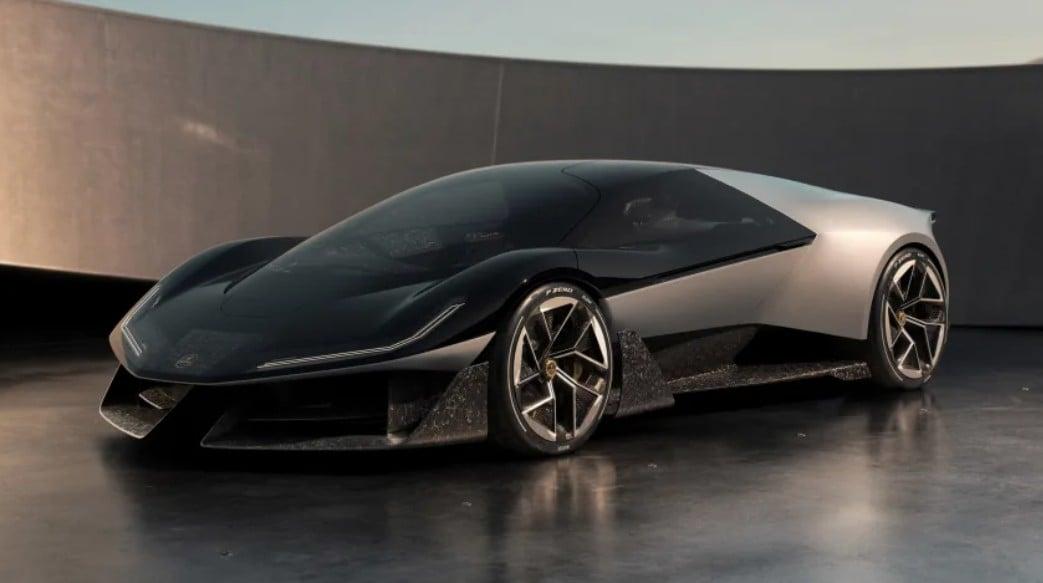
A recently released teaser image suggests the Type 135 will adopt a quieter, more restrained design language than the Evija. Expect a wide stance, minimalist rear lighting and aerodynamic elements integrated into the bodywork rather than bolted on. The car is being designed for the road, not for an auto-show stage.
Pricing and Australian availability
Lotus Australia has not commented on Type 135 pricing or timing. As a benchmark, the Evija lands above $3 million when ordered, and Lotus Cars Australia is positioning the brand toward Porsche, Mercedes-AMG and Ferrari territory. Expect Type 135 pricing to start in the high $500,000 range and climb past $700,000 with options. It will not be a car for mainstream buyers, but it will pull the entire Lotus brand upmarket.
This matters for buyers further down the lineup. As Lotus chases the supercar segment, the Emira will likely be pushed into a premium sports car bracket priced against the Porsche 718. Discounting and dealer flexibility may tighten as the brand moves more aggressively into low-volume, high-margin product.
What to watch next
Geely's involvement is the wildcard. The Type 135 is the first Lotus product where Geely engineering goes from chequebook to chassis. If the launch lands well, expect Geely to push more shared powertrain hardware into upcoming Lotus models. If it does not, the brand's hybrid pivot looks shakier than the announcement suggests.
For Australian buyers, the practical advice is simple. If you have a current Lotus on order, lock specifications now. Late-cycle Emiras and Eletres are likely to see better dealer flexibility as attention shifts to the Type 135. If you are considering a deposit on the Type 135 itself, ask local Lotus dealers for allocation transparency in writing before parting with cash. Carseekers tracks every price move and availability shift across the Lotus range so you don't have to take a salesperson's word for what is genuinely available.
Considering finance for your next car? Loanseekers can help you explore car loan options.
The finer details
Your questions answered.
Is the Lotus Type 135 coming to Australia?
Lotus Australia has not officially confirmed the Type 135 for local sale, but the brand has been growing its Australian dealer footprint with the Emira, Eletre and Emeya already on sale. A flagship of this significance is almost certain to be offered, likely in very limited numbers.
How much will the new Lotus Esprit cost in Australia?
Lotus has not announced pricing. Based on positioning against Ferrari and Lamborghini, expect Type 135 pricing to start in the high $500,000 range and climb beyond $700,000 with options once it reaches Australian showrooms.
What engine does the Lotus Type 135 use?
A brand-new twin-turbocharged V8 engine, developed by Horse Powertrain, the Geely and Renault joint venture. It is derived from a 3.0-litre V6 that already makes up to 400kW. Combined with hybrid electric motors, total output exceeds 745kW.
Is the Lotus Type 135 a plug-in hybrid?
No. Lotus has chosen a smaller battery and an F1-style energy recovery system instead of a plug-in setup. The goal is to save weight, which CEO Qingfeng Feng has identified as the biggest problem with most current hybrid supercars.
When will the Lotus Type 135 be released?
Lotus has not confirmed a launch date. Industry expectations point to a 2027 reveal with deliveries starting in 2028. Australian deliveries would likely follow six to 12 months behind European launches.
How does the Lotus Type 135 compare to the Ferrari 296 GTB?
On paper, the Type 135 will produce around 745kW versus the Ferrari 296 GTB's 610kW, but Ferrari has the brand heritage and dealer network advantage in Australia. The Lotus will likely undercut Ferrari on price while matching or exceeding it on performance, similar to how the Evija was positioned against the LaFerrari.