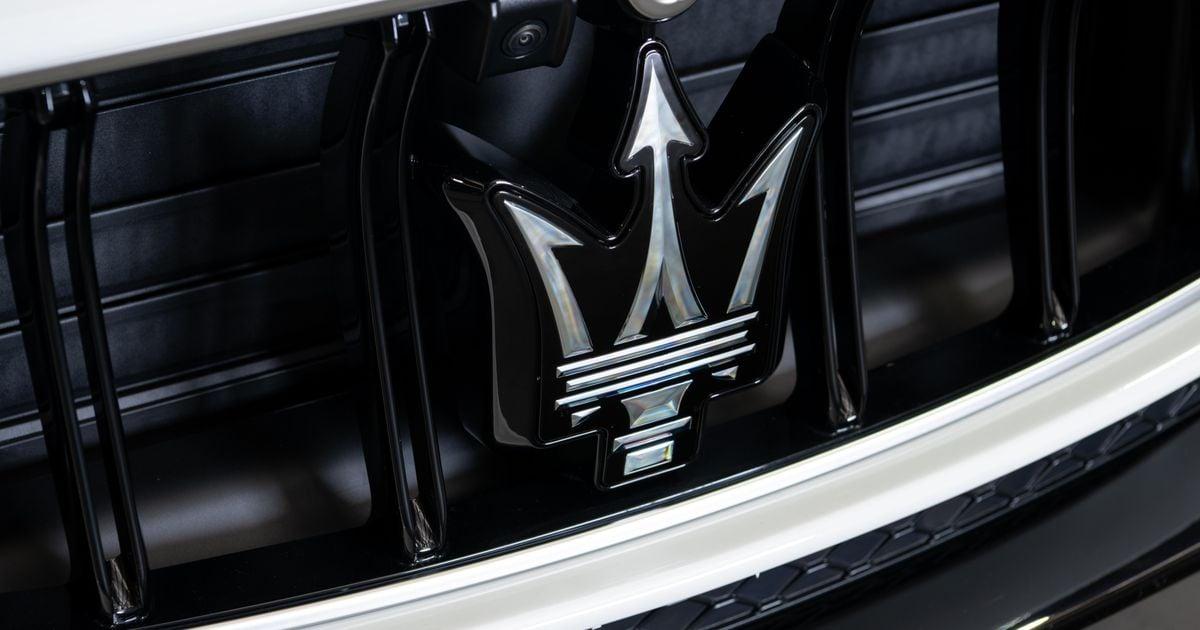

The most Italian of luxury brands could be about to do something unexpected. Maserati looks set to start building cars in China.
According to a report from CNEVPost citing Chinese outlet Yinjian Insight, parent company Stellantis is in advanced talks with Chinese tech giant Huawei and automaker JAC to produce a Maserati-badged electric vehicle in China. The model is scheduled for sometime in 2027.
No formal announcement has been made by Stellantis, Huawei or JAC, but the report claims discussions have been running since early 2025 and are well progressed. If accurate, this is one of the more significant strategic pivots the Italian brand has made in decades.
Who actually is Maextro?
The Chinese-market version of the project would wear the Maextro badge, not Maserati. Maextro is a joint venture between JAC and Huawei aimed at the very top end of the Chinese luxury market.
Maextro's first model was the S800, a full-size luxury sedan launched in 2025. It is offered as a pure electric vehicle and as an extended-range EV with a turbocharged 1.5-litre four-cylinder petrol engine running as a generator. Despite being a brand-new badge, the S800 has comprehensively outsold the Mercedes-Benz S-Class, BMW 7 Series and Audi A8 so far this year in China.
Maextro sold 1142 vehicles in April 2026 alone and has racked up 5465 sales in the first four months of the year. Maserati, by comparison, sold fewer than 1000 vehicles in China across the entire 2025 calendar year. That number tells you everything about why Stellantis is interested in this partnership.
How the Chinese-made Maserati would work
Under the proposed structure, each partner brings something specific. Maserati would handle exterior design and supply the brand endorsement, Huawei would lead technical development and provide the core platform, software and electrical architecture, and JAC would handle manufacturing.
Two versions are planned. The domestic Chinese-market car would be a Maextro. The export version, including for Australia and Europe, would carry the Maserati trident.
Details on the actual body style are vague. A sedan is the most likely outcome given Maextro's current flagship is the S800 luxury sedan and the report ties the project to a successor for the long-running Maserati Quattroporte. Powertrains would lean toward full electric and extended-range electric, with Huawei's expertise central to the package.
Why Maserati is in this position
This is not a vanity exercise. Maserati is in serious trouble. Global sales fell to 11,127 vehicles in 2025, down from 14,725 the year before and 26,689 in 2023. Australian sales told the same story, dropping to 264 in 2025 from 377 in 2024 and 638 in 2023.
Those are not the numbers of a healthy luxury brand. They are the numbers of a brand that has lost its narrative.
Stellantis has already revealed it would not include Maserati among the four key brands, Peugeot, Ram, Fiat and Jeep, that will receive the majority of investment under the group's revised strategy. There have been recurring reports the Italian brand might be sold off, with BYD, Xpeng and Xiaomi all linked to the asset at various points.
BYD executive vice president Stella Li has been quoted describing Maserati as 'very interesting' to her company, but added BYD had taken no action.
The Quattroporte question
Maserati had originally planned to launch an electric Quattroporte Folgore in 2025 as part of its abandoned commitment to drop combustion engines across the lineup. That launch was first pushed to 2028. More recent reports suggested the next Quattroporte might instead use plug-in hybrid power.
The proposed 2027 China-built model would arrive roughly in line with the new Quattroporte timing. It is not yet clear whether the Chinese-built car would replace the Quattroporte Folgore entirely or sit alongside an Italian-built petrol or PHEV version.
For Carseekers readers, the practical question is whether an Australian Quattroporte buyer would accept a car designed in Modena but built in Hefei. Recent data suggests Australian luxury sedan buyers are already showing they will accept Chinese manufacturing, with the Maextro S800 outselling its German rivals in the world's biggest luxury market.
Why this is happening across Stellantis
Maserati is not the only Stellantis brand being repositioned around Chinese partnerships. Last month Stellantis confirmed it would manufacture Peugeot models in China for export, with Australia and Europe both potential destinations.
Stellantis already has a joint venture with Leapmotor, and Opel and Vauxhall are developing a model based on Leapmotor architecture. Why look further afield for Maserati? Because Leapmotor has no experience in the luxury car market. Huawei and JAC, through Maextro, do.
There is a secondary motivation. Stellantis has been negotiating with Chinese brands to make use of spare manufacturing capacity at its European factories, including the Cassino plant in Italy where the Maserati Grecale SUV is built. A Chinese-built Maserati for export would help the strategic picture by freeing up Cassino capacity for higher-volume Chinese export models, while pushing the volume-critical Maserati EV production into a low-cost facility with deep electric vehicle experience.
What it means for Australian buyers
If you are already a Maserati buyer or considering becoming one, the practical impact in Australia is twofold.
First, the badge on the boot would remain Maserati. The dealer network, warranty terms and parts supply would all continue to flow through Maserati Australia. Stellantis is the financial parent on both sides of the deal.
Second, expect pricing to be more competitive than a hand-built Modena Quattroporte. Huawei's platform is already in use under the Maextro S800, which sells in China for the equivalent of roughly A$140,000 to A$200,000 depending on specification. An Australian Maserati-badged version would likely carry a premium over that but should undercut a comparable Mercedes-Benz S-Class or BMW 7 Series locally.
The risk for Maserati is reputational. Italian heritage is the brand's only real moat against the German luxury establishment, and decoupling the metal from Italy is a delicate proposition. The wider luxury market is still working out whether Chinese-built premium vehicles, even those with Italian or German nameplates, hold their residual values the way traditional luxury cars have.
Other Stellantis luxury moves to watch
Maextro will soon launch another model, the V800 people mover, and there is still room in its lineup for a Quattroporte-sized sedan under the 5.48m-long S800. The previous Quattroporte was 5266mm long, putting it neatly within Maextro's existing platform geometry.
That is the elephant in the room. The proposed Chinese-built Maserati would not just be a one-off, it could be the start of a broader platform-sharing program that produces multiple Maserati products from a single Huawei-engineered architecture.
Ferrari, McLaren and Lamborghini posted strong global sales in 2025, with Lamborghini in particular delivering 10,747 vehicles, a fifth consecutive record. Maserati needs a turnaround story. A China-built electric Quattroporte might be the most pragmatic version of one.
Bottom line
Watch for an official announcement from Stellantis. The report is not yet confirmed, but the strategic logic for both sides is strong. If the deal happens, Maserati moves from a slowly fading luxury icon to a brand with credible volume EV capability, and Huawei adds a globally recognised badge to its growing automotive tech footprint. Australian buyers would see a new Maserati flagship within roughly two years.
Considering finance for your next car? Loanseekers can help you explore car loan options.
The finer details
Your questions answered.
Will the next Maserati Quattroporte be made in China?
According to a Chinese media report, yes. Stellantis is in advanced talks with Huawei and JAC to build a Maserati-badged electric vehicle in China for export from 2027, with the same platform underpinning a Maextro-badged version for the local Chinese market.
When will the China-made Maserati arrive in Australia?
If the partnership is finalised, the new model is expected to launch in 2027. Australian buyers would receive it through Maserati Australia and the existing dealer network, with the trident badge intact rather than the Chinese-market Maextro nameplate.
Why is Maserati partnering with Huawei?
Maserati has no significant electric vehicle expertise of its own, and parent Stellantis ruled out Maserati as one of its four priority investment brands. Huawei provides the platform, software and electrical architecture, JAC handles manufacturing, and Maserati supplies the design and the badge.
How is Maserati performing in Australia?
Poorly. Australian sales fell to 264 in 2025, down from 377 in 2024 and 638 in 2023. The combined Chinese-built model strategy is partly an attempt to give the brand a competitive electric flagship that can rebuild Australian and global volume.
Will the Chinese-built Maserati be cheaper than current models?
Likely yes. The Maextro S800 sells in China for the equivalent of A$140,000 to A$200,000 depending on trim. An Australian Maserati-badged version should sit above that but well below a Mercedes-Benz S-Class. Final pricing has not been announced.
Should I wait for the new Maserati or buy a current model?
If you want a traditional Italian-built Maserati with combustion power, buy now. The current Levante, Grecale and GranTurismo lineup is the last of its kind. If you want electric power and longer range with the latest tech, wait for the 2027 model and the formal Stellantis announcement.