
Volkswagen has finally swung its full mainstream weight behind plug-in hybrid family SUVs in Australia. The Tiguan and Tayron eHybrid launch ranges are open for orders now, with EOFY drive-away pricing valid through 30 June 2026 making both surprisingly sharp on price.
What you actually pay
The entry Tiguan 150TSI eHybrid Elegance lists at $64,590 plus on-road costs, but is launched with a $63,990 drive-away offer. The flagship Tiguan 200TSI eHybrid R-Line steps up to $74,550 plus on-roads, or $73,990 drive-away.
The larger Tayron 150TSI eHybrid Elegance is $62,390 plus on-roads, dropping to $61,990 drive-away during the EOFY launch period. The Tayron 200TSI eHybrid R-Line lists at $76,550 plus on-roads, or $75,990 drive-away.
For reference, that puts the Tiguan eHybrid in direct competition with the Hyundai Tucson Hybrid, Toyota RAV4 Hybrid and Mazda CX-5, while the Tayron eHybrid is up against the Hyundai Santa Fe Hybrid, Kia Sorento Hybrid and Skoda Kodiaq.
The PHEV premium is just $3000
This is the line that matters. Volkswagen's Head of Product, Arjun Nidigallu, said the eHybrid pricing represents a $3000 premium over an equivalent petrol Tiguan for a vehicle with over 100km of EV range. "The $3000 uplift really gets a lot of people into that eHybrid," he told media.
For the Tayron, the catch is that the PHEV is front-wheel-drive only and skips the seven-seat option, because the battery sits in the boot floor. If you want all-wheel drive and seven seats, you have to step over to a petrol Tayron and forgo the plug.
The powertrain
Both Tiguan and Tayron eHybrid models share the same 1.5-litre turbocharged four-cylinder petrol engine paired with an electric motor and a 19.7kWh high-voltage battery. They are front-wheel drive only.
The Elegance grade makes 150kW and 350Nm combined, with a six-speed dual-clutch automatic. The R-Line steps up to 200kW and 400Nm, also with a six-speed DSG. Both grades quote a claimed combined fuel consumption between 1.6 and 1.8L/100km on the WLTP cycle, which heavily favours the battery side of the equation.
The real-world story will depend on how often owners actually charge. A driver who plugs in every night will see fuel consumption under 4L/100km on average. A driver who never charges will see fuel consumption closer to 8L/100km, the same as a non-hybrid petrol SUV with extra weight to lug around.
What you get inside
The Elegance grade comes with adaptive suspension (DCC Pro), keyless entry, leather-appointed front seats with heating, ventilation and massage, and a 12.9-inch touchscreen. Both Elegance models ride on 19-inch alloys.
The R-Line steps up to 20-inch alloys, R-Line interior and exterior styling, a larger 15-inch touchscreen and a 700-watt Harman Kardon premium audio system as standard.
Massage seats as standard at the Elegance grade is notable. Most rivals reserve that feature for the most expensive grade or charge thousands for it as an option.
Charging and home setup
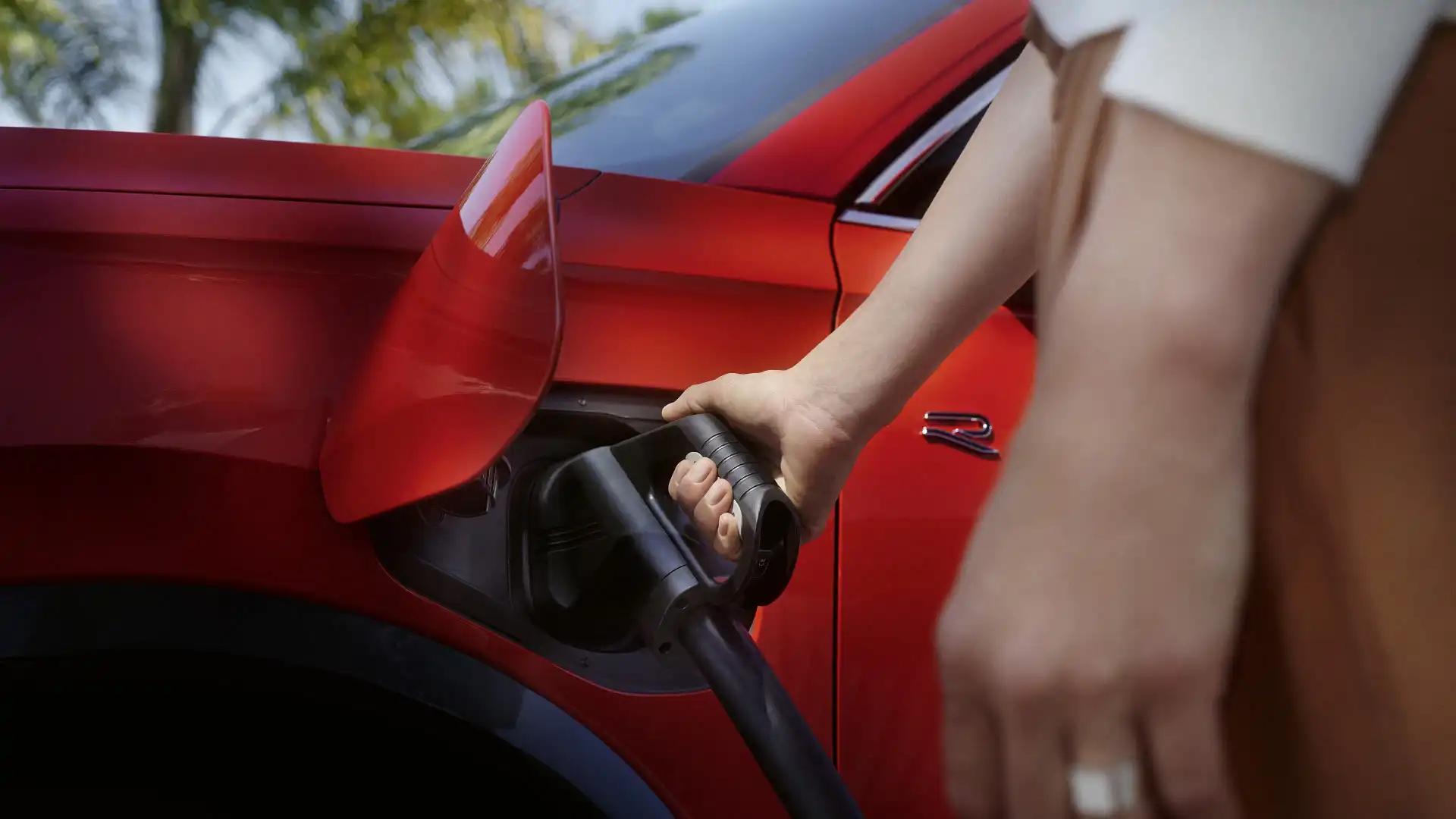
The 19.7kWh battery is big enough to handle most weekday commutes on electric power alone, and small enough to recharge overnight on a 7kW home wallbox in around three hours.
That is the practical sweet spot for Australian buyers, where a daily 30 to 50km commute can be done entirely on the battery, with the petrol engine reserved for longer trips and weekend driving.
Volkswagen has not pushed the DC fast-charging capability heavily in its launch materials, which is typical for PHEVs at this price. The battery is too small to benefit much from fast charging. AC home charging is the realistic use case.
Warranty
Both Tiguan and Tayron eHybrid are backed by Volkswagen's five-year, unlimited-kilometre vehicle warranty. The high-voltage battery is covered by a separate eight-year, 160,000km warranty.
Importantly, Volkswagen has confirmed the warranty does not require visiting only Volkswagen dealerships for logbook servicing. That is a significant departure from some manufacturer policies, and it gives owners flexibility to use independent specialist workshops without voiding cover.
Where it sits against the Toyota RAV4 PHEV
The Tiguan eHybrid's most obvious cross-shop is the Toyota RAV4. Toyota does not currently sell a PHEV RAV4 in Australia in volume, instead focusing on the hybrid. That means the Tiguan eHybrid is one of the cheapest plug-in mid-size SUVs Australian buyers can actually walk into a dealer and buy at the moment.
The Mitsubishi Outlander PHEV is the other main rival, priced from around $58,000 plus on-roads with a smaller battery and shorter electric range. The Tiguan eHybrid sits slightly above on price but ahead on range and refinement.
The Tayron's seven-seat problem
The biggest catch with the Tayron eHybrid is the lack of seven seats. The battery pack sits in the boot floor, displacing the third row. Tayron eHybrid is five-seat only.
That is a significant limitation for buyers who specifically picked the Tayron for family hauling. The seven-seat Tayron remains available as a petrol or diesel, but you give up the plug-in capability and the cost savings on commuting.
If seven seats and a plug are non-negotiables, you are now looking at the Kia Sorento PHEV or waiting for the upcoming BYD Ti7 seven-seat PHEV.
Dealer behaviour to watch
Volkswagen has been aggressive on dealer-funded discounts for the previous Tiguan generation. The launch drive-away pricing on the eHybrid is sharp, but there is still room to negotiate.
If you are walking into a dealer in June, ask for an additional cash discount on the published EOFY price, particularly on the higher-grade R-Line models where dealer margin is thicker. Stack any State Government EV incentives (currently still available in some states for PHEVs with sufficient electric range), and you can shave another $1500 to $3000 off the effective drive-away.
Do not pay full price for window tinting, paint protection or fabric protection on top. Those are still high-margin dealer add-ons that have not been touched by the manufacturer price cuts.
Should you buy now or wait
The EOFY launch pricing is genuinely sharp. The $3000 premium over an equivalent petrol Tiguan is a tighter PHEV premium than Volkswagen has ever offered in Australia.
If you have home charging available and a daily commute under 80km, the Tiguan eHybrid is the most compelling plug-in family SUV launch of 2026 so far. Buy now.
If you do not have home charging, or your daily driving is mostly highway, a regular Tiguan with the 110TSI petrol engine will be cheaper to buy and easier to live with. The PHEV's value proposition collapses if you cannot charge regularly.
For the latest dealer-by-dealer drive-away comparisons, Carseekers is tracking Tiguan and Tayron eHybrid offers across major Australian metros through the EOFY 2026 sales window.
Considering finance for your next car? Loanseekers can help you explore car loan options.
The finer details
Your questions answered.
How much does the VW Tiguan eHybrid cost in Australia?
The Tiguan 150TSI eHybrid Elegance lists at $64,590 plus on-roads but is offered at $63,990 drive-away during the EOFY launch period. The 200TSI eHybrid R-Line is $74,550 plus on-roads or $73,990 drive-away. The EOFY pricing is valid until 30 June 2026.
Does the VW Tayron eHybrid come with seven seats?
No. The Tayron eHybrid is five-seat only, because the plug-in hybrid battery pack occupies the boot floor where the third row would normally sit. The seven-seat Tayron remains available as a petrol or diesel but cannot be optioned with the eHybrid powertrain.
What is the electric range of the VW Tiguan and Tayron eHybrid?
Volkswagen has confirmed both eHybrids deliver over 100km of electric driving range on the WLTP cycle, using a 19.7kWh battery. Real-world Australian electric range is likely to sit closer to 80km to 90km, particularly on highway runs or in cold weather.
Is the VW Tiguan eHybrid worth the extra over a petrol Tiguan?
Volkswagen has priced the eHybrid at just $3000 over the equivalent petrol Tiguan, which is one of the smallest PHEV premiums in the segment. If you have home charging and a daily commute under 80km, the eHybrid pays back the difference within two years on fuel savings alone. Without home charging, the value proposition collapses.
Can I service the VW Tiguan eHybrid outside a Volkswagen dealer?
Yes. Volkswagen has confirmed the new vehicle warranty does not require visiting only Volkswagen dealerships for logbook servicing. Independent specialist workshops are an option, which can significantly reduce running costs over the warranty period.
How does the VW Tiguan eHybrid compare to the Mitsubishi Outlander PHEV?
The Mitsubishi Outlander PHEV is around $5,000 to $8,000 cheaper but has a smaller battery and shorter electric range, plus a less refined cabin. The Tiguan eHybrid offers a longer electric range, more premium interior, but with five seats only. Outlander PHEV retains its seven-seat option, which makes it the choice for larger families.