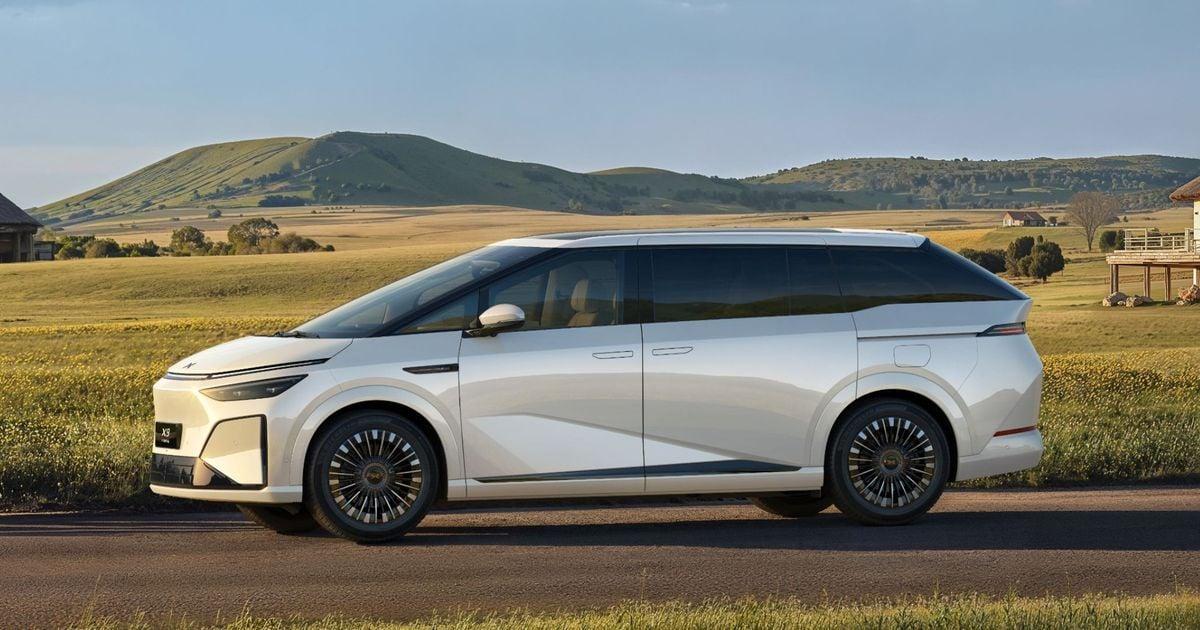

Xpeng is about to give Australian families a third Chinese electric people mover option, and it might be the most distinctive of the lot.
The Xpeng X9 has been formally cleared for Australian sale through government homologation filings, which confirm the second model in Xpeng's local lineup will be a seven-seat electric people mover. Xpeng ANZ has confirmed pricing and specifications will land before the end of June.
This matters for two reasons. First, the X9 will be a direct rival to the Zeekr 009 already on sale here and to the upcoming Denza D9. Second, Australian filings have ruled out the extended-range electric variant available in some overseas markets, meaning the local X9 will be electric only.
Size and segment
The X9 sits in the upper end of the people mover segment. The Australian-specification car measures 5316mm long, 1988mm wide and 1788mm tall on a 3160mm wheelbase. That makes it almost identical in dimensions to the Zeekr 009 and the Denza D9, both of which target wealthy families looking for an electric alternative to the Kia Carnival, Lexus LM and Toyota Granvia.
The X9 is taller than a typical SUV but narrower than a Carnival, which suggests Xpeng is targeting premium buyers who value an upright cabin and sliding doors rather than the lower-slung crossover-people-mover hybrids that have taken off elsewhere.
Two grades, four variants
The local filing lists two model grades. The X9 Standard Range and X9 Long Range will each be available in front-wheel drive (FWD) and all-wheel drive (AWD), giving Australian buyers four variants to choose from at launch.
FWD variants use a single 255kW motor on the front axle. AWD versions add a 140kW rear-axle motor for a combined 355kW output, which is genuinely substantial for a vehicle this size.
The whole drivetrain runs on an 800-volt electrical architecture, the high-voltage standard that allows rapid DC charging. Xpeng has not confirmed the local DC charging rate yet, but Chinese-market versions are good for around 350kW peak DC charging.
Battery and range
Chinese-market X9s use either a 94.8kWh lithium iron phosphate (LFP) battery or a 110kWh nickel manganese cobalt (NMC) battery. Range claims sit between 665km and 750km on the CLTC cycle, which traditionally overstates real-world figures by 25 to 35 per cent. WLTP-equivalent ranges should land between 480km and 580km.
Australian wheel sizing will impact range. The Chinese market offers a 19-inch wheel option on lower-spec cars, but local filings show only 20-inch alloys will be fitted, which will reduce range slightly compared to the smaller wheel.
Fast charging will allow a 400km (CLTC) top-up in just under 12 minutes on a high-power DC station, while vehicle-to-load output is rated at 6kW. The V2L spec is useful for camping or running power tools, and matches what BYD and Zeekr already offer in the segment.
What's inside
The seven-seat cabin is accessed by powered sliding doors on both sides. Standard leather upholstery is fitted, with genuine Nappa leather available as an option.
The second-row 'zero-gravity space seats' are the headline feature. They offer one-click entry, a lying-and-sitting recline function and a built-in massage system. These are aimed squarely at the chauffeured-buyer demographic and would not feel out of place in a Lexus LM.
Real wood, microfibre suede-style roof lining and Nappa leather options round out the cabin materials. On the dashboard, the X9 fits a 10.25-inch digital instrument cluster, a head-up display and a 17.3-inch central touchscreen. Second-row occupants get an even larger 21.4-inch entertainment screen.
The Chinese-market car also includes air suspension and rear-wheel steering on higher trims. Whether the Australian car retains those features at launch is one of the key questions still to be answered.
Driver tech
All cabin functions are powered by a Qualcomm Snapdragon chip. Driver assistance uses a Turing AI processor combined with radar, ultrasonic sensors and cameras. Xpeng's full XPILOT advanced driver assistance system is available in China, although Australian regulations may restrict the most advanced hands-off motorway driving features.
For Carseekers readers used to Tesla Autopilot or BMW Driving Assistant, the X9 should be comparable for everyday motorway cruising, automated parking and traffic-jam assist.
Pricing benchmarks
Xpeng ANZ has not committed to a price yet, but the segment benchmarks set themselves. The Zeekr 009 is priced from A$135,900 plus on-roads, and the upcoming Denza D9 will land between A$85,990 and A$95,990 plus on-roads.
The Denza pricing is the wildcard. If the X9 follows it down, expect a starting price somewhere between A$90,000 and A$100,000 for the Standard Range FWD variant, with the AWD Long Range climbing into A$130,000-plus territory. If Xpeng targets the Zeekr's pricing instead, the X9 will start higher and finish higher.
Xpeng's pitch is likely to be a mix of the two. The brand was the original Chinese 'smart EV' label and tends to charge more for software and assistance features than its competitors. That premium positioning could see the X9 split the difference between the Denza and Zeekr.
Why this is happening now
Xpeng's Australian story has been turbulent. The brand's previous Australian distributor, TrueEV, had confirmed the X9 alongside an updated Tesla Model Y -rivalling G6 SUV. That relationship has fallen apart, with Xpeng and TrueEV now in Australian Federal Court over local distribution rights.
Xpeng's new direct-to-market subsidiary, Xpeng ANZ, has confirmed it will share pricing and specifications on both the X9 and the updated G6 before the end of June. That timeline strongly suggests deliveries before the end of 2026, with the X9 likely to land in Q4.
What comes next
The Australian lineup is set to expand further beyond the X9 and G6. Xpeng has said it is considering the G9L large SUV, available as either an EREV or full EV, and the P7 electric sedan for local showrooms. The Chinese-market G9L, L03 and L05 SUVs are already confirmed in government certification filings, indicating fast model expansion.
For buyers considering a Chinese EV brand for the first time, Xpeng's direct-to-market structure is worth understanding. With no traditional dealer franchise model, Xpeng ANZ will likely operate a mix of company-owned stores and service partnerships. That can affect both servicing convenience and resale value, so check the local network coverage before committing in regional areas.
Dealer behaviour to watch
Launch pricing on a new Chinese premium model is typically firm. Discounts, especially in the first six months, are rare. If a salesperson promises a meaningful discount before the X9 has even been officially priced, that should raise a red flag about the underlying RRP being set above competitive levels.
Where Xpeng is more likely to negotiate is on accessory bundles, included servicing or extended warranty terms. The X9's status as a six-figure family vehicle means buyers should benchmark warranty terms aggressively against the Zeekr 009 and Denza D9 before signing.
Bottom line
The X9 is the third electric people mover from a Chinese brand confirmed for the Australian market in two years. It brings serious size, premium materials and a recline-and-massage second row that elevates it above utilitarian rivals. Watch for Xpeng ANZ's pricing announcement before the end of June and expect first deliveries in late 2026. If you are weighing a Carnival hybrid against an electric people mover and have a six-figure budget, the X9 deserves a spot on the shortlist.
Considering finance for your next car? Loanseekers can help you explore car loan options.
The finer details
Your questions answered.
Is the Xpeng X9 coming to Australia?
Yes. Xpeng ANZ has confirmed the X9 for Australia with pricing and specifications expected to be announced before the end of June. The Australian model has been homologated as an electric vehicle only, ruling out the extended-range EV variant available in China.
How much will the Xpeng X9 cost in Australia?
Pricing has not been confirmed but the X9 is expected to land between A$90,000 and A$135,000 depending on variant. The Denza D9 sits between $85,990 and $95,990, while the Zeekr 009 starts at $135,900. The X9 is likely to split the difference.
How does the Xpeng X9 compare to the Zeekr 009?
Both are large electric people movers measuring around 5.3 metres long with sliding doors and seven seats. The X9 offers higher power outputs on its AWD model at 355kW. The Zeekr 009 is already on sale, while the X9 launches later in 2026. Final positioning depends on Xpeng's pricing strategy.
What is the Xpeng X9's electric range?
Chinese-market X9s offer 665km to 750km on the CLTC cycle from 94.8kWh LFP or 110kWh NMC batteries. WLTP-equivalent figures should land between 480km and 580km depending on the variant. Australian specifications are yet to be finalised.
When will the Xpeng X9 arrive in Australia?
Xpeng ANZ has confirmed pricing and specifications will be released before the end of June 2026. First deliveries are likely in Q4 2026 based on standard import and homologation timelines following pricing announcements.
Should I buy a Xpeng X9 or wait for the Denza D9?
The Denza D9 is more affordable and arrives slightly sooner. The X9 offers more power and Xpeng's smart EV software heritage. If pricing matters more than performance and tech, the Denza will likely be the better value. If you want the highest-tech option, wait for the X9 pricing announcement.