
BYD is moving fast in Australia. The brand's first plug-in hybrid sedan, the Seal 6, has only just landed in local showrooms, and the next one is already approved.
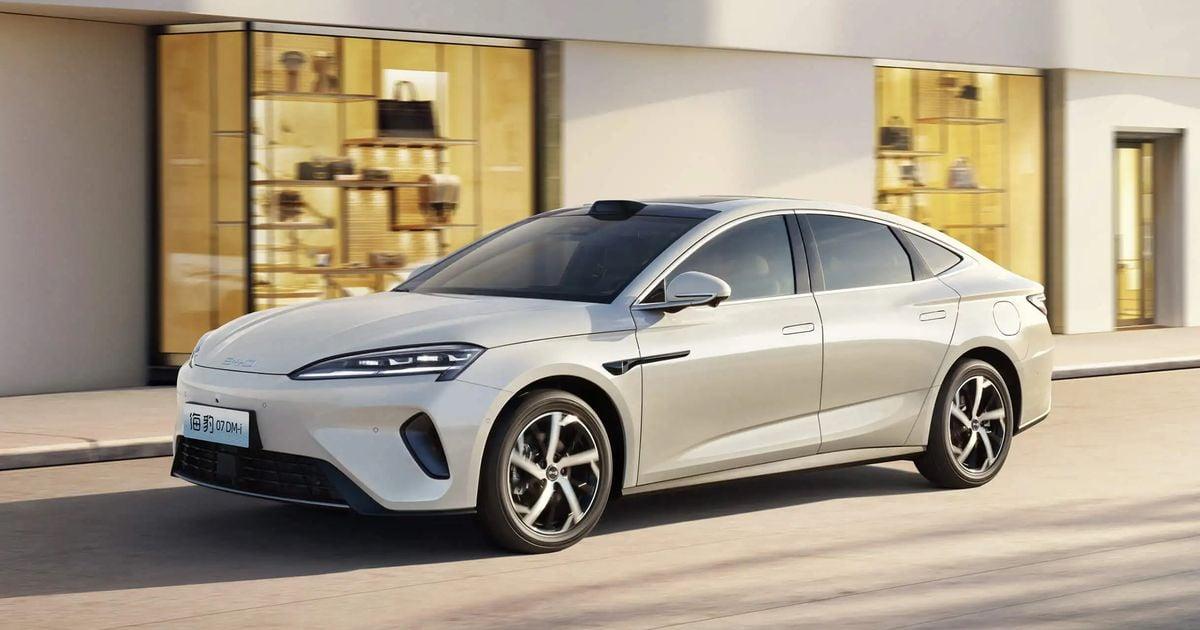
The 2027 BYD Seal 7 has appeared in Australian Government approval documents with a turbocharged 1.5-litre four-cylinder PHEV powertrain making 197kW. That is meaningfully more than the Seal 6, which sits below it in BYD's range, and it lines the Seal 7 up as a direct challenger to the Toyota Camry and other mid-size sedans.
For Australian buyers, this matters because BYD is doing what most legacy brands have stopped doing. It is investing heavily in sedans at exactly the moment when the rest of the market has written sedans off in favour of SUVs.
Where the Seal 7 sits in BYD's range
BYD's Seal naming is, frankly, confusing. The brand sells the electric Seal sedan, the Seal 6 PHEV sedan and wagon, and on top of that runs a Seal 06 GT electric hatch, an electric Seal 6 on a different platform, and an entry-level Seal 05 DM-i in China.
The Seal 7 sits towards the top of this lineup. It is 4980mm long, 1890mm wide and 1495mm tall on a 2900mm wheelbase. That makes it 60mm longer, 50mm wider and 50mm taller than a Camry, with a wheelbase 75mm longer.
More relevantly to existing BYD buyers, the Seal 7 is 140mm longer and 15mm wider than the Seal 6 on a 110mm longer wheelbase. So this is a proper step up in size, not a near-twin with a different badge.
What the approval documents show
The Australian-spec powertrain is listed as a 197kW turbocharged 1.5-litre four-cylinder PHEV setup. That is the upper of the two engine choices BYD offers in China, where the Seal 7 is known as the Seal 07 DM-i.
A less powerful naturally aspirated 1.5-litre version is also offered overseas, but that does not appear in the Australian approval. BYD Australia has not yet confirmed local launch timing, despite the model being in production in China since 2023.
Battery capacity is not specified in the local documents, which is the key omission. The Chinese-market Seal 07 DM-i is offered with 17.6kWh or 29.46kWh lithium iron phosphate batteries.
The range numbers buyers actually care about
Electric-only range on the WLTC cycle is 110km for the smaller battery and 180km for the bigger one. WLTC is broadly comparable to the WLTP standard most Australian-market PHEVs are now quoted against.
That 180km figure matters. It is significantly more than the 110km Volkswagen quotes for the new Tiguan and Tayron eHybrid range, and well clear of the 84km Mitsubishi Outlander PHEV.
The petrol engine in the PHEV setup makes 115kW and 225Nm, while the electric motor delivers 200kW and 315Nm. Combined system output lands at 197kW, which is what Australian approval lists.
Charging and V2L capability
The smaller battery can DC fast-charge at up to 40kW, while the larger version goes up to 69kW. Both support 7kW AC charging, which is the typical home wallbox speed.
More usefully, both batteries support vehicle-to-load functionality. That means you can run camp gear, tools or even another EV from the Seal 7's battery, a feature that is increasingly common on Chinese-brand cars and still rare on Japanese or European competitors.
All Seal 7 variants are front-wheel drive only, with MacPherson strut front and five-link rear suspension. Higher-spec versions with the turbocharged engine add DiSus-C adaptive dampers, which BYD has been deploying across its premium lines.
Inside the cabin
The interior is where BYD is making the most ground on legacy competitors. The Seal 7 gets a 15.6-inch touchscreen, a 10.25-inch digital instrument cluster, colour-adjustable ambient lighting, wireless phone charging and an opening panoramic sunroof with a power sunshade.
Leather upholstery is standard, with power-adjustable, heated and ventilated front seats. The top-spec variant adds a head-up display, heated steering wheel and a refrigerator in the centre console, which can be set to heat or cool.
There is also in-car karaoke, sentinel mode, rest mode, baby mode and car wash mode. Some of that will be removed for the Australian market, some of it will not, and frankly Australian families will get more use out of the in-car karaoke than most journalists are willing to admit.
Safety and driver assistance
All variants get BYD's DiPilot 100 driver assistance suite, which includes adaptive cruise, lane centring and remote parking assist. The flagship steps up to DiPilot 300, which incorporates a LiDAR sensor.
The big question for Australian buyers will be how the Seal 7 performs in ANCAP testing. BYD has scored well on previous ANCAP runs, with recent five-star results for the Seal 6, but the Seal 7's bigger size and different platform mean it will need to be tested independently.
Why this is happening now
Australia is, as the industry euphemistically puts it, an SUV-hungry market. Sedans have been in structural decline for over a decade. Most brands have responded by quietly killing off sedan nameplates or letting them age out without replacement.
BYD is doing the opposite. The Seal sedan is one of its top sellers globally, and the brand is bringing it to Australia in multiple variants. The Seal 6 PHEV sedan and wagon are already here. The Seal 7 is approved.
Part of this is brand discipline. BYD is a vehicle-platforms business at heart, and sedans give the best aerodynamic efficiency for PHEV and EV powertrains. Part of it is opportunity. The buyers who do still want a sedan in Australia, particularly fleet buyers and salary-sacrifice EV lessees, now have fewer choices than ever, and BYD wants them.
What it means for Camry and Mazda6 buyers
The Camry is the elephant in the room. It has owned the sedan-with-hybrid space in Australia for years, with the latest hybrid-only generation strengthening that grip.
The Seal 7 is a different proposition. PHEV with 110-180km EV range means most daily commutes can be done on electric power alone, with the petrol engine for road trips. That is closer to an EV-with-safety-net than a traditional hybrid.
The Camry's strengths are dealer network, resale, reliability data and ownership simplicity. The Seal 7's strengths will be charging at home and never visiting a petrol station for weeks on end. Different buyers, different priorities, and there is plenty of room in the market for both right now.
Pricing expectations
BYD has not announced Australian pricing. Looking at the company's local lineup, the Seal 6 PHEV sedan starts around the $46,000 mark, and the larger Seal 7 with significantly more power will need to sit above it.
A reasonable expectation, based on the Chinese-market pricing relative to the Seal 6 and BYD's track record of aggressive launch pricing in Australia, is a starting figure in the high $40,000s to mid $50,000s drive-away. That would land it well inside Camry money for the lower battery and at the upper end against an Outlander PHEV for the larger battery.
What Carseekers is watching
The Seal 7 approval is significant for two reasons. First, it confirms BYD is doubling down on sedans in Australia at a time when others are walking away. Second, it brings a 180km EV-range PHEV into a price bracket where 110km is the current ceiling from European brands.
If you are currently shopping a Camry, an Accord, a Mazda6 successor or a PHEV SUV and have been on the fence about whether a sedan still makes sense, the Seal 7 is worth waiting to see priced. The bigger battery option in particular could be the most useful PHEV daily driver in the segment.
Launch timing has not been confirmed by BYD Australia, but given the approval is in, we would expect first stock to land within the second half of 2026.
Considering finance for your next car? Loanseekers can help you explore car loan options.
The finer details
Your questions answered.
When is the BYD Seal 7 coming to Australia?
The Seal 7 has cleared Australian Government approval but BYD Australia has not officially confirmed a launch date. Given the approval is in and the model has been in production in China since 2023, a launch in the second half of 2026 is realistic. Watch for a confirmed announcement from BYD Australia in the coming months.
How does the BYD Seal 7 compare to the Seal 6?
The Seal 7 is 140mm longer and 15mm wider than the Seal 6, with a 110mm longer wheelbase. It also makes 197kW versus the Seal 6's lower outputs, and the bigger battery option offers up to 180km of EV range. It is a proper step up in size and capability, not a near twin.
How much will the BYD Seal 7 cost in Australia?
BYD Australia has not announced pricing. Based on the Seal 6's pricing position and BYD's track record of aggressive launch deals, expect the Seal 7 to start somewhere in the high $40,000s to mid $50,000s drive-away. The bigger-battery, higher-spec version will likely push past $55,000.
Is the BYD Seal 7 better than a Toyota Camry?
Different cars for different buyers. The Camry is a hybrid only, with strong resale and a wide dealer network. The Seal 7 is a PHEV with 110 to 180km of EV range, so most daily commutes can be done without petrol. If you can charge at home, the Seal 7 will be cheaper to run. If you value resale and dealer support, Toyota still wins.
Does the BYD Seal 7 have vehicle to load capability?
Yes. Both battery sizes support V2L, meaning you can power camp gear, tools or even another EV from the car's battery. This is increasingly standard on Chinese-brand PHEVs and EVs but still rare on Japanese and European equivalents.
What battery options will the Seal 7 have in Australia?
BYD has not confirmed Australian battery specifications. In China the Seal 07 DM-i offers a 17.6kWh battery with 110km of WLTC EV range, or a 29.46kWh battery with 180km of WLTC range. Both options use lithium iron phosphate chemistry. Australia is likely to get one or both, depending on local positioning.