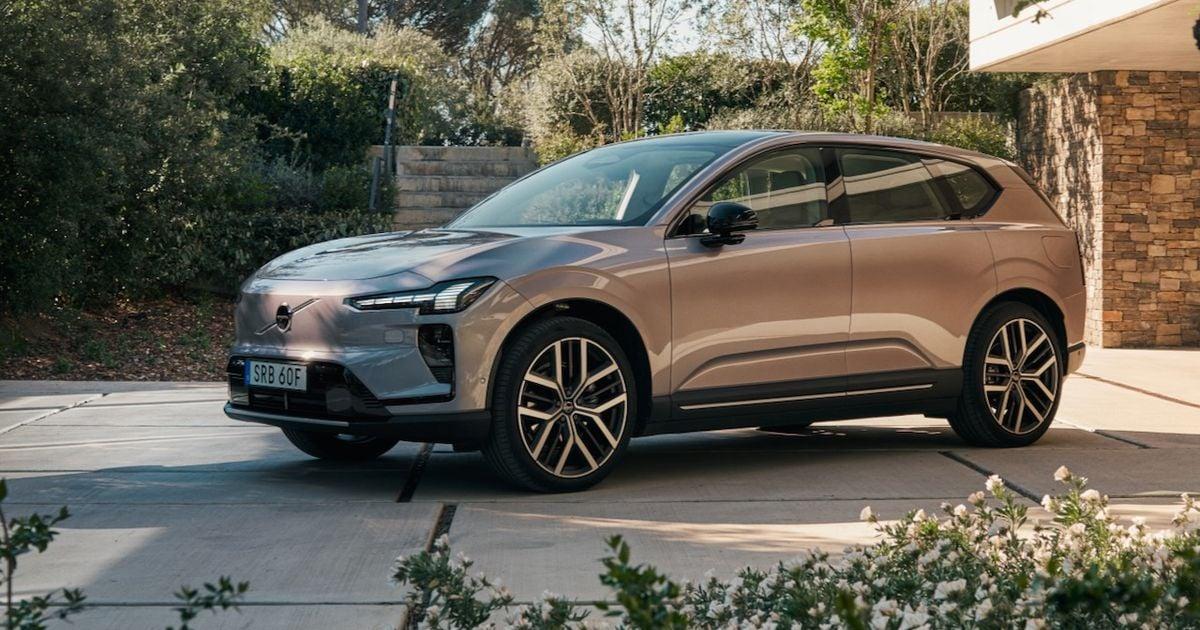

Volvo has dropped local pricing for the all-new 2027 EX60 electric mid-size SUV, and the headline figures make for a serious shopping decision. The entry-level P6 RWD Ultra lands at $86,990 before on-road costs, with the dual-motor P10 AWD Ultra pegged at $101,990. Both undercut the closest German rivals from BMW and Audi, while range stretches to 660km on the AWD model. That is a genuinely competitive opening hand from Sweden, and the EX60 will arrive in showrooms late in the third or fourth quarter of 2026.
This is the electric counterpart to the Volvo XC60, the brand's best-selling model of all time. Volvo is treating the EX60 with the seriousness that role demands. Here is the full Australian breakdown.
Pricing and what you get
There are two variants confirmed for the local launch. The 2027 Volvo EX60 P6 RWD Ultra costs $86,990 before on-roads. The 2027 Volvo EX60 P10 AWD Ultra costs $101,990 before on-roads. Both are Ultra trim, which is Volvo's upper specification grade and a step above the Plus trims sold in some other markets.
Final Australian equipment lists are still to be confirmed. Volvo Australia has flagged that supply will be somewhat limited at launch because the EX60 is built in Sweden rather than China, like several other Volvo models sold here. That has two implications for buyers. Early allocations will fill quickly, and the pricing should hold without the heavy discounting that sometimes appears on Chinese-built Volvos within months of launch.
How it compares to BMW and Audi rivals
The EX60's most direct competitors are the new-generation BMW iX3 and the Audi Q6 e-tron. The BMW iX3 currently opens at $101,900 before on-roads, and the Audi Q6 e-tron starts at $99,900 before on-roads. The Volvo P6 RWD undercuts both by roughly $13,000 to $15,000. Even the dual-motor P10 lands fractionally cheaper than the iX3 base car.
That is unusual for Volvo. The brand has historically priced its electric cars at parity or above the Germans, banking on safety credentials and Scandinavian design to justify the premium. Pricing the EX60 below the iX3 and Q6 e-tron is an aggressive opening move, and it should force buyers to give Volvo a serious look rather than defaulting to a known luxury badge.
Power, range, and charging
The EX60 P6 uses a single rear-mounted electric motor producing 275kW and 480Nm. WLTP range is 620km from an 83kWh battery, with 80kWh usable. Energy consumption is rated at 14.7kWh per 100km on the WLTP cycle. Sprint to 100km/h takes a claimed 5.9 seconds.
The P10 adds a front motor for all-wheel-drive grip. Combined outputs jump to 375kW and 710Nm, cutting the 0-100km/h time to 4.6 seconds. The battery grows to 95kWh with 91kWh usable, and WLTP range increases to 660km. Energy consumption climbs slightly to 15.7kWh per 100km, reflecting the additional motor and weight.
DC fast charging on the P6 maxes out at 320kW on 800V infrastructure, dropping to 120kW on 400V chargers. The P10 lifts the 800V peak to 370kW and the 400V peak to 150kW. Australian charging networks are mostly 400V architecture today, but new 800V-capable sites are rolling out from Evie, Chargefox, and Tesla. Buyers with regular long-distance routes should map their preferred chargers before committing to a variant.
A more powerful P12 variant exists overseas, with 500kW, 790Nm, a 3.9-second 0-100km/h time, and up to 810km of WLTP range from a 117kWh battery. Volvo Australia is still evaluating that car for local launch but has not committed to it yet.
Technology and construction firsts
The EX60 is the first Volvo to use a 'mega-cast' aluminium rear floor and subframe. Where traditional manufacturing might use as many as 100 separate aluminium pieces, the EX60 uses a single large casting. The result is lower weight, fewer joints, and a faster build line. Tesla pioneered this approach with the Model Y, and most premium EV brands are now following.
The EX60 also uses cell-to-body construction. The battery cells are integrated into the structural floor of the car, rather than being housed in a separate pack that is then bolted to the platform. This gives the car a lower floor, more interior space, and improved torsional rigidity. The safety implications are also strong, because the structural battery doubles as crash energy management.
Where this fits in the Volvo line-up
The EX60 is positioned squarely above the Volvo EX30 compact electric SUV. It sits below the EX90 three-row flagship. As the electric counterpart to the Volvo XC60, it is expected to be a major sales contributor for the brand. The XC60 has historically accounted for roughly a third of Volvo's Australian sales, and the EX60 will be tasked with cannibalising and replacing that volume over the next decade as the brand transitions away from combustion.
Volvo Australia has also flagged that an entry-level EX60 variant, a high-performance P12, and a Cross Country soft-roader are all under evaluation for the local market. None of those are confirmed yet, but the brand is clearly leaving room to flesh out the range over the model's life cycle.
Dealer behaviour and what to watch
Volvo dealers are generally less aggressive on markup tactics than mass-market brands, but the EX60 will be a tightly allocated launch car. Expect dealers to favour customers with deposits down before the order book formally opens. If you have been waiting for a serious electric mid-size SUV with European packaging, registering an expression of interest with two or three dealers is the smart move.
Watch for two specific traps in the negotiation. The first is the dealer delivery fee. Volvo dealers sometimes attach delivery and pre-delivery inspection charges that are higher than they need to be. Compare quotes across at least two locations. The second is finance. Volvo Financial Services may run launch-period offers that look attractive on paper but include balloon repayments or restrictive end-of-term conditions. Always read the comparison rate and the full schedule before signing.
The bigger market picture
For mid-size electric SUV buyers in Australia, 2026 has suddenly become an interesting year. The EX60 joins the BMW iX3, the Audi Q6 e-tron, the Tesla Model Y, the Polestar 4, and the upcoming Kia EV5 in a segment that simply did not exist three years ago. Cross-shopping across all of those is now realistic, and Volvo has just put itself near the top of the value list with this launch.
If the XC60 has been your benchmark family SUV for years, the EX60 is the obvious next step when your lease or finance term ends. The cabin packaging, the safety reputation, the design language, and the dealer experience all carry through. The major change is the powertrain, and on the evidence of these numbers, that change is no longer a compromise. Carseekers lists live Volvo inventory from dealers across Australia, including current XC60 stock, so you can compare prices and timing before committing to the EX60 order book.
One last note on the EX60's positioning. Volvo has not yet locked in trim variations below Ultra grade for Australia, which means at launch the entry price will be higher than markets where Plus or Core grades are sold. If demand patterns shift after launch, Volvo Australia could introduce a sharper-priced entry trim. Watch the dealer announcements through 2027 for any signal on that.
Considering finance for your next car? Loanseekers can help you explore car loan options.
The finer details
Your questions answered.
How much does the 2027 Volvo EX60 cost in Australia?
The 2027 Volvo EX60 starts at $86,990 before on-road costs for the P6 RWD Ultra. The dual-motor P10 AWD Ultra lifts to $101,990 before on-roads. Both variants ship in Ultra trim, with final equipment lists still to be confirmed by Volvo Australia.
When does the Volvo EX60 arrive in Australia?
Volvo Australia expects the EX60 to land late in the third quarter or in the fourth quarter of 2026. Supply will be somewhat limited at launch because the car is built in Sweden, not China, so early allocations are likely to fill quickly.
What is the driving range of the Volvo EX60?
The EX60 P6 RWD has a claimed WLTP range of 620km from an 83kWh battery with 80kWh usable. The dual-motor P10 AWD lifts that to 660km from a 95kWh battery with 91kWh usable. A flagship P12 with 810km of range is under evaluation for Australia.
Is the Volvo EX60 cheaper than the BMW iX3?
Yes. The base BMW iX3 starts at $101,900 before on-roads, while the Volvo EX60 P6 starts at $86,990. The Audi Q6 e-tron starts at $99,900 before on-roads. The EX60 undercuts both German rivals on entry price.
How fast can the Volvo EX60 DC charge?
The EX60 P6 peaks at 320kW on 800V DC infrastructure and 120kW on 400V chargers. The P10 peaks at 370kW on 800V and 150kW on 400V. Most Australian public chargers are still 400V, but 800V-capable sites are rolling out.
Is the Volvo EX60 the replacement for the XC60?
Not directly. The XC60 and EX60 will sell alongside each other for now. The EX60 is the all-electric counterpart to the XC60, and over time it is expected to absorb a growing share of the XC60's sales as combustion variants are phased out.