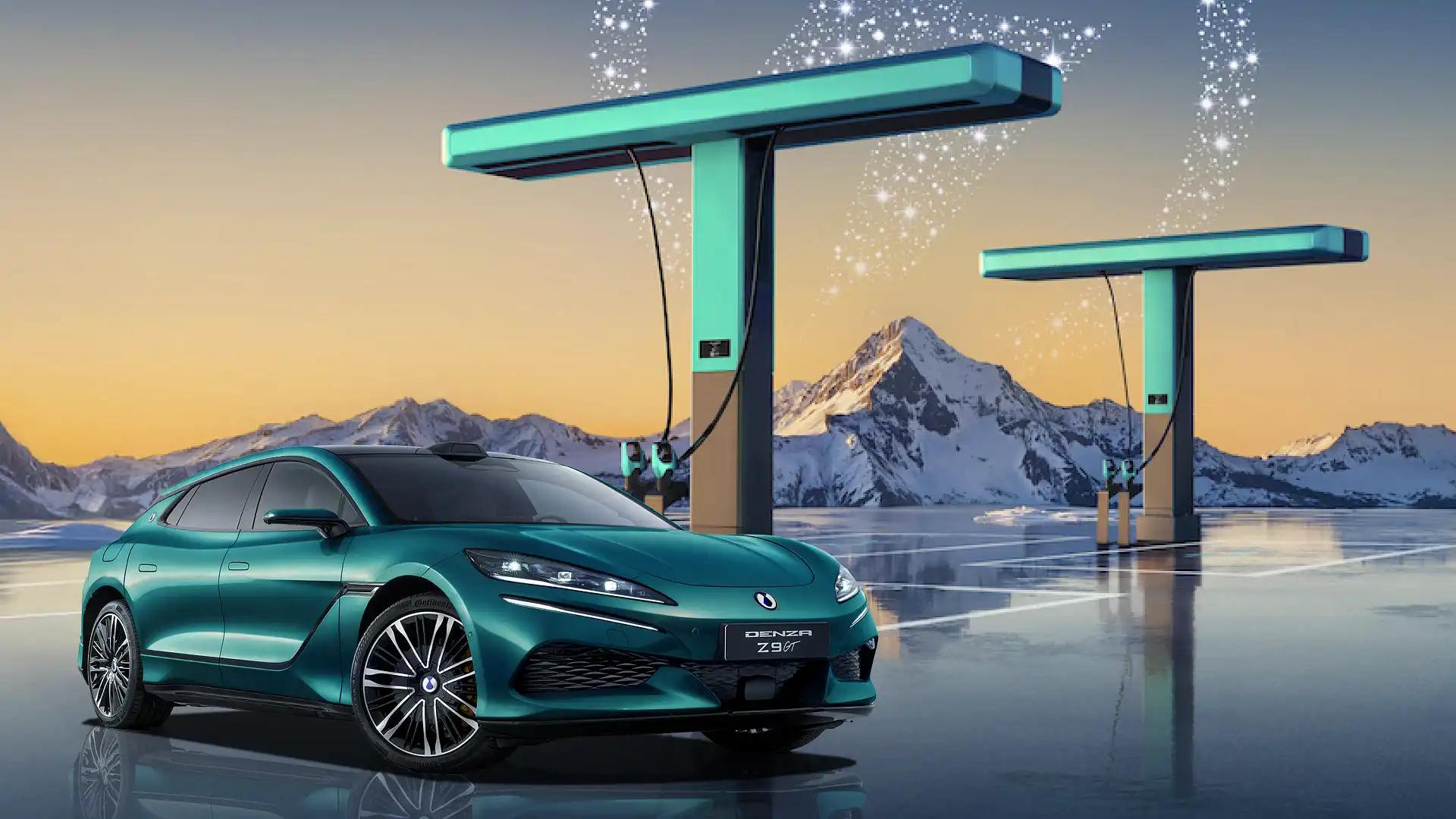
BYD has just dropped a hint that should reshape every EV buying decision in Australia from 2027 onward. The 1500kW Flash charging technology launching with the Denza Z9 GT super wagon later this year is going to trickle down across the BYD family, and eventually into mainstream Australian showrooms.
That is the explicit confirmation from Mark Harland, the chief operating officer of Denza Australia, who told Drive that Flash charging "trickles down across the range in Denza and, further in the future, probably BYD."
If this plays out the way Harland describes, the BYD Atto 3 successor on a Carseekers deal in 2027 or 2028 could recharge from 10 to 80 per cent in roughly five minutes. That is the same time it takes to fill a petrol Toyota HiLux.
What 1500kW actually means
Flash chargers deliver up to 1500 kilowatts. To put that in context, Australia's current fastest public chargers are 400kW, and even those are uncommon. The 150kW plugs that have become standard in city CBD locations are 10 times slower.
The practical claims for BYD vehicles fitted with Flash-compatible powertrains are: 10 to 70 per cent in five minutes, 10 to 97 per cent in nine minutes. Add three minutes in sub-zero climates, which is a less relevant claim for most of Australia.
Those numbers do not just nudge the EV charging equation. They blow it up.
For reference, a Tesla Model Y takes 25 to 30 minutes for a 10 to 80 per cent charge at 175kW to 250kW. The current BYD Atto 3 needs about 40 minutes for the same recharge based on Drive testing. The Zeekr 7X RWD, currently the fastest-charging EV sold in Australia on paper, claims 10 to 80 per cent in 13 minutes at 450kW, though it cannot actually achieve that figure on existing local infrastructure.
The infrastructure catch
This is the part that matters. A car capable of accepting 1500kW is useless without a 1500kW charger plugged into it.
Denza will launch the first Flash charging locations in Australia later this year at five flagship showrooms in Sydney, Melbourne, Adelaide, Brisbane and Perth. By the end of 2026, Harland is targeting Flash chargers at the company's broader "flagship" dealer stores nationwide.
The ambition by year's end is to have Flash charging at most major-city flagship Denza showrooms. Beyond that, expansion into independent public charging operators like Evie, Chargefox and the NRMA network is the missing piece. None of those operators currently have anything close to 1500kW hardware deployed.
Until they do, Flash charging is essentially a Denza-dealer-bay experience. That is useful for top-up charging if you live near a flagship store, but it does not yet replace the broader public network.
How Flash charging changes the BYD product roadmap
In China, Flash charging is already offered on a variety of BYD group models. The Fangchengbao Bao 8, sold in China as an electric Denza B8, has it. So does the successor to the current Atto 3.
For Australian buyers, the practical implication is straightforward. If you are within 12 months of buying a BYD Atto 3, Sealion 6, Sealion 7 or Sealion 8, you should know that the next generation of those cars in China is already moving toward Flash-charging compatibility. By 2027 to 2028, the BYD Australian range will likely include Flash-compatible options at mainstream price points.
This does not mean you should wait two years to buy. The current BYD line-up still offers strong value and decent charging speeds for typical daily use. But for someone weighing a longer-term ownership decision, knowing that 1500kW is coming to mainstream BYD models gives you a clearer picture of where the technology is heading.
Why Denza gets it first
Denza is BYD's luxury sub-brand. Mark Harland was direct about the strategy: "I look at the Flash charging the way I look at Formula One. Z9 GT right now is the pinnacle of technology for BYD, Denza, the family."
Flagship products get expensive technology first because they can absorb the cost. The Z9 GT is priced above $100,000 plus on-roads in Australia and possibly as high as $160,000 based on European RRPs. A 122kWh battery and the high-voltage architecture needed to accept 1500kW input adds significant cost compared to a conventional 400-volt EV.
As production scales and component costs fall, the same architecture can be deployed in lower-margin vehicles. This is the same trickle-down pattern that brought adaptive cruise control, blind-spot monitoring and LED matrix headlights from luxury cars into Toyota Corolla Cross territory over the past decade.
What buyers should think about now
Three practical takeaways.
First, if you are seriously considering an EV in 2026 and your concern is fast charging, look at what current BYD products can actually deliver in your specific use case rather than waiting for 1500kW. A 40-minute charge on an BYD Atto 3 is genuinely inconvenient on long road trips, but for most owners who charge overnight at home, it never matters.
Second, if you are an apartment-living EV buyer who depends on public charging, the Flash network rollout starting in late 2026 changes the equation for you specifically. Living within 15 minutes of a Denza flagship showroom with public Flash bays starts to look meaningful. Until that network actually arrives, current 350kW DC fast chargers from Evie and Chargefox remain the practical maximum.
Third, do not let dealers oversell a future technology that has not yet shipped on mainstream BYD product in Australia. Today, no BYD or Denza vehicle on Australian showroom floors accepts 1500kW input. The Z9 GT will be the first, and it lands later this year. Mainstream BYD models with Flash charging are still 18 to 24 months away based on Harland's timeline.
What this does to competitors
If BYD actually pulls this off, the competitive pressure on Tesla, Hyundai, Kia, Polestar and the established European EV brands gets intense. None of them currently has a public roadmap for charging speeds anywhere near 1500kW at retail. The fastest-charging EVs from Hyundai-Kia (the Kia EV6, Ioniq 5N, Ioniq 6) max out around 350kW on 800-volt architecture.
This matters because charging speed is one of the last remaining objections from petrol switchers. "It takes too long to charge" has been the standard pushback for years. A nine-minute 10 to 97 per cent charge eliminates that objection entirely, if the charger is available.
The brands that respond first are likely to be Zeekr, which already runs 800-volt architecture on the 7X, and Geely-platform vehicles, including Volvo and Polestar. The European premium players will follow but more slowly, given their existing investments in 400-volt platforms.
The bigger picture
What BYD is signalling with the Flash rollout is that the brand intends to make charging anxiety obsolete. Not just reduce it, but eliminate it as a buying objection.
For the Australian market specifically, that has knock-on effects beyond the BYD range. If 1500kW becomes a standard expectation by 2028, Australia's public charging operators have to upgrade. That is a multi-billion-dollar infrastructure investment that nobody has yet committed to, and which the federal government's $40 million regional charging announcement in the 2026 Budget does not even begin to address.
For now, the practical advice is simple. Buy the EV that suits your daily needs today. Watch what BYD actually ships in Denza dealer bays through late 2026 and 2027 to gauge the real pace of Flash charging deployment. And use the Carseekers comparison tools to track which mainstream BYD models gain Flash compatibility first, because that is where the meaningful affordable Flash charging story will actually land.
Considering finance for your next car? Loanseekers can help you explore car loan options.
The finer details
Your questions answered.
What is BYD Flash charging and how fast is it?
BYD Flash charging delivers up to 1500 kilowatts of power, capable of recharging an EV battery from 10 to 70 per cent in five minutes or 10 to 97 per cent in nine minutes. That is roughly four times faster than Australia's current fastest public chargers and 10 times faster than the standard 150kW plugs found in most city locations.
When will Flash charging come to mainstream BYD cars in Australia?
Denza Australia chief operating officer Mark Harland has confirmed Flash charging will trickle down across the Denza range first, then into mainstream BYD models. No specific timeline has been given but it is likely 18 to 24 months away. The technology is already deployed on the BYD Atto 3 successor in China.
Where will I be able to use BYD Flash chargers in Australia?
The first Flash charging sites launch later this year at Denza flagship dealerships in Sydney, Melbourne, Adelaide, Brisbane and Perth. By year-end Denza is targeting flagship stores nationally. Public Flash charging beyond Denza dealer bays will require investment from operators like Evie and Chargefox, which has not been committed.
How does BYD Flash charging compare to Tesla Supercharging?
Tesla Superchargers deliver up to 250kW, which charges a Model Y from 10 to 80 per cent in 25 to 30 minutes. BYD Flash charging at 1500kW is six times faster on paper, charging compatible BYD vehicles from 10 to 97 per cent in nine minutes. The gap is significant but Flash requires both the right car and a Flash-equipped charger.
Should I wait for Flash charging before buying a BYD?
Probably not. For most buyers who charge overnight at home, the current BYD Atto 3 charging speeds are fine for daily use. Flash charging matters most for apartment dwellers and long-distance highway drivers. Current BYD models like the Atto 3 and Sealion 6 still represent strong value and will be supported with warranty and parts long after Flash compatibility arrives.
Will the Denza Z9 GT have Flash charging in Australia?
Yes. The Denza Z9 GT is the first car in Australia to launch with Flash charging support when it arrives later in 2026. Its 122kWh battery and high-voltage architecture are designed for 1500kW charging. Pricing is expected to land above $100,000 plus on-road costs, making it a halo vehicle rather than a mass-market option.