BMW has officially shown the M Concept Neue Klasse ahead of the 24 Hours of Le Mans, and the message it sends couldn't be clearer. The first fully electric BMW M3 is coming, it's going to look more aggressive than the current car, and it will sit on an 800V architecture with a battery north of 100kWh and at least two motors. Reports suggest a four-motor setup producing 1000kW or more, with production due to start in 2027.
For Australian buyers, that's a long way off. But the concept tells you more about where the M brand is heading than any conventional press release would, and the answer is going to make a lot of M3 enthusiasts uncomfortable.
What the M Concept Neue Klasse actually shows
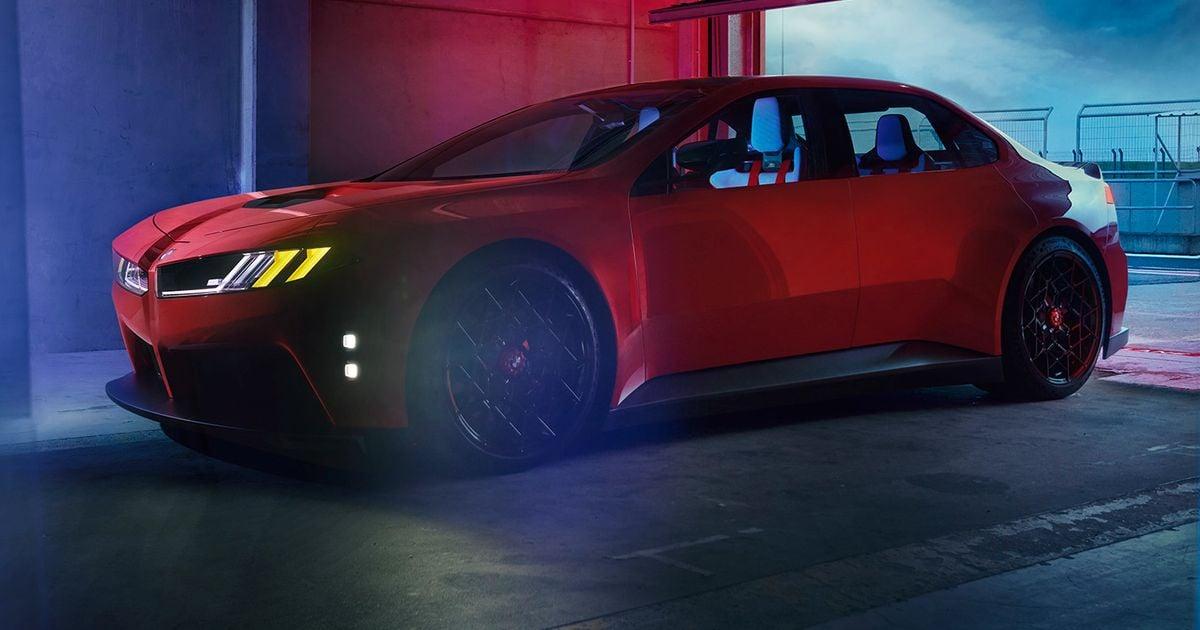
The concept is built on the architecture of the upcoming BMW i3 sedan, which itself is the first car on the new Neue Klasse platform. M has taken that base and applied its usual treatment: pumped-up wheel arches, a sharper shark nose, a deeper V-shape in the bonnet, and a clearer separation between the kidney grilles and the lower air intakes.
BMW describes the front bumper as "trimaran-style", inspired by high-speed sailing boats, which sounds like marketing fluff until you look at how the bumper integrates the front splitter mounting points and the cooling intakes for the EV powertrain. Yellow highlights in the headlights are a new M signature designed to link road cars to BMW's racing programme. The rear gets a ducktail spoiler for downforce, with white track lights at the front and red versions at the rear framing the air intakes.
The car is painted in Monza Red, a new shade for M, with natural fibre finish for the front splitter, bonnet vent and rear diffuser. The interior gets four bucket seats with Merino leather in Bathurst Blue and Berry Red, red five-point seat belts, black nubuck leather on the steering wheel, door trims and roll bars, and a hexagon-backlit knit material on the dashboard.
It is, by BMW concept standards, a relatively production-ready preview. Most of what's shown here is likely to make it to the road in 2027 in something close to its current form.
The drivetrain rumours that matter
BMW has only officially confirmed three things about the electric M3 powertrain: 800V architecture, a battery of at least 100kWh, and at least two motors with all-wheel drive standard. That's the floor.
The ceiling is more interesting. Reports point to a four-motor setup making at least 1000kW. For context, the current G80 petrol M3 Competition xDrive produces 390kW. The CS produces 405kW. Even the next-gen petrol M3 is expected to top out somewhere around 500kW with electrification assistance. The electric M3 is being pitched into a different segment of performance entirely.
The four-motor setup, if it lands, will give the electric M3 individual wheel torque control, which is the same technology that makes cars like the Rivian R1T and the upcoming Porsche Cayenne Electric capable of dynamic feats that physically can't be done with a single motor per axle. Genuine torque vectoring per wheel, on-throttle yaw control, and tank-turn-style differential braking are all on the table.
800V architecture means charging speeds in the 300kW+ range on the right DC fast charger, which translates to roughly 10 to 80 per cent in around 18 to 20 minutes. That's the same charging envelope as the Hyundai Ioniq 5 N and Kia EV6 GT, and well ahead of the current i4 M50.
Petrol M3 is not dead
The more important detail for purist buyers: BMW has explicitly confirmed that a petrol-powered next-generation M3 will continue, based on the new petrol-powered 3 Series. That car will run in parallel with the electric M3, giving BMW two distinct M3 products at the same time for the first time.
The petrol M3 will keep the inline-six powertrain BMW has refined for decades, almost certainly with some form of electrification assistance to meet emissions targets without losing the character buyers expect. Reports suggest a mild-hybrid system at minimum, possibly stepping up to a PHEV configuration on higher-spec variants.
For Australian buyers, this matters. The current M3 Competition xDrive sells well into the wait-list end of the BMW M lineup. The choice in 2027 will be: do you want the new petrol M3, with the inline-six character and the familiar driving feel, or the electric M3 with four motors, faster charging than most EVs on sale today, and a different driving experience entirely.
What this means for Australian M buyers
Three practical takeaways:
First, if you're considering a current G80 M3 right now, the news doesn't change the case much. The car will still be sold here through 2026 and likely into 2027 before the new generation lands. Current M3 stock will start moving with sharper drive-away pricing as the launch approaches. If you want the inline-six S58 powertrain in its current form, this is the window.
Second, for buyers eyeing the next M3 (electric or petrol), expect launch pricing to land high in 2027. BMW has signalled that the electric M3 will not be significantly more expensive than the petrol M3, which suggests both will sit in the $190,000 to $220,000 bracket on Australian list pricing. Early stock will go to long-deposit buyers. Patient buyers waiting six to twelve months past launch typically get sharper prices.
Third, watch the next-generation BMW lineup as a whole. The electric M3 sits on the same Neue Klasse platform as the iX3 (already confirmed for Australian launch mid-2026), the upcoming i3 sedan, and a wave of further models. Platform investment of this scale is BMW's most significant since the 1980s, and the success of the electric M3 will define the brand's performance trajectory into the 2030s.
You can compare current BMW M3 and BMW M4 variants on Carseekers before contacting a dealer, which gives you a clean view of where current pricing sits ahead of the new generation arriving.
The bigger picture
M's identity has always been built around naturally-aspirated and twin-turbo straight-sixes, sharp handling, and a deep brand connection to motorsport. The electric M3 with four motors and 1000kW asks whether that identity can survive the move to electric.
BMW seems to think it can, partly by keeping the petrol M3 alive in parallel and partly by leaning hard into motorsport language for the electric car. The Le Mans reveal timing wasn't an accident. The yellow accents, the track lights, the trimaran nose, all of it speaks to a brand trying to make the case that electric M cars are an evolution of motorsport, not a departure from it.
Whether that lands with the buyers who've kept the M3 nameplate alive for forty years is a question only 2027 will answer. For now, the concept is a clear statement of intent, and the message is that BMW M isn't planning to disappear quietly into an electric future.
Considering finance for your next car? Loanseekers can help you explore car loan options.
The finer details
Your questions answered.
When will the electric BMW M3 launch in Australia?
Production of the electric M3 is reported to begin in 2027. Australian launch typically follows European launch by three to six months, which suggests a local arrival in the second half of 2027 at the earliest. Expect order books to open well ahead of physical deliveries.
Will the petrol BMW M3 be discontinued when the electric M3 arrives?
No. BMW has confirmed that a petrol-powered next-generation M3 will continue, based on the new petrol 3 Series, running in parallel with the electric M3. The petrol M3 will keep the inline-six powertrain, almost certainly with some form of electrification assistance to meet emissions standards.
How much power will the electric BMW M3 produce?
BMW has officially confirmed at least two motors, all-wheel drive and a battery of at least 100kWh. Reports indicate a four-motor setup producing at least 1000kW, which would put the electric M3 in a different performance bracket to the 390kW current M3 Competition and the 405kW M3 CS.
Will the electric BMW M3 be more expensive than the petrol M3?
BMW has signalled that the electric M3 will not be significantly more expensive than the petrol M3. Both cars are expected to sit in the $190,000 to $220,000 bracket on Australian list pricing at launch, depending on specification and option choices.
How fast will the electric BMW M3 charge?
With 800V architecture, the electric M3 should accept DC fast charging in the 300kW+ range on compatible chargers. That translates to a 10 to 80 per cent charge in around 18 to 20 minutes, which matches the charging envelope of the Hyundai Ioniq 5 N and Kia EV6 GT and significantly improves on the current i4 M50.
Should I buy a current BMW M3 now or wait for the new one?
If you want the current inline-six S58 powertrain in its naturally aggressive form, the window to buy a current G80 M3 closes once the new car arrives. Current M3 stock will move with sharper drive-away pricing through 2026 and into 2027. If you want the new car's technology, four-motor performance or eight-figure power, waiting until 2027 makes sense.