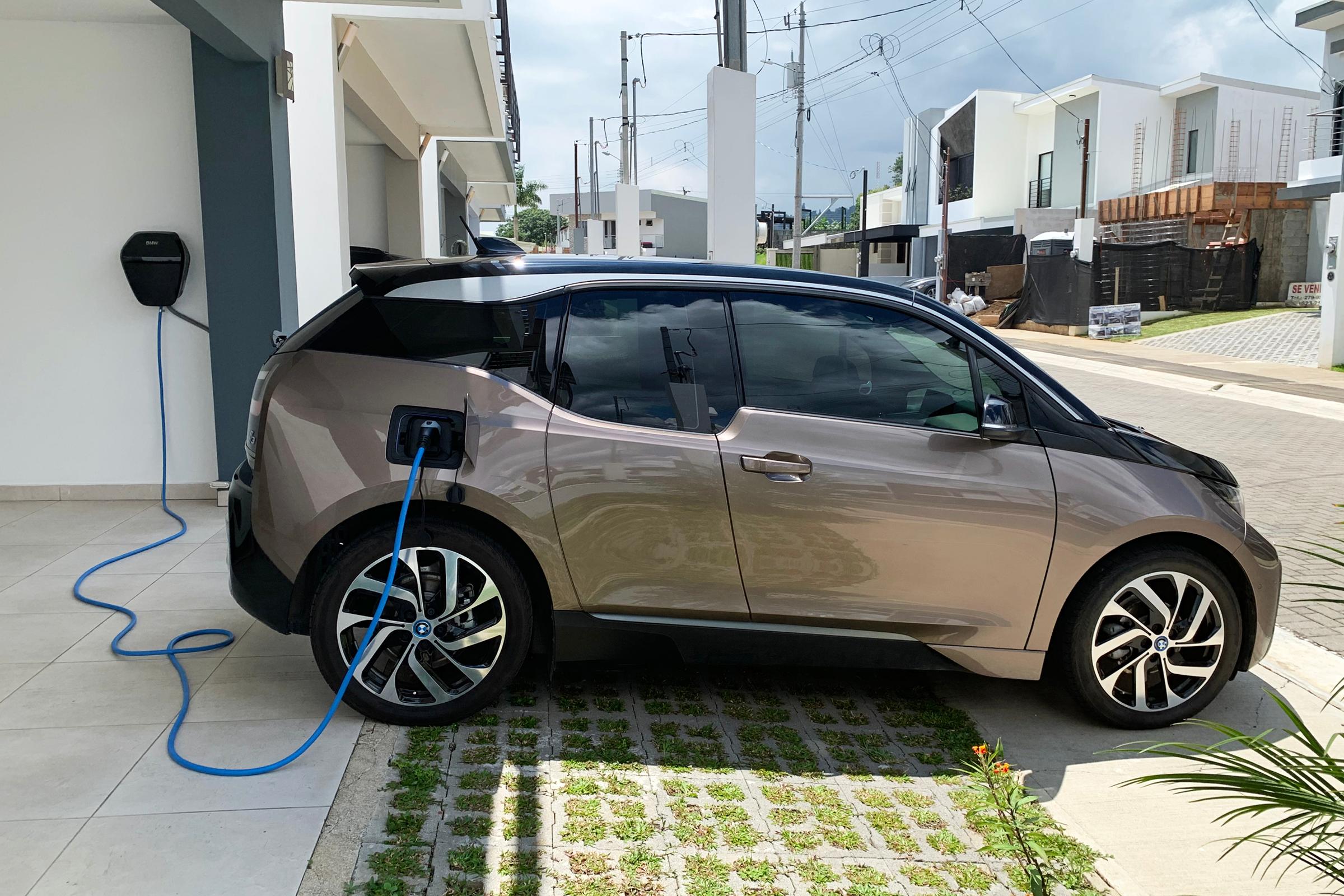

BMW i3 charging from a residential 220–240V wallbox in Costa Rica. Context photo; Australian electrical installation requirements apply. Photo resized and cropped for display.
Home EV charger installation is often the first practical question after choosing an electric car, but you may not need a wall charger at all. A standard power point can cover modest daily driving. A dedicated charger makes more sense if you regularly drive long distances, have a large battery or only have a short window to charge.
This guide covers that choice, the electrician's checks, quotes, strata approval, charger bundles and current programs, all checked against official sources as of October 2026.
Start with your driving, not the charger
The Australian Government's EV charging guidance says a standard power point delivers a maximum of 2.4 kW, so a full charge from empty can take around a day, or longer with a large battery. It also notes the average Australian drives about 33 km a day, which typically uses no more than 10% of an EV battery.
A dedicated wall charger runs at 7 to 22 kW. The same guidance says it typically charges 3 to 10 times faster than a power point, adding 30 to 80 km of range for each hour of charging.
The ACT Government's EV charger buyers guide describes a middle option: a 15 amp socket upgrade that outputs 3.6 kW. It also warns that not every manufacturer supplies a 10 or 15 amp home charging cable as standard, so confirm in writing what comes with the car.
If you use a power point, plug the cable straight in; the government guidance recommends against extension cords and power boards. Occasional public fast charging can cover road trips, so size your home setup for an ordinary week.
Single-phase, three-phase and what your car can accept
Your power supply sets one limit. Victoria's State Electricity Commission (SEC) says single-phase power is common in Victorian homes and supports AC charging of up to 7.4 kW, depending on the property's supply. Three-phase power can support 11 kW or 22 kW.
The car sets the other limit. EVs convert AC to DC through an on-board charger, and the government's charging equipment guide notes that some EVs may accept only 11 kW on AC. SEC says most EVs sold in Victoria accept a maximum of 7 kW or 11 kW AC, and full 22 kW AC support is not common.
Before paying for a three-phase upgrade or a 22 kW unit, check the maximum AC charging rate for your exact variant in the owner's manual or the manufacturer's specifications. A faster charger still works with a slower car, but the car only draws what it can accept.
What a licensed electrician checks
A wall charger connects directly to your home's supply, must be installed by a licensed electrician and may need a switchboard and supply connection upgrade, the government guidance says. SEC adds that EV chargers need a dedicated circuit with safety switch protection.
Ask the electrician to inspect the switchboard and measure the cable route to your parking spot. SEC says a meter change is unlikely, and a phase or mains change usually only comes up if your car can accept faster charging and you want it, or you plan to charge two EVs at once.
Keep the paperwork. In Victoria, the electrician must give you a Certificate of Electrical Safety, and main switchboard and consumer mains work must also be inspected by an independent licensed inspector.
In NSW, electricians must lodge a Certificate of Compliance for Electrical Work with Building Commission NSW, and the certificate can help with warranty claims on the installed equipment. Other states and territories have their own requirements, so ask which certificate applies and request a copy.
How to compare home EV charger quotes
Installation prices vary with the charger and the complexity of the job. As of October 2026, the ACT Government's buyers guide puts a 7 kW dedicated charger at around $2,000 to $3,000 installed. Treat that as a reference point, not a price for your home.
Ask every installer to itemise the same things so the quotes line up.
Hardware: charger model, power rating, fixed or separate cable, and warranty period.
Cabling and switchboard: cable length and route, the new circuit, and any switchboard or supply upgrade priced separately with the reason.
Setup and workmanship: commissioning, app setup, the compliance certificate, and how long the installation work is guaranteed.
The government's guide for strata residents says most electricians can install EV chargers, while a specialist EV charging company may be better at planning a custom solution for a whole building.
In South Australia, the Technical Regulator's installation standard only allows installers to fit a home wall charger whose brand and model is registered with the regulator and which is set up to respond to demand response signals, such as pausing or limiting charging. Ask an SA installer to confirm the quoted unit is registered.
Consumer rights apply too. Products must be of acceptable quality, and services must be provided with due care and skill and within a reasonable time, the ACCC explains. A charger warranty is an extra promise on top of those rights, not a replacement.
Apartments, townhouses and strata approval
If you share parking or electrical infrastructure, you will usually need approval from the owners corporation (body corporate). Tenants must first get the landlord's approval, according to the strata residents guide, which includes a checklist and a quote template.
Start by asking the strata manager or committee secretary whether the building is EV ready. The guide describes three assessment outcomes: EV ready, EV capable (enough capacity, but wiring changes may be needed) or insufficient (electrical upgrades are needed). It recommends load management, especially where several chargers will be installed.
Changes to shared property often need a special resolution, and the owner agreement required varies by state and territory, typically from 50% to 75%. The ACT Government says it has amended its strata law so building managers or executive committees cannot, without good reason, prevent or restrict EV charger installation.
Ask how the electricity will be billed: through a personal meter on your own account, or from the common property supply with the owners corporation billing residents. If approval is a long way off, weigh up public charging reliability near home and work before you buy.
What home charging will add to your power bill
The cost is roughly the energy you add in kWh multiplied by your tariff. The Green Vehicle Guide's home charging calculator estimates time and cost from your charging rate, battery size and electricity price. Use the rates on your own bill, not a generic savings figure.
Your tariff type matters. On a time-of-use plan, off-peak rates usually apply overnight and on weekends, and you typically need a smart meter, energy.gov.au explains. On a demand tariff, your highest demand in the billing month sets the demand charge for the whole month, so ask how demand is measured.
SEC notes that some EV energy plans offer a lower overnight rate or a free, time-limited charging window in the middle of the day. With rooftop solar, the government suggests charging while the sun is shining, which a smart charger can schedule automatically.
For the wider picture, including servicing, see our look at EV running costs.
Charger bundles and charging credits in EV deals
If a dealer or manufacturer offer includes a wall charger, an installation allowance or public charging credit, get the details in writing before you sign.
What is included? The charger model and power rating, and whether installation is covered or only the hardware.
What counts as a standard installation? Look for cable-length limits and whether switchboard work or supply upgrades are excluded.
What conditions apply to credits? Note the network, expiry date, any cap and whether the credit stays with the car if you sell it.
Is there a price alternative? Ask whether the dealer will reduce the price instead if you do not need the charger.
Then value the offer against your own electrician's quote. A bundled charger is worth only what you would otherwise pay for the same result at your home.
When you compare dealer offers for an exact variant through Carseekers, such as the Kia EV5 or Hyundai Ioniq 5, check that any charger or credit is listed separately from the drive-away price so the offers stay comparable.
Grants and rebates: check before you count on one
As of October 2026, the Australian Government's rebates finder lists no national rebate for home EV chargers. The household charger support it lists comes mostly from states and councils, and some of it is finance rather than cash.
In NSW, Home Energy Saver offers zero-interest loans of up to $15,000 for approved upgrades, including a Level 2 EV charger. As of October 2026, loans are open to homeowners and landlords with a combined household income of up to $210,000. A discount of up to $4,000 for lower-income households is listed as coming soon.
The ACT's Sustainable Household Scheme offers eligible homeowners loans of $2,000 to $20,000 at 3% interest, and EV charging infrastructure is an eligible product.
Nationally, the Household Energy Upgrades Fund offers discounted finance through participating lenders, with EV chargers among the eligible upgrades. Some councils list charger rebates too, so search the finder for your area. Scheme and lender criteria apply.
Programs also close: NSW's EV ready buildings grant for apartment buildings closed stage 2 applications on 8 October 2025. Check the program's own page before a quote depends on it.
If you are also financing the car, Loanseekers can help you explore car loan options; approval and terms depend on lender assessment.
The finer details
Your questions answered.
How long does a 7 kW home charger take to fully charge an EV?
The ACT Government's EV charger buyers guide says a 7 kW charger can fully charge a standard EV in about 6 to 9 hours. A larger battery takes longer, and the car's maximum AC rate, battery temperature and state of charge also affect speed. For a rough estimate for your car, divide the energy needed in kWh by the charging rate in kW.
Should I charge my EV to 100% at home every night?
Not necessarily. Australian Government guidance says regularly charging to 100% may harm some battery types, and it broadly recommends keeping everyday charge between 20% and 80% while checking with your manufacturer. Victoria's SEC adds that lithium iron phosphate (LFP) and nickel manganese cobalt (NMC) batteries need different charging approaches, so follow the advice in your car's owner's manual or on the manufacturer's website.
Should I choose a tethered or untethered home EV charger?
A tethered charger has its cable fixed to the unit, while an untethered one needs a separate cable, and SEC says the options vary enough that it is best to ask your installer. Type 2 is the standard AC plug in Australia. Government guidance says you will usually need your own Type 2 cable at public AC chargers and recommends one at least 5 metres long, so check whether one comes with the car.
Can I install an EV charger in a rented home?
Only with your rental provider's permission. SEC suggests a formal written request covering the charger type, where it would go, confirmation that a licensed electrician will do the work, and who pays for the hardware, installation and electricity. In a strata building, the landlord can then deal with the owners corporation on your behalf.