BYD's next flagship SUV has just become a lot more interesting for Australian families. The Ti7, a seven-seat plug-in hybrid that has been a runaway hit in China under the Fangchengbao brand, has now been locked in for right-hand-drive export markets, with BYD UK confirming a third row of seats. That is the single biggest signal yet that the Ti7 is heading to Australia, where Carseekers has been tracking BYD's expanding lineup as it edges towards a top-three finish on the local sales charts.
A seven-seater with Denza looks and a BYD badge
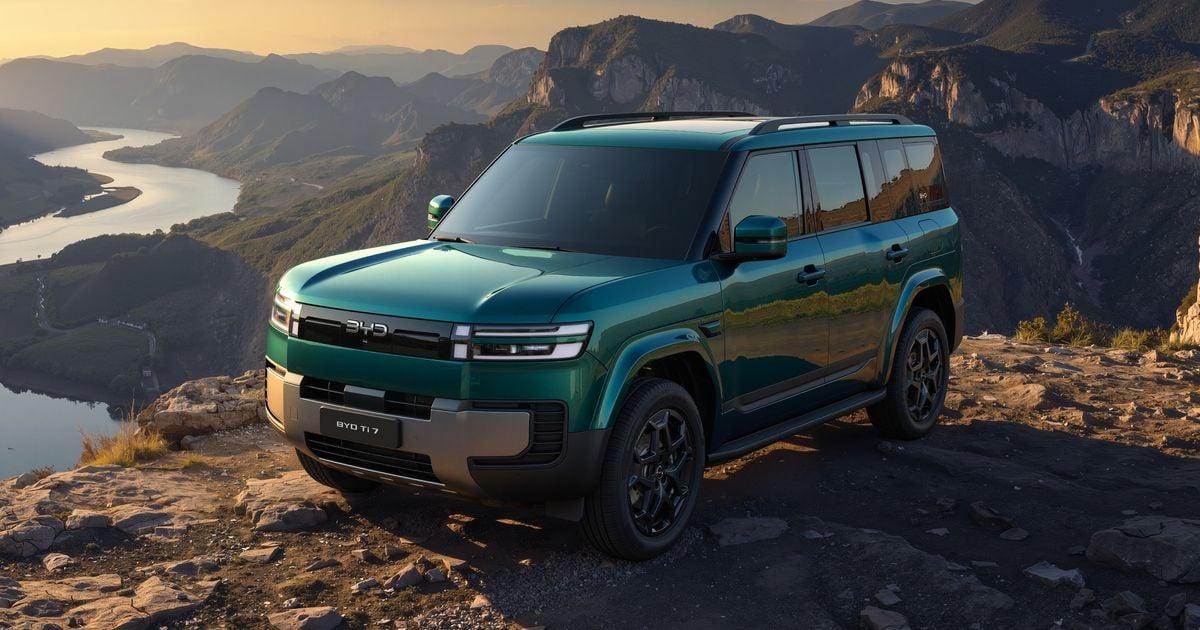
The Ti7 sits in unusual territory. It is sized like the Sealion 8 the brand already sells locally, but it carries the boxy, upright design language of the Denza B5 and B8 SUVs rather than the soap-bar styling of the rest of BYD's passenger range.
It also wears a BYD badge in the UK and Thailand, which strongly suggests Australia will follow suit, even though similar Fangchengbao-derived SUVs (the ladder-frame B5 and B8) have arrived here as Denzas.
BYD filed to trademark both the Ti7 and Ti9 names in Australia in late 2025, and this month it lodged paperwork to protect the B3 nameplate as well. That points to the smaller Ti3 arriving as a Denza, with the Ti7 launching under the more familiar BYD brand to tap the buyer base it has already built up.
What the Ti7 is, mechanically
In UK specification, the Ti7 runs a 1.5-litre turbocharged four-cylinder petrol engine paired with a plug-in hybrid system. BYD UK quotes a 0 to 100km/h time of 4.8 seconds and a WLTP electric-only range of 127km. There is no mention of the all-electric powertrain that the Chinese-market Ti7 also offers.
For Australian buyers used to PHEVs with 40km to 80km of real-world EV range, a triple-figure WLTP number on the launch model is a meaningful shift. It is enough to handle most weekday commutes on battery alone, then the engine takes the load on longer drives. BYD also confirmed 15.6-inch touchscreen infotainment and vehicle-to-load (V2L) for plugging in fridges, kettles and camping gear, which is now table stakes in this segment.
The Chinese-spec Ti7 hints at what we will get
China-market Ti7 PHEVs run a 115kW/225Nm petrol engine and either a single 200kW/315Nm front motor for front-wheel drive, or dual motors making 160kW/260Nm front and 200kW/360Nm rear for all-wheel drive.
Battery options are 26.6kWh or 35.6kWh, with CLTC electric-only range from 135km up to 200km depending on variant. DC fast charging is rated at 54kW to 72kW.
There is also a fully electric Ti7 in China with up to 755km of CLTC range from a 105.7kWh battery, plus AWD versions with 0 to 100km/h in 4.5 seconds. BYD has not signalled whether the EV will join the PHEV in Australia, but local boss Stephen Collins has previously said BYD will not add models for the sake of it.
Suspension, safety and screens
All Ti7s use four-wheel independent suspension, with double wishbones at the front and a five-link rear setup. That is more sophisticated than the cheaper twist-beam rears found in many small-to-mid SUVs at this price point.
The Ti7 also packs the latest DiPilot 100 active safety suite, with some variants stepping up to DiPilot 300 that adds LiDAR to the camera-and-radar array. Standard kit includes front and rear cross-traffic alert, blind-spot monitoring, safe-exit warning, adaptive cruise and a surround-view camera.
Inside, you get a 15.6-inch touchscreen, a 10.25-inch digital instrument cluster and a 26-inch head-up display. Heated and ventilated power front seats, leather upholstery, a heated steering wheel, a panoramic sunroof with electric sunshade and wireless phone charging are all standard across the range in China.
How big is it, really
The Fangchengbao Ti7 measures 4999mm long, 1995mm wide and 1865mm tall on a 2920mm wheelbase. BYD UK quotes 5146mm overall length, which suggests a longer export-spec bumper.
That puts it right on top of the Sealion 8 PHEV BYD already sells here (5040mm long, 1996mm wide, 1760mm tall, 2950mm wheelbase). The Ti7 is just over 100mm taller, which is what generates the extra third-row headroom.
That overlap is exactly what makes the Ti7's positioning interesting. It is not really a replacement for the Sealion 8. It is a stablemate with a more rugged design, aimed at families who want the seven seats and the higher driving position but do not want to step up to a Toyota Kluger hybrid or Kia Sorento hybrid.
A sales hit in China
The Ti7 has already proven itself at home. Chinese registrations data shows 57,197 examples delivered between January and April 2026, which means it has outsold every other Fangchengbao combined and slipped into China's top 20 best-sellers.
That matters for Australia because it underwrites the supply story. BYD has the volume to feed export markets, and it has already signalled it wants Australia in particular. Almost 5000 BYDs and Denzas left China bound for Australia just this month to keep up with local demand.
What this does to BYD's local model count
If the Ti7 lands as expected, plus the BYD Seal 7 PHEV sedan, the M9 PHEV people mover, the V9 electric van and the Atto 2 that has already arrived, BYD will be running a 15-vehicle local lineup. Add the Atto 3, the Atto 1, the Dolphin, the Seal, the Seal 6 PHEV, the BYD Shark 6 ute, the Sealion 5, 6, 7 and 8, plus the new entries, and BYD is suddenly only a couple of models short of Toyota's 18-strong local range.
This is the part of the BYD story that is easy to miss. Two years ago the brand was a one-model novelty. Now it is the second-biggest seller in Australia by month (7702 deliveries in April versus Toyota's 15,185), and it is hunting fourth-place Ford for the year-to-date crown.
Where it will likely sit on price
BYD has not confirmed Australian pricing yet, but the surrounding range gives a fairly clear corridor. The Sealion 8 PHEV opens around the high-$60,000s before on-roads and tops out in the $70,000s. The Ti7, with its seven seats and more premium positioning, should sit slightly above. Expect a starting point in the high-$60,000s for the entry PHEV, with the higher-spec AWD variant pushing into the high-$70,000s drive-away.
That would directly intercept buyers cross-shopping the Kluger Hybrid (mid-$60,000s drive-away), Sorento Hybrid (around $70,000 drive-away) and the Mitsubishi Outlander PHEV (low-$70,000s drive-away).
What dealers will not tell you yet
If you walk into a BYD dealer in the next few months and ask about the Ti7, expect blank looks. The local communications team has not detailed timing publicly, and dealer staff often only get full product training a few weeks before launch.
That is normal. What is less normal, and worth watching, is how BYD's dealer network has been pricing the existing lineup. The early Atto 3, Dolphin and Seal launches saw very few drive-away discounts off list, but as the local lineup has ballooned the brand has started leaning on EOFY drive-away deals to clear stock. If Ti7 supply outpaces demand at launch, expect the same. If supply is constrained, expect to be told there is a waitlist, which is a common dealer tactic to push add-on packs and accessories.
How the Ti7 fits into BYD's PHEV-versus-EV strategy
The interesting wrinkle is which powertrain BYD picks for Australia. The local team confirmed in February it was doing calibration work on an off-road-capable vehicle with PHEV or extended-range EV (EREV) power, which lines up neatly with the Ti7.
The PHEV makes commercial sense. Australian buyers in this segment still default to a tank of fuel for road trips, and battery-only EV uptake in the seven-seat class is tiny. A 127km WLTP EV range is also a sweet spot for the Federal Government's New Vehicle Efficiency Standard, helping BYD bank low-emissions credits to offset heavier vehicles.
What to do if you are shopping now
If you are sitting on a Sealion 8 PHEV order, do not panic. The Ti7 is unlikely to land before the first half of 2027, and the Sealion 8 will remain in the lineup. If you are seven-seat shopping and can wait, the Ti7 is worth holding out for, particularly if you want a more rugged look and the higher driving position that the boxier body delivers.
If you cannot wait, the Sealion 8 PHEV remains the closest comparison locally, with the Mitsubishi Outlander PHEV the obvious cross-shop for buyers who want to stay with an established brand and dealer network.
The Ti7 is not going to be the cheapest seven-seater in the market. But on paper, it stacks up as the most technologically aggressive PHEV family SUV BYD has brought to Australia so far. The next milestone to watch is Australian Government approval paperwork, which has already cleared the way for the Seal 7 sedan. Once Ti7 homologation documents surface here, a 2027 local launch becomes a near-certainty.
The bigger BYD picture
The Ti7 is one piece of a deliberate strategy. BYD is filling every segment it can without cannibalising itself. Where it has a gap, it adds. Where it overlaps, it pauses. The recent decision to skip the new Atto 5 in Australia (covered separately) is the same logic in reverse. The Ti7 fills the rugged seven-seat PHEV gap that the Sealion 8 leaves open, and it brings new buyers into BYD showrooms who were not previously cross-shopping the brand.
For Australian families who want a plug-in hybrid with a real EV range, three rows, and a price that undercuts most premium European seven-seaters, the Ti7 is going to be one of the most important launches of 2027. Watch this space.
Warranty, servicing and the long-tail cost
BYD Australia currently runs a six-year, 150,000km new-vehicle warranty across most of the range, with an eight-year, 160,000km cover on the high-voltage battery. That sits in front of the five-year deals Toyota, Hyundai and Kia offer, but behind MG's industry-leading ten-year package. Expect the Ti7 to inherit the same six-and-eight setup.
Service pricing has been a sore point for some early BYD owners, with regional dealer networks still thin in parts of Queensland, Western Australia and Tasmania. If you live more than 200km from a metro centre, factor in towing a stranded PHEV before you sign. BYD has been opening new dealers at pace, but coverage gaps are real.
Safety, ANCAP and ADAS
BYD's local ANCAP results have been strong, with five-star ratings for the Atto 3, Sealion 6 and Sealion 7. The Ti7's safety pack, with DiPilot 100 or DiPilot 300 plus LiDAR on higher grades, should comfortably clear five-star criteria once it is tested locally.
The key buyer point here is that LiDAR is still rare at this price. Toyota, Kia and Hyundai do not offer it on any current Australian model. If you value the smoothest possible adaptive cruise and lane-centring on highway runs, a higher-spec Ti7 may be the cheapest LiDAR-equipped SUV you can buy in Australia in 2027.
Resale and the China question
Resale value remains the unknown for any new Chinese brand in Australia. The Atto 3 has held up reasonably well over its first two and a half years, but the wave of new BYDs hitting the used market in 2026 has started to soften private resale prices. If you plan to keep the car for ten years, that matters less. If you turn cars over every three to four years on novated lease cycles, model glut is a risk worth pricing in.
The Ti7's saving grace on resale is that it occupies a niche the rest of the BYD range does not fill. A boxy seven-seat PHEV does not compete directly with the Sealion 6, 7 or 8 on the used market, which should help it hold value better than a generic mid-size electric SUV.
Considering finance for your next car? Loanseekers can help you explore car loan options.
The finer details
Your questions answered.
Is the BYD Ti7 coming to Australia?
BYD has not officially confirmed an Australian launch, but the Ti7 has been locked in for right-hand-drive UK, Thailand and Kuwait markets, and BYD Australia has been doing local calibration work on a plug-in hybrid off-road SUV that matches the Ti7's brief. A 2027 Australian launch is highly likely.
How much will the BYD Ti7 cost in Australia?
BYD has not confirmed pricing, but based on where the Sealion 8 PHEV sits and the Ti7's seven-seat layout, expect a starting point in the high-$60,000s plus on-roads for the front-drive PHEV and high-$70,000s drive-away for the AWD variant. That would put it on top of the Toyota Kluger Hybrid, Kia Sorento Hybrid and Mitsubishi Outlander PHEV.
How does the BYD Ti7 compare to the Sealion 8?
The Ti7 is almost identical in length and width to the Sealion 8 but stands 100mm taller, which makes room for a genuine third row of seats. It also wears the boxier, more rugged Denza-style design language, while the Sealion 8 is a more conventional curved family SUV. They will sell side by side as different propositions, not direct replacements.
What is the electric range of the BYD Ti7 PHEV?
BYD UK has confirmed 127km of electric-only range on the WLTP cycle for the launch PHEV. That is enough for most Australian weekday commuting on battery alone, with the 1.5-litre turbo engine kicking in for longer drives. Chinese-market Ti7s with the larger 35.6kWh battery quote up to 200km on the more generous CLTC cycle.
Will BYD sell an electric Ti7 in Australia?
An all-electric Ti7 exists in China with up to 755km of CLTC range, but BYD UK has only confirmed the PHEV for export. BYD Australia has said it will not add models for the sake of it, so the PHEV is more likely to come first. An EV version is possible later if demand justifies it, but not at launch.
When will the BYD Ti7 arrive in Australian showrooms?
There is no confirmed local date, but based on BYD's typical 12 to 18-month lead time between trademark filings and showroom arrivals, and the timing of approval documents for sister model Seal 7, expect the Ti7 to land in the first half of 2027. Holding out makes sense if you want a seven-seat plug-in hybrid and can wait.