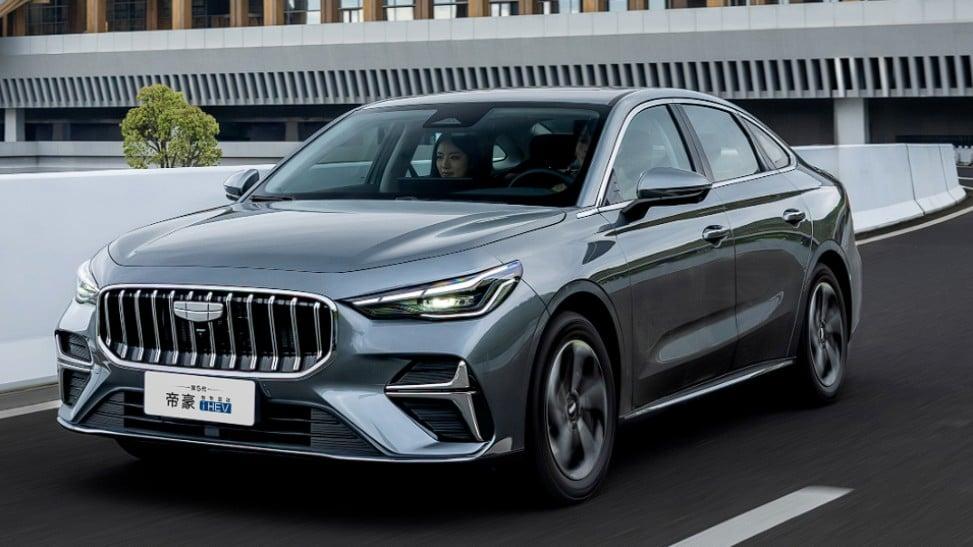
Geely is making serious efficiency claims for its new Emgrand i-HEV sedan. The headline number is 48.41 per cent thermal efficiency, which Geely says is a world record for a production hybrid drivetrain. The car is also claimed to deliver 2.22L/100km on the highway cycle, beating the Toyota Prius by 12 per cent under similar conditions. Mixed-cycle fuel consumption is rated at 3.83L/100km.
For Australian buyers, two questions matter. First, are these numbers real or marketing? Second, when will the Emgrand i-HEV land in Australia? The answers tell you whether Geely's efficiency record claim is a meaningful step forward or yet another headline that doesn't translate to local showrooms.
What thermal efficiency actually means
Thermal efficiency measures how much of the fuel's energy actually moves the car versus how much is wasted as heat. Diesel engines have historically been the high-efficiency benchmark at around 40 to 45 per cent. Modern petrol engines sit closer to 35 per cent. Hybrid drivetrains push higher because the electric motor handles the inefficient low-load operating points where the petrol engine is at its worst.
Geely's 48.41 per cent claim surpasses Dongfeng's 48.09 per cent for its 1.5-litre turbo announced in December 2025, and beats Geely's own 46.5 per cent claim for Chinese-market versions of the Starray EM-i, known as the Starship 7. Each of these claims represents a small but real engineering step. The Emgrand i-HEV is now the global benchmark for hybrid thermal efficiency, at least until someone else nudges past it.
This is also a Chinese pissing contest. Chinese carmakers are using thermal efficiency the same way German makers used Nurburgring lap times in the 2000s, as a marketing battleground. The substance is real but the messaging is more aggressive than the engineering gains alone would warrant.
The 11-in-1 hybrid drive
The Emgrand i-HEV uses a development of the Starship 7's 11-in-1 hybrid drive system. The dual-motor powertrain delivers up to 230kW on electric power alone. By comparison, the Toyota Camry hybrid peaks at 100kW from its electric motor. The Honda Accord hybrid manages 135kW from its electric drive side.
That is a substantial gap. Geely's electric motor is doing the heavy lifting in normal driving, with the petrol engine acting more as a generator and high-load support than as a primary drive source. The system can operate in pure electric, hybrid parallel, or direct drive modes depending on driving conditions.
Geely says the electric drive system can power the vehicle in up to 80 per cent of driving situations, which is roughly 27 per cent higher than comparable hybrid drivetrains. That number explains the fuel consumption advantage. The car is essentially running like an EV most of the time with petrol backing up the energy budget.
AI-managed drive control
The Emgrand uses an AI-powered drive control system that adapts to changes in temperature, humidity, altitude and road gradient in real time. The marketing here is a bit overcooked. Modern hybrid powertrains have included sophisticated drive management for two decades. Calling it AI doesn't change the underlying engineering, but the descriptor does fit current Chinese marketing conventions.
Where the system might genuinely add value is in regional adaptation. Australian highway driving differs from Chinese urban driving in altitude, ambient temperature swings and typical traffic patterns. A control system that adapts to local conditions in real time should translate well to Australian usage, assuming Geely tunes it for the market when local sales begin.
The Australian arrival question
The Emgrand i-HEV goes on sale in China later this month, joining the 1.5-litre turbo petrol version already on sale. Geely Australia displayed an earlier plug-in hybrid version of the Emgrand at the Melbourne Motor Show in April this year to gauge public reaction. Local sales have not been confirmed.
Geely Australia has been deliberately cautious about its local lineup. Brand-building, dealer footprint and after-sales support take time. Launching too many models too quickly risks the kind of brand damage Geely has worked hard to avoid. A sub-3.0L/100km mixed cycle hybrid sedan in the sub-$40,000 driveaway range would be highly competitive, but only if the dealer network and parts supply are ready.
Expect a measured rollout. The Geely Starray EM-i PHEV is the lead model. The Emgrand i-HEV is likely to follow in 2027 if local demand for the Starray meets expectations.
How the Emgrand stacks up against Camry and Accord
The Toyota Camry hybrid is rated at 4.0L/100km on Australian mixed-cycle testing. The Honda Accord hybrid manages 4.3L/100km. Both are well-respected hybrid benchmarks with mature dealer support. The Emgrand at 3.83L/100km mixed cycle is ahead of both, on paper.
What the Emgrand doesn't have is Toyota's hybrid reliability data or Honda's brand goodwill. For Australian buyers, the question is whether a 0.2 to 0.5L/100km efficiency gain is worth shifting to a newer brand without the same depth of long-term reliability evidence.
For mileage-heavy fleet operators, the answer might be yes. Over 100,000km of operation, the efficiency difference adds up. For private buyers, the calculus depends on personal risk tolerance for newer Chinese brands.
Carseekers tracks every hybrid sedan launch and dealer offer in Australia. Geely's local lineup is still small but is one of the most interesting brand stories to watch through 2027.
Considering finance for your next car? Loanseekers can help you explore car loan options.
The finer details
Your questions answered.
Is the Geely Emgrand i-HEV coming to Australia?
Geely Australia has not confirmed the Emgrand i-HEV for local sale. An earlier plug-in hybrid version was displayed at the Melbourne Motor Show in April 2026 to gauge public reaction. If the Starray EM-i launch performs well locally, the Emgrand could follow in 2027.
What is the Geely Emgrand i-HEV fuel consumption?
Geely claims 2.22L/100km on the WLTC highway cycle and 3.83L/100km on the mixed cycle. By comparison, the Toyota Camry hybrid is rated at 4.0L/100km and the Honda Accord hybrid at 4.3L/100km on Australian mixed-cycle testing.
What does 48.41% thermal efficiency mean?
Thermal efficiency measures how much of the fuel's energy moves the car versus what is wasted as heat. The Geely Emgrand's 48.41 per cent figure is a claimed world record for production hybrid drivetrains, narrowly beating Dongfeng's previous 48.09 per cent claim from December 2025.
How does the Geely Emgrand compare to the Toyota Camry hybrid?
On paper, the Emgrand is more efficient at 3.83L/100km versus the Camry's 4.0L/100km, and offers significantly more electric drive power at 230kW versus 100kW. The Camry has stronger long-term reliability data and an established dealer network in Australia.
Will the Geely Emgrand be available in Australia in 2027?
Geely Australia has not confirmed a 2027 launch. The brand is rolling out its local lineup deliberately, with the Starray EM-i PHEV as the lead hybrid product. The Emgrand i-HEV is a logical follow-up, but no firm dates have been announced.
What is the Geely Emgrand's electric driving range?
The Emgrand i-HEV is a full hybrid, not a plug-in hybrid, so it does not offer a pure electric driving range in the traditional PHEV sense. Geely claims the electric drive can power the vehicle in up to 80 per cent of driving situations, with the petrol engine acting as a generator when needed.