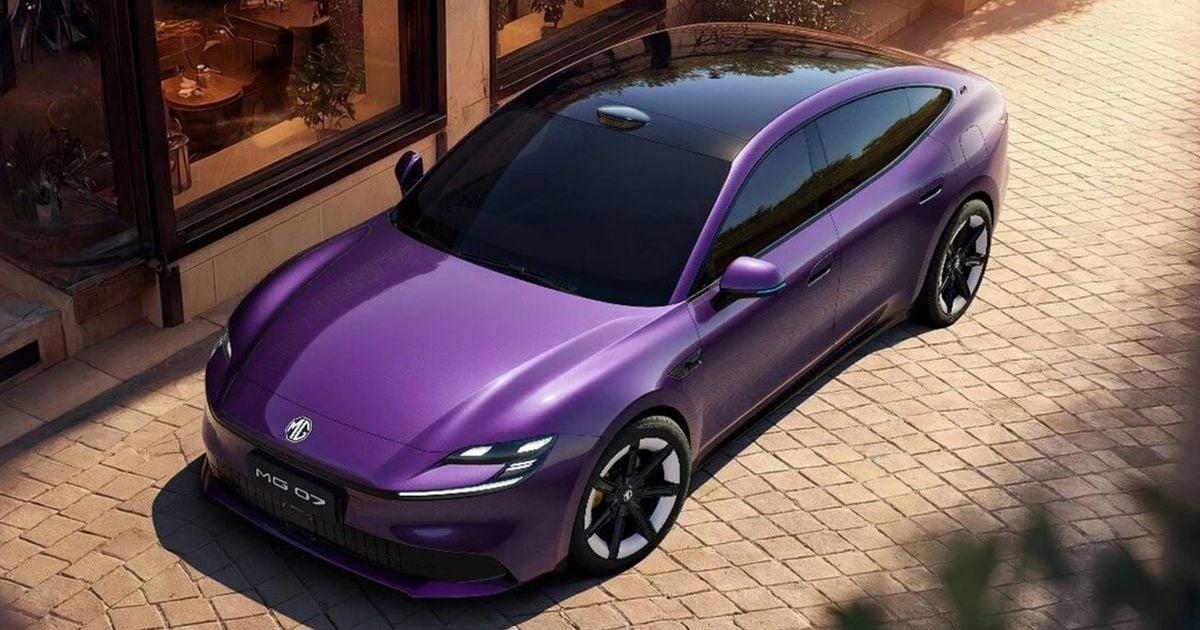

MG has previewed the 07, a fastback sedan that will go on sale in China before the end of 2026 as a higher-end rival to the Tesla Model 3 and BYD Seal. It is the kind of car that signals where MG is going as a brand, and Australian buyers should pay close attention because where MG goes in China usually ends up shaping what it pushes here too.
The 07 is a completely different car to the petrol-powered, 4.8-metre MG 7 already on sale in Australia. It sits on a new 800-volt architecture, will be offered with both pure electric and plug-in hybrid powertrains, and will be MG's first model to use LiDAR, the laser-based sensor tech that parent company SAIC's premium brand IM Motors has already deployed on the IM LS7 SUV.
What 800-volt architecture actually means for buyers
800-volt platforms are the new battleground in Chinese EV engineering. Most current EVs in Australia, including the Tesla Model Y and the older MG 4, run 400-volt systems. Doubling the voltage cuts charging times sharply, reduces wiring weight, and improves efficiency under hard acceleration.
For MG, moving to 800 volts is a leap upmarket. It is the platform technology that lets the brand argue it deserves to be cross-shopped with cars like the Hyundai Ioniq 6 and Tesla Model 3, not just the cheap end of the EV market. If the 07 makes it to Australia, expect MG dealers to lean hard on the charging speed claim and use it to justify a steeper sticker than the MG 4 or MG S5.
LiDAR is the headline feature, but it is complicated
The MG 07's roof-mounted LiDAR unit is the visual giveaway. It sits in a housing above the windscreen, and it is part of what SAIC calls the Momenta R7 Enhanced World Model system, an AI-driven driver-assist stack that learns from past driving situations.
In theory, LiDAR is the next step up from the camera-and-radar setups in current MG models, which include features like autonomous emergency braking and lane-keep assist. In practice, the technology has had a rough year. Volvo recently pulled LiDAR from the Australia-bound ES90 and EX90, after cancelling a contract with its LiDAR supplier. Volvo's marketing originally described it as a game-changer for safety, and then quietly walked it back.
For Australian buyers, the takeaway is that LiDAR sounds impressive on a spec sheet but the value depends entirely on the software behind it. MG and SAIC's track record on driver-assist refinement is not in the same league as Volvo or Mercedes-Benz, so this is a feature to test in person before paying for it.
Will the MG 07 actually come to Australia?
MG has not committed to bringing the 07 here, and there is a real reason to think it might not. MG Australia already sells the IM5, a similarly large electric passenger car borrowed from sister brand IM Motors. Adding the MG 07 on top would mean two large electric sedans in the same MG showroom from the same corporate parent.
That said, the pricing tells a story. The MG 07 will start at under 200,000 RMB in China, roughly A$40,700 at current exchange rates. The cheapest Tesla Model 3 in China is 235,500 RMB, around A$47,900. If MG positions the 07 as the cheaper, better-equipped alternative to a Model 3, the case for an Australian launch gets stronger.
A realistic Australian price would likely sit around $50,000 to $55,000 drive-away to leave room for shipping, compliance and dealer margin. That puts it directly against the Tesla Model 3 RWD and the BYD Seal, both fast-moving cars in the local market.
What dealers will say versus what is actually known
Be careful with dealer claims on the MG 07 over the next 12 months. The car has been teased but not detailed. Powertrain specifics, dimensions and Australian-spec features are all still unknown. If a salesperson tells you a launch date or a price is locked in, ask for the source.
What is reasonably certain is the design direction. Spy shots earlier this year showed semi-concealed door handles, where the Australia-spec IM5 uses flush-fitting units now subject to a ban in China. The new car looks aggressive, with red brake calipers on the performance variant and an MG 4-style steering wheel. The interior has a floating centre touchscreen, which is the now-standard layout for Chinese EVs at this price.
Where MG sits in the Australian EV market right now
Through the end of April 2026, MG was the fourth-best-selling EV brand in Australia, behind BYD, Tesla and Kia. The MG 4 sat just outside the EV top 10, ahead of the MG S5 SUV. The Tesla Model Y was the most popular EV overall, ahead of the BYD Sealion 7 and Zeekr 7X.
The wider picture is record territory. EV sales hit 16.4 per cent year-to-date market share in April 2026, with that surge driven partly by record-high fuel prices and brands like Ford and JAC throwing $4000 fuel cards at diesel-ute buyers to keep them out of EVs.
MG's growth in that mix is built on price. The MG 4 and S5 are aggressively priced against bigger-name rivals. The MG 07 would represent a step up the food chain, into a part of the market where price alone is not the deciding factor.
The honest buyer angle
If MG brings the 07 to Australia, the question for buyers is not whether it has more tech than a Tesla Model 3. The 800V platform and LiDAR will likely give it a stronger spec sheet on paper. The question is whether MG can deliver the software polish, charging network access and resale value that a Model 3 currently offers.
For Carseekers readers shopping in this segment, the right move is to wait for confirmed Australian specs before getting attached to the MG 07. The IM5 already offers a large MG-branded EV here, and any 07 launch will need to clearly justify why a buyer would pick it over its in-house sibling.
For now, treat the MG 07 as a strong signal of where MG is heading, not a car you should hold out for. The brand's pattern is to bring its sharpest-priced China-market cars to Australia within 18 to 24 months when the business case stacks up. We will know within a year whether the 07 makes the cut.
How the MG 07 changes MG's brand positioning
For years, MG's pitch in Australia has been simple: more car for less money. The MG 4 and S5 sit at price points that undercut Hyundai, Kia and Toyota in their segments. The MG 07 is a deliberate step away from that formula. It is the first MG that asks buyers to pay closer to Tesla and BYD money for a non-luxury badge, and it leans on tech features rather than price to justify the spend.
That is a meaningful change. It means MG salespeople will start having very different conversations with customers. Where the current pitch is built around drive-away pricing and value, the MG 07 conversation will be built around platform technology, charging speed and driver assistance capability. Australian buyers who walk into MG dealers expecting a discount-led experience may be surprised at how the brand presents this car if it lands here.
What SAIC's premium brand IM Motors brings to the picture
IM Motors is the SAIC subsidiary that supplies the IM5 already sold here as an MG-badged car. It is also the source of the LiDAR-equipped LS7 SUV that previewed the tech now appearing in the MG 07. That cross-pollination of platform and tech between MG and IM Motors is becoming the standard SAIC strategy.
For buyers, this is a double-edged thing. On the upside, MG benefits from premium-brand engineering filtering down at MG pricing. On the downside, it raises the question of brand identity. If an MG 07 shares its 800V platform, LiDAR system and driver assistance suite with cars sold under the IM badge in China, what exactly is the difference between MG and IM as brands? That question matters for resale, parts availability and warranty support over a five to ten year ownership window.
The fuel price tailwind helping EV uptake
The MG 07 lands at an interesting moment for Australian EV demand. Record fuel prices through early 2026 have pushed EV market share to 16.4 per cent year-to-date, up sharply from previous years. Brands like Ford and JAC are responding by throwing $4000 fuel cards at diesel-ute buyers, which is essentially a tacit admission that fuel cost is the primary lever moving consumers toward EVs right now.
In that environment, a Tesla Model 3 alternative with stronger tech credentials and a sharper price point would find willing buyers. That is the strategic logic for bringing the MG 07 to Australia even if it overlaps with the IM5.
What to do if you are shopping a Model 3 right now
If you are mid-decision on a Tesla Model 3, the MG 07's potential arrival does not change much in the near term. Tesla's product is here, its software is mature, and the Supercharger network is the most reliable fast-charging option in Australia. None of that goes away because a Chinese rival might arrive in 12 to 18 months.
But if you have flexibility on timing, the MG 07's pricing pressure and tech feature set will likely push Tesla to respond. Tesla has cut Model 3 pricing multiple times in Australia already, and adding a cheaper Chinese rival to the mix would likely accelerate that pattern.
The MG 07 is most interesting as a market signal rather than a confirmed purchase option. It tells buyers what the next 18 months of the mid-size EV sedan segment will look like, and it gives Tesla and BYD buyers leverage they did not have 12 months ago.
Considering finance for your next car? Loanseekers can help you explore car loan options.
The finer details
Your questions answered.
Is the MG 07 coming to Australia?
Not confirmed. MG Australia already sells the IM5, a similarly large electric passenger sedan from sister brand IM Motors, so an MG 07 launch here would create overlap. Expect a clearer answer within 12 to 18 months as the China rollout progresses.
How does the MG 07 compare on price to the Tesla Model 3?
In China, the MG 07 will start under 200,000 RMB, roughly A$40,700, undercutting the entry Tesla Model 3 at 235,500 RMB. If it reaches Australia, expect a price around $50,000 to $55,000 drive-away to allow for shipping and compliance.
What is the MG 07's LiDAR system?
It is a roof-mounted laser sensor that feeds into SAIC's Momenta R7 Enhanced World Model, an AI-based driver-assist platform. LiDAR offers richer 3D mapping than cameras alone, but its real-world value depends on the software, an area where MG's track record is still being proven.
What is the MG 07's 800V architecture good for?
An 800-volt platform allows much faster DC charging, lighter wiring, and better efficiency under hard acceleration than the 400-volt systems used in most current MG and Tesla models. Real-world charging times should be significantly shorter when the right charger is available.
How is the MG 07 different from the MG 7 already on sale in Australia?
Completely different cars. The Australian-sold MG 7 is a 4.8-metre petrol sedan. The MG 07 is a new fastback EV and plug-in hybrid built on an 800V platform, positioned as a higher-grade model in the lineup with LiDAR tech and Tesla Model 3 pricing.
Should I wait for the MG 07 instead of buying an MG 4 or IM5 now?
Only if you specifically want the larger sedan body style with LiDAR tech and have time to wait through 2026 with no confirmed local launch. If you want an MG EV now, the MG 4 covers small hatch buyers and the IM5 covers large sedan buyers, both available today.