Australia's people mover buyers have spent years with one obvious default. Now they have a genuine plug-in hybrid alternative with a price attached.
BYD has confirmed local pricing for the M9, its first proper crack at the family van market. The eight-seat M9 Dynamic opens at $61,990 before on-road costs, while the seven-seat M9 Premium sits at $72,990 before on-roads.
What BYD is actually charging
The M9 arrives in the fourth quarter of 2026, with the Premium reaching showrooms first and the cheaper Dynamic following. Both variants are front-wheel drive.
Power comes from BYD's DM-i 5.0 plug-in hybrid system, a 1.5-litre turbocharged petrol engine working with an electric motor. The Dynamic carries a 20.39kWh Blade battery, and the Premium steps up to a 36.6kWh pack.
The Premium is the one BYD leans on for its headline numbers. It claims 218kW of combined system power, up to 145km of electric-only range on the WLTP cycle, and up to 850km of combined range.
That plug-in layout is the real story for family buyers. Around town the M9 Premium can run as a pure EV, then fall back on petrol for longer trips, which is a different proposition to a regular hybrid that always blends the two.
The pricing pitch does not land the way it was teased
When the M9 was first approved for sale, the expectation was that BYD would undercut the Kia Carnival outright. The official numbers tell a more nuanced story, and buyers should read it carefully.
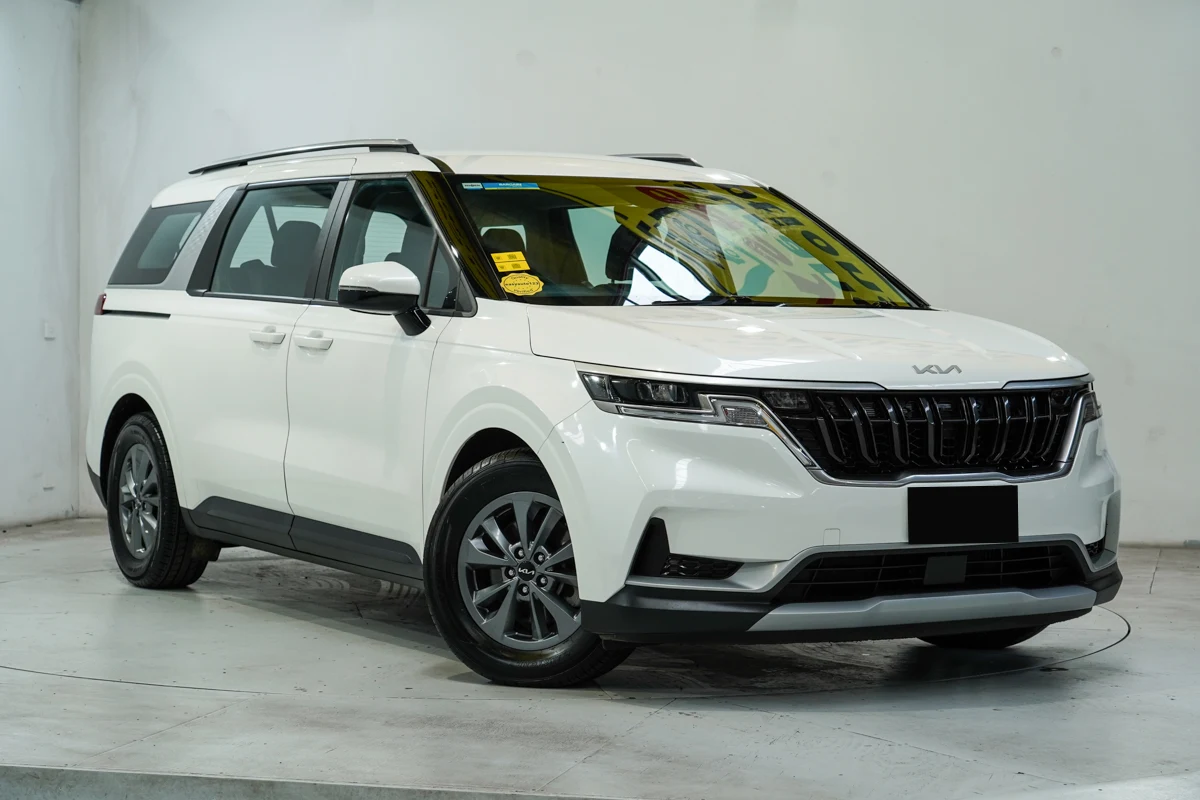
The Kia Carnival Hybrid now opens at $56,100 before on-road costs in S trim. That is almost $5,900 cheaper than the entry M9 Dynamic. So the cheapest hybrid van crown still belongs to Kia at the bottom of the range.
Move up the range and the maths flips. The top Carnival GT-Line Hybrid lists at $76,630 before on-roads, while the loaded M9 Premium comes in at $72,990. There the BYD undercuts the Kia by roughly $3,640 and adds plug-in capability the Carnival does not offer.
For context, the Carnival S diesel still exists at $52,800 before on-roads, so the cheapest way into a Carnival is cheaper again. The M9 is not a blanket price cut. It is a value play at the top, not the bottom.
Plug-in hybrid versus regular hybrid is the decision that matters
The Carnival Hybrid uses a conventional petrol-electric system that you never plug in. It is efficient, but it always burns some fuel.
The M9 is a plug-in. If you have a driveway and a wallbox, the Premium's 145km of electric range covers most weekly school runs, sport drop-offs and commutes without touching petrol.
That can mean real savings for high-kilometre families, but only if you actually charge it. A plug-in hybrid that never gets plugged in carries a heavier battery around for no benefit and can use more fuel than a normal hybrid. Be honest about your charging habits before you pay the premium.
The seat count is a genuine trade-off
Here is a detail dealers tend to gloss over. The Carnival seats eight in production form, and it is the only mainstream van in the class that does.
The seven-seat M9 asks larger families to give up a seat. For a household with three children spread across the second and third rows, or anyone who carpools, that eighth seat is not a nice-to-have, it is the whole reason to buy a van.
The M9 is longer than the Carnival at 5,145mm, so the room is there. BYD has simply chosen a seven-seat layout with second-row captain's chairs, which suits comfort-focused buyers more than maximum-capacity ones.
Dealer behaviour to watch before you sign
Pre-launch Chinese models tend to arrive in tight numbers, and demand runs ahead of supply in the first months. Expect firm pricing and little discounting on the M9 until stock settles.
Be wary of non-refundable deposit offers taken before BYD Australia publishes the full, final specification and price book. A deposit is not a locked price. The formal price list is the point at which you can hold a dealer to a figure.
BYD's showroom and service network has also grown more slowly than its model range. A plug-in hybrid van needs specific service training, so regional buyers should confirm local servicing before committing, not after.
On the Kia side, the Carnival is a known quantity with a deep used and demo market. That gives you more negotiating leverage on a Carnival than on a brand-new M9 that dealers know they can sell at full price.
Where the money question comes in
Whichever van wins your shortlist, the sticker price is only half the cost. Dealer finance is where a good on-paper deal quietly gets more expensive.
Because the M9 is a new import that Carseekers does not stock, the smartest move on a BYD is to sort the finance independently rather than accept the first rate a dealer offers. Loanseekers compares car loans across more than 70 lenders, so you can see whether the dealer's plug-in hybrid finance offer is genuinely competitive on a $60,000-plus van, or just convenient.
The same discipline applies to the Carnival. Getting the car price right and the finance right are two separate wins, and dealers count on buyers only focusing on one.
How Carseekers can help on the Carnival
If your shortlist lands on the Kia, this is where Carseekers does the work. The Kia Carnival is available through Carseekers, and the New Car Specialists chase the drive-away price across dealers so you are not the one making the calls and playing quotes off each other.
That matters most on a popular, high-demand model like the Carnival, where walk-in buyers routinely pay more than they needed to. Carseekers exists to close that gap on the purchase price, then Loanseekers does the same on the finance.
For the M9 specifically, keep an eye on how launch stock lands. As we covered when the M9 was first approved for Australia, BYD's ambitions in this segment are serious, and the M9 is only the start.
The bigger picture for van buyers
The M9 is not the knockout price blow some expected, but it does something more useful. It gives the class its first mainstream plug-in hybrid at a price that sits inside Carnival money.
Buyers who charge at home and mostly drive short trips could save meaningfully on running costs with the M9 Premium. Buyers who need eight seats, want the cheapest hybrid van, or cannot charge at home are still better served by the Carnival.
The rivalry is spreading too. The electric Xpeng X9 is another new people mover locked in for Australia, and the more the segment fills out, the more room buyers have to negotiate. Competition on your shortlist is leverage in your pocket.
Bottom line
The BYD M9 makes the people mover decision more interesting than it has been in years. It undercuts the top Carnival Hybrid, adds plug-in efficiency, and forces Kia to defend a segment it has owned for a long time.
Just do not assume it is automatically the cheaper choice. Match the van to how you actually drive and how many people you actually carry, get the purchase price and the finance sorted separately, and the M9's arrival works in your favour no matter which badge you end up in.
The finer details
Your questions answered.
When does the BYD M9 go on sale in Australia?
The BYD M9 arrives in the fourth quarter of 2026, meaning between October and December. The seven-seat M9 Premium reaches showrooms first, with the cheaper eight-seat M9 Dynamic following. As with any pre-launch model, wait for BYD Australia to publish the final price book before committing.
How much does the BYD M9 cost in Australia?
The eight-seat M9 Dynamic opens at $61,990 before on-road costs, and the seven-seat M9 Premium is $72,990 before on-roads. Both use BYD's DM-i 5.0 plug-in hybrid system. On-road costs will add several thousand dollars on top depending on your state.
Is the BYD M9 cheaper than the Kia Carnival?
Not across the board. The Kia Carnival Hybrid starts at $56,100 before on-roads, almost $5,900 under the entry M9. But the top M9 Premium at $72,990 undercuts the Carnival GT-Line Hybrid at $76,630. The M9 is a value play at the top of the range, not the bottom.
How far can the BYD M9 go on electric power?
The M9 Premium claims up to 145km of electric-only range on the WLTP cycle from its 36.6kWh battery, with up to 850km of combined range. The cheaper Dynamic uses a smaller 20.39kWh battery, so its electric range is lower. Both can drive as an EV around town and switch to petrol for longer trips.
Should I put a deposit on the BYD M9 before launch?
Be careful. A deposit is not a locked price, and pre-launch demand usually keeps discounting off the table. Avoid non-refundable deposit offers taken before BYD publishes the final specification and price list. The official price book is the point at which you can hold a dealer to a figure.
Do you have to plug in the BYD M9?
For it to make financial sense, yes. The M9 is a plug-in hybrid, so its savings come from charging at home and running on electricity for daily trips. A plug-in hybrid that never gets plugged in carries a heavy battery for no benefit and can use more fuel than a regular hybrid like the Carnival.