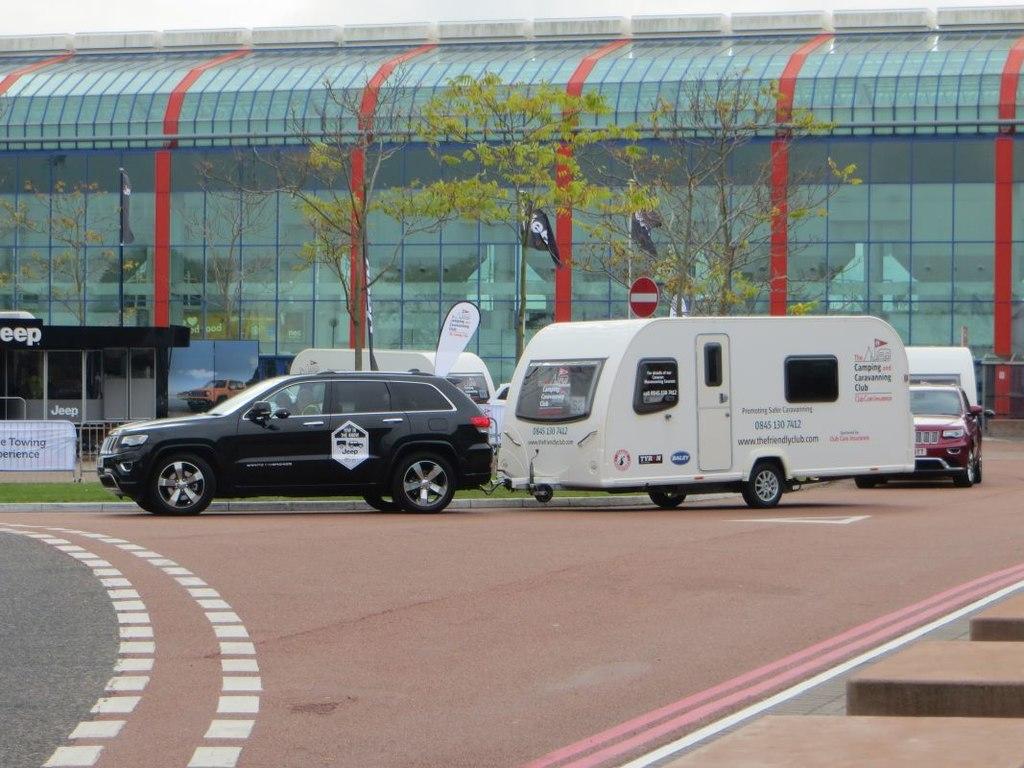
A vehicle and caravan photographed near an exhibition venue in England. Illustrative towing context, not evidence of a compliant Australian combination. Previews may crop the photograph.
Photo: Bill Nicholls · CC BY-SA 2.0
Towball weight uses some of the towing vehicle's load allowance. To assess a combination, you need the loaded vehicle and trailer masses plus their individual limits, not just the advertised maximum towing capacity.
Ford's vehicle-weight explanation says trailer nose weight reduces available payload when hitched. Transport WA's GVM and GCM guidance explains why maximum advertised towing capacity may be unavailable when the vehicle is heavily loaded.
Collect the limits before weighing
Record the exact vehicle's GVM, GCM, axle limits, towing capacity and maximum towball load. Collect the towbar, coupling, wheel and tyre ratings and the trailer's ATM, GTM and axle limits.
Use manufacturer and compliance information for the particular vehicle and trailer. Ask a competent towing specialist to resolve unclear terminology or any modification affecting those limits.
Our HiLux GVM-upgrade article concerns a model-specific payload change. A change to one rating does not establish that every other limit rises with it.
Follow a fictional combination through the arithmetic
The following figures are hypothetical teaching inputs, not specifications or approval for any car or caravan. Assume an unhitched vehicle weighs 2800 kg with its occupants, fuel, fitted accessories and trip luggage already aboard.
Assume the trailer's manufacturer-set ATM rating is 2500 kg and, for this fictional trip, its actual total loaded mass is exactly 2500 kg. Of that measured total, 200 kg is imposed on the towball when hitched. Its wheels therefore support 2300 kg in this simplified example.
The hitched vehicle mass is 3000 kg: 2800 plus the 200 kg towball load. Against an assumed GVM of 3200 kg, the illustrated vehicle headroom is 200 kg.
The combination mass is 5300 kg: the 3000 kg hitched vehicle plus the 2300 kg supported at the trailer wheels. Equivalently, it is the 2800 kg unhitched vehicle plus the trailer's 2500 kg actual total loaded mass.
Do not add 3000 kg to 2500 kg: that would count this example's towball load twice. Against an assumed GCM of 5500 kg, the illustrated combination headroom is 200 kg.
Passing those totals is not the final result
The example has not checked the actual front and rear axle loads, towing rating, trailer limits, towbar, coupling, tyres, brakes or load distribution. An axle can still be the limiting component even when the combined totals appear acceptable.
Have the loaded, ready-to-travel combination weighed appropriately and the relevant separate axle loads checked. Keep the measurements and compare every applicable rating. Follow the manufacturer and jurisdiction's towing requirements rather than treating this worksheet as a compliance certificate.
Price the vehicle around the real load
List everything you actually carry before choosing a tow vehicle. If the intended load cannot fit the applicable limits, reduce it or choose a suitable combination with professional advice.
For a ute shortlist, explore our used ute collection, then obtain the exact vehicle ratings and loaded measurements before deciding whether a candidate can do your towing job.
For information about financing the tow vehicle, see Loanseekers once its required specification and purchase budget are clear.